
Definition and function of bank reserves
What exactly does a bank hold when it says it has reserves?
Not the envelope marked “in case the washing machine breaks”...
When you hear that a bank has plenty of reserves, you might picture a room full of banknotes and a manager sleeping soundly. Not a completely absurd image, but it mixes up different things. In banking, reserves don’t mean any money put aside, or the bank’s version of your emergency washing-machine fund.
In lesson 2.2 we saw that a loan can create a deposit, but payments between banks need another ingredient. That ingredient is bank reserves: principally, money banks hold in their accounts at the central bank. Just as you have an account at your bank, a Spanish bank can hold an account at the Banco de España, part of the Eurosystem. Its balance there is reserves. Some definitions also include cash in the bank’s vaults and ATMs; the precise rules depend on the monetary system.
The first trap: “Reserves” can mean two very different things 🪤
First, separate two uses of reserves. In company accounts, reserves can mean retained profits and related equity categories. These belong within shareholders’ equity: part of the owners’ residual claim. The word does not mean a matching pile of banknotes has been placed in a separate account.
Bank reserves in this lesson are different: balances held by commercial banks at the central bank. They are assets for those banks and liabilities for the central bank. When a report says the banking system has abundant reserves, it normally means this settlement money, not that every bank has accumulated unusually large retained profits.
The money banks use to pay one another 🔄
You pay for coffee using a bank deposit. If the café uses another bank, the two institutions must settle between themselves. Reserves provide a common settlement asset, so the receiving bank need not accept an unsecured promise from the sending bank as the final payment. Your deposit and the interbank settlement are related but distinct entries.
Transfer €500 from bank A to bank B: your deposit at A falls and the recipient’s deposit at B rises. Settlement can transfer €500 in reserves between the banks. Payment arrangements differ: where reciprocal obligations are netted, €500 owed one way and €300 the other require a net €200. Don’t assume every payment system settles everything only at day-end; gross and net mechanisms differ. In the euro area, TARGET services provide central-bank payment infrastructure.
A transfer changes which bank holds reserves, not necessarily the system-wide total. Individual banks can obtain reserves by borrowing, selling assets or using eligible central-bank facilities. The banking system collectively cannot create central-bank reserve balances merely by moving them between its members. That distinction becomes important when reading aggregate liquidity charts.
Required and excess reserves: The minimum and what sits above it 🧱
Required reserves are minimum balances an institution must hold under the applicable framework. A reserve ratio applies to a specified liability base, not necessarily every item called a deposit. Definitions, exclusions and maintenance rules matter. A ratio tells you the legal requirement; it does not fully describe a bank’s liquidity position.
For a dated reference, the ECB’s November 2023 explanation described a 1% requirement on specified liabilities, mainly deposits and short-term debt securities. In the simplest illustration, €100 of liabilities subject to that ratio requires €1 of reserves before relevant adjustments. The Fed reduced US requirement ratios to zero in 2020. These are institutional examples, not timeless global rules.
Excess reserves are balances above the applicable minimum. Asset-purchase programs can leave the system with substantial reserves. That does not mean banks have set aside a corresponding fund for new household loans. Nor does the aggregate tell you whether the bank facing a payment today can readily access the balances it needs.
The Eurosystem’s minimum is generally assessed as an average over a maintenance period, rather than one identical balance at every close of business. The source describes periods of roughly six or seven weeks. A bank can therefore offset a lower balance on one day with higher balances on others, while still managing daily payment obligations.
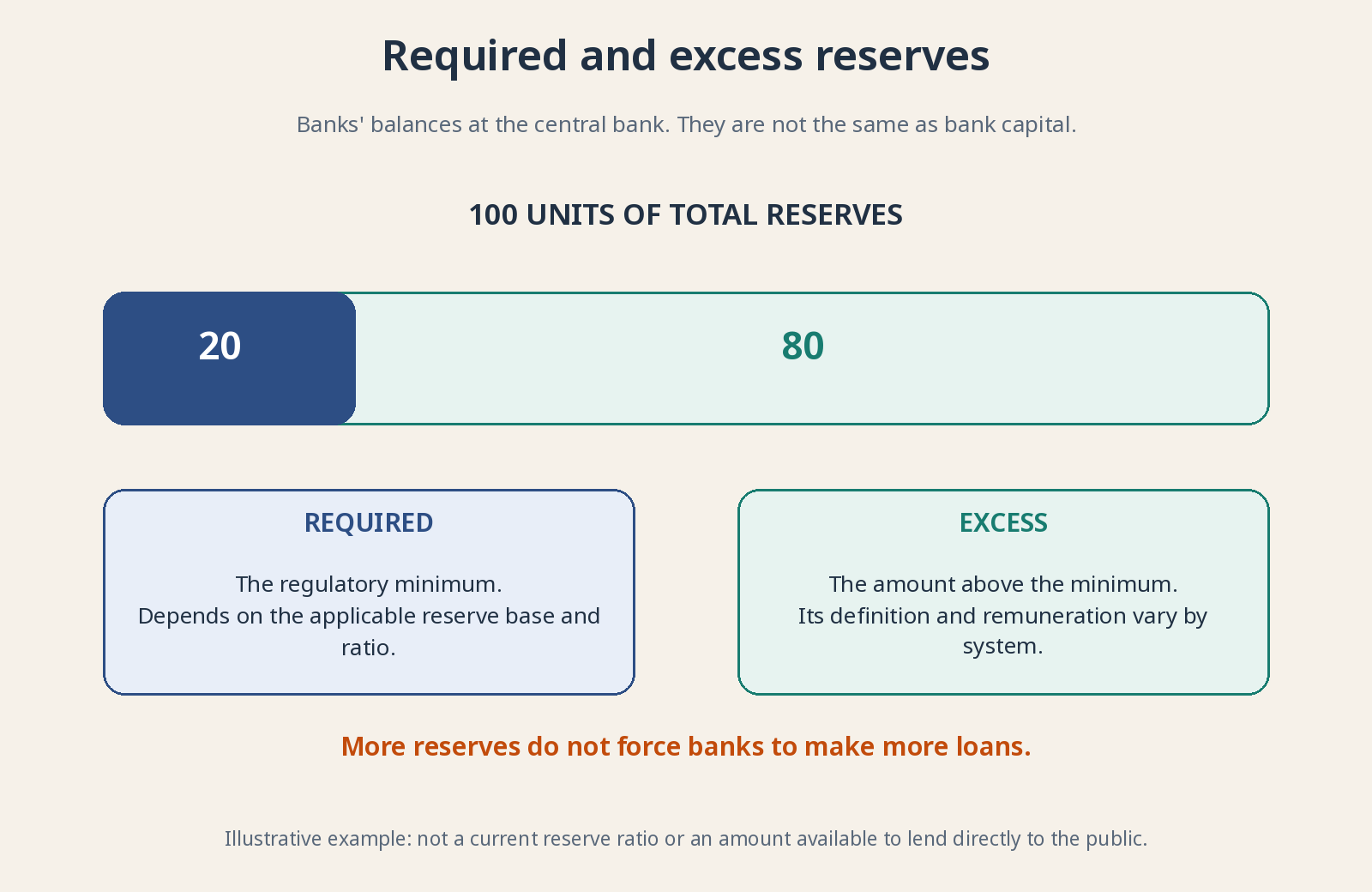
Invented example: 100 total, 20 required, 80 excess. Not a current reserve ratio or money to lend to households.
Liquidity, solvency, capital and provisions: Four separate drawers 🗂️
Reserves, liquidity, solvency and capital answer different questions. A bank can hold reserves yet suffer losses that exhaust its equity. It can also own valuable long-term assets but lack cash today. Personally, having €3,000 available while owing €50,000 you cannot repay illustrates why today’s cash balance alone does not establish financial health.
-
Liquidity asks whether payments can be met when due. Reserves help directly; other assets may help if they can be sold or pledged on workable terms. The crucial word is when. A valuable claim payable years from now may do little for an obligation due this afternoon.
-
Solvency asks whether assets and the ability to generate resources support the obligations. It is not merely the amount of cash available today. Asset valuations and realistic loss estimates matter: an apparently positive net worth based on implausible prices may offer little real protection.
-
Capital absorbs losses through owners’ claims before those losses reach more senior creditors under the applicable hierarchy. Equity includes shareholders’ contributions and retained earnings; regulatory capital has additional eligibility rules. If losses of 10 reduce equity, owners bear that reduction first. Capital is a balance-sheet buffer, not an idle reserve account.
-
Provisions recognize expected losses, such as a loan that is unlikely to be repaid in full. They affect reported earnings and asset values under the relevant accounting rules. They are not necessarily cash locked away in a separate pot. Calling them provisions describes recognition of risk, not a new source of settlement money.
More capital and more reserves are not interchangeable requirements. After 2008, Basel III strengthened capital standards and introduced liquidity measures, including resilience to a month of stressed outflows and more stable funding. Holding eligible liquid assets, maintaining sound funding and financing assets with loss-absorbing capital address related but different vulnerabilities.
So what are reserves actually for today? 🚰
So what do reserves actually do in a modern banking system? Keep the practical functions separate rather than imagining one balance performs every financial task:
-
Settle payments between banks: transfers, direct debits and card-related obligations ultimately require accepted settlement arrangements. Reserves are central to that plumbing.
-
Meet applicable reserve requirements. The required amount depends on the jurisdiction and rules; a zero regulatory ratio does not mean a bank can operate without payment liquidity.
-
Provide liquidity against unexpected outflows. This helps a bank meet payments without immediately selling longer-term assets, although reserves alone do not protect against every size of run or every underlying loss.
-
Transmit monetary policy. If an eligible bank can earn a hypothetical 2% at a central-bank deposit facility, that influences the rates it accepts elsewhere. It is unlikely to lend far below an accessible safe alternative without a reason. Market frictions and differences in access mean the relationship is not a perfect universal floor.
Not every reserve category earns the same rate. The ECB stopped remunerating required reserves in 2023, while deposit-facility balances have a separately specified policy rate. Treat that as a dated distinction and check the applicable framework when using live figures. A total reserve number alone does not reveal the income earned on it.
Would a higher reserve ratio shut off credit? It can raise reserve demand and the cost of supporting affected liabilities; a reduction can ease those costs. But with abundant reserves, changing the minimum may have little marginal effect. Lending still depends on capital, risk, funding and borrowers. It is not a tap controlled by one percentage.
Why does this matter to you as an investor? 📈
Because when liquidity becomes scarce or expensive, banks can tighten credit, sell assets or reduce risk. Companies face more expensive refinancing—renewing their loans—and credit-funded consumption suffers. Pressure can reach bonds, stocks and housing, though not equally or simultaneously.
That doesn’t turn a reserve figure into an infallible trading signal. Check its distribution, institutions’ access to financing and market conditions. The system can have ample liquidity while the particular bank needing it has too little. Rain in Galicia, Spain’s wet northwest, doesn’t automatically water your plant in dry Murcia.
When analyzing a bank, go beyond “it has lots of reserves.” Ask about its capital, loan quality and reliance on funding that can disappear suddenly.
In your own portfolio, distinguish liquidity from wealth too. A valuable asset won’t pay an urgent bill if selling quickly means accepting a disastrous price. An emergency buffer and no personal leverage buy the freedom not to sell cheaply when the financial plumbing starts to cough.