
Anatomy of a banking crisis
How can a bank collapse when it looked perfectly normal yesterday?
A queue of withdrawals moves much faster than a thirty-year mortgage...
Let’s be honest: a bank looks solid until too many people ask at once whether it really is. The logo doesn’t change. The loans don’t disappear. What can vanish within hours is the confidence holding the whole thing together.
After money, credit, reserves and interbank financing, it’s time to put the pieces together when something breaks. A banking crisis isn’t simply a bank’s share price falling sharply. It threatens institutions’ ability to make payments, absorb losses and keep lending. Banks are the economy’s plumbing. When the pipes clog, everyone notices—not just shareholders.
Liquidity vs. solvency: Short of cash isn’t the same as underwater 🧱
If you remember one distinction from this lesson, make it liquidity versus solvency. We introduced it in the reserves page. Now we’ll see why confusing the two produces bad explanations—and potentially expensive investment decisions.
Liquidity means being able to pay when payment is due. A bank can hold reasonably sound loans that repay over many years while lacking the cash to meet withdrawals today. The borrowers’ repayment calendars don’t accelerate just because depositors arrive together. Valuable assets and immediately available money are not the same thing.
Solvency concerns whether assets support liabilities. Losses reduce the equity cushion; sufficiently large losses leave assets worth less than obligations. A temporary loan can bridge a cash shortage, but it cannot by itself erase that underlying loss. New financing changes liquidity, not magically the economic value of the loan book.
The problems can reinforce each other. A cash-strapped bank may sell assets at steep discounts, turning funding pressure into capital losses. Doubts about solvency make lenders and depositors more reluctant to provide cash. The distinction remains useful even when the two mechanisms become tangled during a crisis.
Leverage: A thin cushion supporting a large balance sheet ⚖️
Leverage means using liabilities to finance assets rather than relying only on owners’ capital. Banks normally operate with substantial leverage: deposits and other borrowing fund much of their balance sheets. This amplifies how asset-value changes affect equity. The lever helps lift a bigger balance sheet, but it also transmits losses back to its owners.
Take invented assets of 100, liabilities of 92 and equity of 8. A loss of 5 leaves equity of 3. A loss of 8 wipes out the entire equity cushion; further losses make assets smaller than liabilities. Regulatory trouble can arise before that boundary. A modest percentage loss on assets can therefore devastate shareholders. This is simplified accounting, not a real regulatory capital ratio or a description of every bank.
Maturity transformation adds another vulnerability. Deposits may leave quickly while mortgages repay over decades. A sound thirty-year mortgage is not suddenly repayable on demand. Selling it or borrowing against it may help, but on terms affected by interest rates, collateral eligibility and market conditions. Credit quality alone doesn’t solve the timing mismatch. None of this is a reason to copy a bank’s leverage in your own share portfolio. You do not share its institutional funding access or safeguards.
A bank run: Everyone heads for the exit at once 🏃
A bank run is a rush to withdraw deposits because customers fear they may not recover their money. Even someone who thinks a bank might survive can feel pressure to leave before others. Individually understandable decisions can intensify collective trouble. Deposit insurance and credible payment arrangements aim partly to interrupt that logic.
Classic images show street queues, from the Great Depression to Northern Rock in 2007. A digital run doesn’t need a pavement queue: transfers can be initiated rapidly through phones and online accounts. The branch can look quiet while funding disappears. The technology changes the speed, not the basic dependence on confidence.
Anatomy of a blockage: From rumors to fire sales 🔥
Triggers vary: credit losses, poor interest-rate management, doubts about published accounts or an exposed funding weakness. Once confidence deteriorates, psychology and balance-sheet mechanics can feed each other. The following stages describe a possible feedback loop, not an inevitable sequence for every bank:
-
Confidence weakens. Depositors worry about repayment, while lenders demand higher rates, stronger collateral or other protections. Funding becomes less dependable before the doors ever close.
-
Withdrawals accelerate and refinancing becomes harder. Customers move deposits while markets decline to renew funding. What had seemed a manageable maturity mismatch becomes an immediate cash need.
-
Forced sales raise cash but may crystallize losses. Selling under pressure can mean accepting prices well below what the bank expected. Those losses can erode equity and make the original doubts look more justified.
-
Contagion spreads to institutions with similar assets, customers or funding structures—or simply a similar label. Interbank exposures and precautionary behavior can carry the shock beyond the first bank. Similarity is not proof of identical losses, but frightened markets don’t always wait for a careful comparison.
Not every withdrawal ends in failure. Asset quality, deposit concentration, available collateral, funding options and the authorities’ response all matter. This is an explanation of vulnerability, not a claim that all banks sharing one characteristic must collapse.
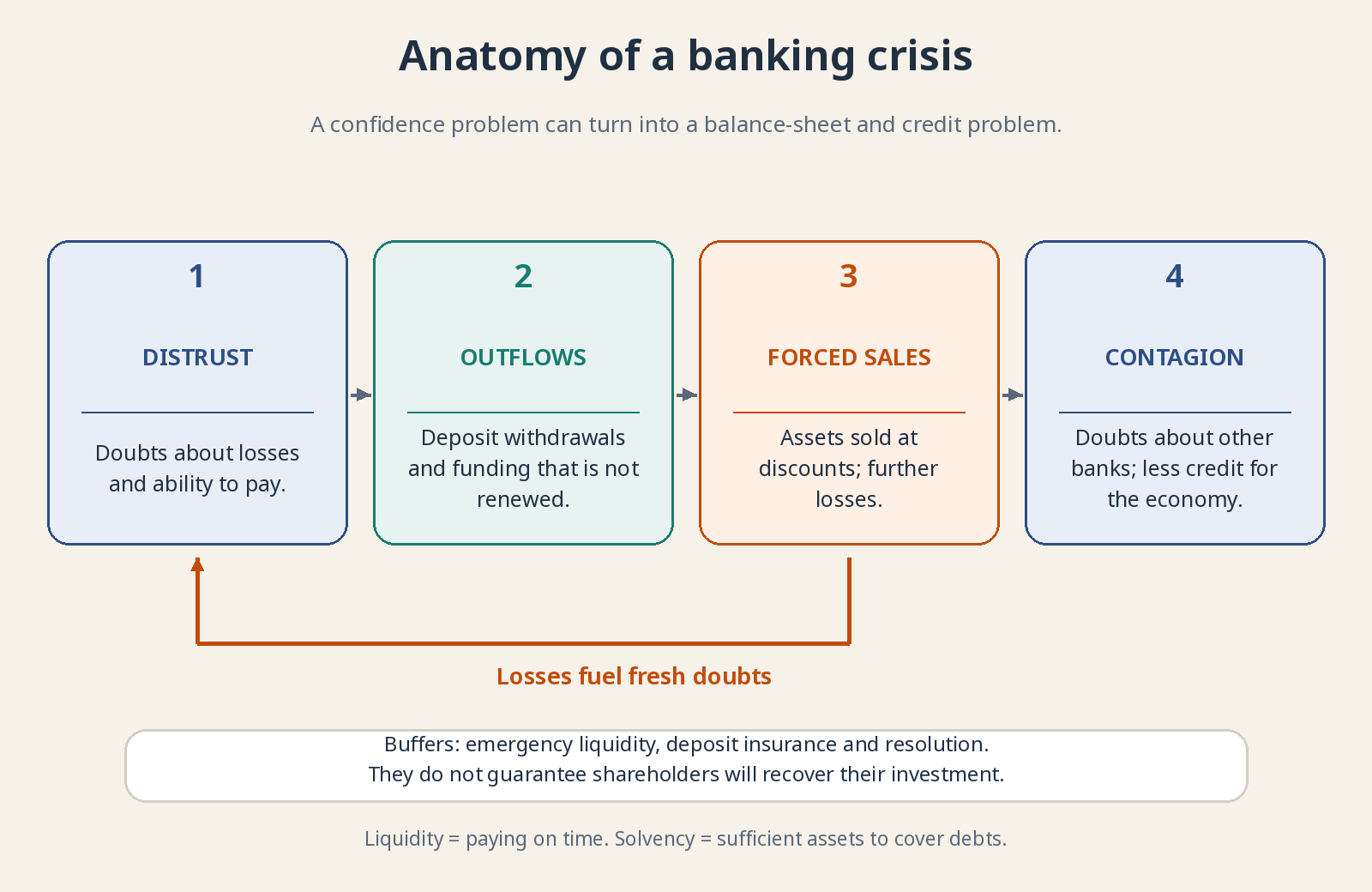
Deposit protection, central-bank liquidity and resolution tools aim to break the loop—not erase every loss.
Real cases: Similar, not identical 📚
In 2008, weak US mortgage credit, difficult-to-value securities and fragile short-term financing interacted. Interbank mistrust amplified the crisis. Spain’s savings banks, known as cajas de ahorros, also faced property exposure and governance weaknesses; restructuring involved public support and mergers. Similar funding symptoms can therefore sit on top of different national asset problems.
Banco Popular’s 2017 resolution illustrates why continuity of banking services does not protect every investor. It was sold to Santander for €1. Depositors retained access, while shareholders and some debt holders lost their investments. Resolution is an orderly framework for handling a failing institution, not a promise to preserve its previous ownership claims.
At Silicon Valley Bank in 2023, interest-rate losses on securities, inadequate risk management and concentrated, largely uninsured business deposits were central. Closely connected technology-sector clients withdrew rapidly. This was not simply another version of poor-quality mortgage lending. Low credit risk on a bond does not eliminate interest-rate risk or the danger of funding it with unstable deposits.
The shock absorbers: Who puts out the fire? 🛟
Modern systems use several safeguards to interrupt this feedback. Learn what each protects and what it leaves exposed. Protecting payment services, protecting insured deposits and protecting shareholders are three different objectives.
Deposit insurance covers eligible deposits under specified limits. Spain’s bank-funded Deposit Guarantee Fund (FGD) generally covers €100,000 per depositor per institution, not per account; joint-account entitlements are allocated among holders. Some temporary high balances receive special treatment. Separate Spanish securities-return coverage can apply up to €100,000 when eligible assets cannot be returned, not when investments fall in price. It does not insure the bank’s own shares. The EU’s general deposit limit is €100,000; US FDIC coverage generally uses a $250,000 limit subject to depositor, bank and ownership-category rules.
A lender of last resort can provide liquidity against eligible collateral under conditions. Insolvency needs other measures, potentially new capital, a sale or resolution with losses allocated to shareholders and creditors. European resolution rules seek to place losses on investors before public funds, subject to the legal framework. Liquidity support and absorbing a permanent loss are not interchangeable remedies.
Safeguards can create moral hazard: expecting someone else to bear losses may encourage excessive risk. That is why protecting deposits or essential payments should not be read as a reward for every bad decision. A safer banking system does not make every bank share a safe investment. Keep those two propositions separate.
Why does this matter to you as an investor? 📈
Because when banks restrict credit, the circular flow stiffens: purchases, investment and hiring get postponed. Even healthy businesses can face a worse environment. Look for quality, resilient financing and the capacity to survive. A collapsed share price doesn’t prove a bargain. A stock down 70% can still fall another 70%.
For savings, learn the applicable deposit-guarantee limits—Spain’s scheme is the FGD—and don’t confuse a protected deposit with an investment product. Protect your own balance sheet: emergency savings, diversification and no personal borrowing to seize a “historic opportunity.” Don’t try to nail the bottom. Further losses and capital increases may precede recovery. Issuing new shares to fill a hole can dilute existing owners’ slice of the pie. A long horizon and regular contributions support a suitable strategy; they don’t rescue every bad purchase.
The advantage isn’t being the bravest person on the news. It’s remaining able to follow a reasonable plan while others must sell. Patience works better when you don’t owe the money you’re trying to be patient with.