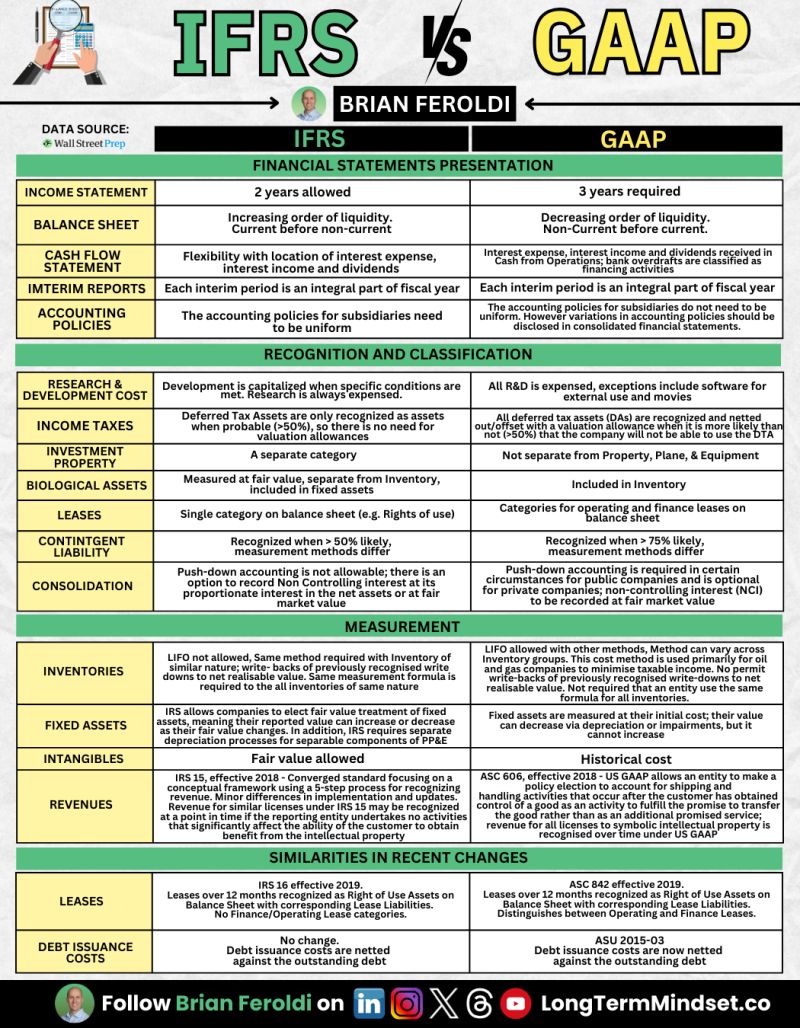
IFRS vs GAAP
When analyzing a company's financial statements to make investment decisions, understanding its underlying accounting standards is essential. Key valuation metrics like net income, EBITDA, and leverage ratios can vary significantly depending on which accounting framework is used.
Two major standards govern global markets:
-
IFRS (International Financial Reporting Standards): Issued by the IASB and used in the European Union and over 140 countries worldwide.
-
US GAAP (Generally Accepted Accounting Principles): Issued by the FASB and required by the SEC for US-listed companies.
1. Financial Statement Presentation 📄
The presentation structure of financial statements differs between the two frameworks:
-
Income Statement:
-
🌍 IFRS: 2 years of comparative data allowed.
-
🇺🇸 GAAP: 3 years of comparative data required.
-
-
Balance Sheet:
-
🌍 IFRS: Presented in increasing order of liquidity (current assets before non-current).
-
🇺🇸 GAAP: Presented in decreasing order of liquidity (non-current assets before current).
-
-
Cash Flow Statement:
-
🌍 IFRS: Offers flexibility to classify interest expense, interest income, and dividends received across operating, investing, or financing activities.
-
🇺🇸 GAAP: Strict requirement. Interest expense, interest income, and dividends received must be classified under Operating Cash Flows (CFO). Bank overdrafts are classified as financing activities.
-
-
Interim Reports:
-
🤝 Both: Each interim period is treated as an integral part of the full fiscal year under both standards.
-
-
Accounting Policies for Subsidiaries:
-
🌍 IFRS: Accounting policies for all subsidiaries within a group must be uniform.
-
🇺🇸 GAAP: Policies do not need to be strictly uniform across subsidiaries, though variations must be disclosed in consolidated notes.
-
2. Recognition and Classification 🏷️
Differences in how assets and liabilities are defined and recorded on the balance sheet:
-
Research & Development (R&D) Costs: 🧪
-
🌍 IFRS: Research is expensed immediately, but Development is capitalized as an asset once specific criteria are met.
-
🇺🇸 GAAP: All R&D is expensed immediately. Minor exceptions apply only to software for external use and movie productions.
-
-
Income Taxes (Deferred Tax Assets): 🏛️
-
🌍 IFRS: Deferred Tax Assets (DTAs) are only recognized when probable (>50%) to be utilized; valuation allowances are not used.
-
🇺🇸 GAAP: All DTAs are recognized first, then offset with a valuation allowance if it is more likely than not (>50%) that the company will not realize them.
-
-
Investment Property: 🏢
-
🌍 IFRS: Classified as a distinct, separate category on the balance sheet.
-
🇺🇸 GAAP: Not separated from Property, Plant, & Equipment (PP&E).
-
-
Biological Assets: 🌾🐮
-
🌍 IFRS: Measured at fair value, separated from inventory, and included in fixed assets.
-
🇺🇸 GAAP: Included directly within inventory.
-
-
Leases: 🔑
-
🌍 IFRS: Single category on the balance sheet (Right-of-Use assets).
-
🇺🇸 GAAP: Separates leases into distinct operating and finance lease categories on the balance sheet.
-
-
Contingent Liabilities: ⚠️
-
🌍 IFRS: Recognized when the likelihood of loss is >50%.
-
🇺🇸 GAAP: Requires a higher threshold; recognized when likelihood is >75%.
-
-
Consolidation: 🏢🏢
-
🌍 IFRS: Push-down accounting is not allowed. Non-Controlling Interest (NCI) can be measured at fair value or at proportionate interest in net assets.
-
🇺🇸 GAAP: Push-down accounting is required under specific circumstances (optional for private companies). NCI must be recorded at fair value.
-
3. Measurement and Valuation 📏
-
Inventories (LIFO vs. FIFO): 📦
-
🌍 IFRS: LIFO is prohibited. Requires consistent valuation formulas across inventories of similar nature and allows write-backs of prior inventory write-downs to net realizable value.
-
🇺🇸 GAAP: Allows LIFO (frequently used by oil and gas firms to reduce taxable income). Does not require identical formulas across all inventory groups and prohibits write-backs of write-downs.
-
-
Fixed Assets (PP&E): 🏭
-
🌍 IFRS: Allows revaluation to fair value (values can adjust upward or downward). Requires component depreciation for separable parts of PP&E.
-
🇺🇸 GAAP: Measured strictly at initial historical cost. Carrying value can decrease via depreciation or impairment, but cannot be revalued upward.
-
-
Intangible Assets: 🧠
-
🌍 IFRS: Revaluation to fair value is permitted.
-
🇺🇸 GAAP: Valued strictly at historical cost.
-
-
Revenue Recognition: 💰
-
Both converged around a joint 5-step model in 2018 (IFRS 15 / ASC 606), with minor operational differences:
-
🌍 IFRS 15: License revenue for intellectual property is recognized at a point in time if reporting entity activities do not significantly affect customer benefit.
-
🇺🇸 ASC 606: Offers a policy choice for post-control shipping/handling. Symbolic IP licenses are recognized over time.
-
4. Recent Convergence Updates 🔄
-
Lease Accounting (IFRS 16 / ASC 842 - Effective 2019):
-
Leases over 12 months must be recognized on the balance sheet as Right-of-Use Assets with corresponding Lease Liabilities.
-
Key distinction: IFRS uses a unified single-lease model, while GAAP retains separate accounting treatments for operating vs. finance leases.
-
-
Debt Issuance Costs (ASU 2015-03):
-
🌍 IFRS: Costs associated with issuing debt are directly netted against the outstanding debt balance on the balance sheet.
-
🇺🇸 GAAP: Aligned with IFRS; debt issuance costs are netted directly against the debt balance rather than presented as a deferred asset.
-
💡 Key Takeaways for Fundamental Analysis
-
R&D Expenses & Earnings Quality: US GAAP penalizes short-term net income by expensing all R&D immediately, whereas IFRS can boost reported earnings and assets by capitalizing qualifying development costs.
-
Asset Revaluation: IFRS provides a more current market-reflective balance sheet by permitting upward revaluations of real estate and intangibles, while US GAAP relies strictly on conservative historical cost accounting.
-
LIFO Inventory Distortion: US GAAP companies using LIFO during inflationary periods will show artificially lower inventory values and reduced gross margins compared to equivalent IFRS firms using FIFO.