
1.5 Menger’s principle of imputation
Is an oven worth what it cost—or what it helps you sell?
Working hard to make something nobody wants doesn’t oblige the world to buy it...
Imagine opening a bakery and spending €30,000 on a spectacular oven. Touchscreen, programmable steam, more buttons than an aircraft cockpit. A year later, the neighborhood doesn’t want your bread. Is the oven still worth €30,000 because that’s what the invoice says? Your accountant can keep the paperwork. The market doesn’t have to be impressed.
In the previous lesson we met Carl Menger, the Viennese economist whose 1871 Principles of Economics helped establish the Austrian school. Now for one of his most useful ideas: the principle of imputation. The word sounds like an accusation, but here it simply means attributing something—not blame, but value. The everyday question is this: where does the economic value of the tools we use to produce things come from?
Subjective value: Worth something to someone 🧠
Subjective value means that something matters to a person because of what it can do in that person’s circumstances. It doesn’t mean every preference is random or every object equally valuable. A bottle of water means something different beside a kitchen tap than it does when you are thirsty far from one.
Earlier theories often explained value through production costs, especially labor, as in the labor theories developed differently by Ricardo and Marx. Menger, alongside the marginalist work of William Stanley Jevons and Léon Walras, shifted attention toward people’s needs and choices. The question became why someone values the result, not merely what was sacrificed to produce it.
Marginal utility means the satisfaction or service supplied by the next unit, not accounting profit. It helps explain the water–diamond paradox: water is essential overall, but another unit can be worth little when water is abundant; an additional scarce diamond can command a high price. Total importance and the value of an extra unit are different questions.
Consumer goods and higher-order goods: Menger’s ladder 🪜
Menger groups goods by their relationship to consumption. Picture a staircase: the bottom step meets the need directly, while higher steps help produce the goods below. The classification is about the production relationship, not moral superiority or product quality:
-
First-order goods, or consumer goods, satisfy needs directly. The bread you eat is the simplest example. It is the result someone ultimately wants, rather than another tool for making it.
-
Second-order goods help produce those consumer goods: flour, an oven, a mixer and the baker’s labor services. You value them here because of their contribution to bread production, not because eating an oven sounds particularly appealing.
-
Third-order and higher-order goods help produce the earlier stages: wheat for flour, the mill, an oven manufacturer and the steel it uses. A resource can occupy different positions depending on the particular production process being studied.
The higher the order, the further the resource is from final consumption. In modern language, equipment such as ovens, mixers and delivery vans is productive capital. You don’t usually acquire it for its own sake; you acquire it to help provide something customers want later. Time and the sequence of production therefore matter.
Bread moves forward; the explanation of value runs backward 🍞
Production runs forward: wheat becomes flour, flour becomes dough and baking produces bread. The explanation of value runs backward from the consumer. If customers value the bread, resources expected to contribute to it can acquire value too. The physical direction of production is not the direction of the explanation.
Imputation attributes value to productive resources through their expected contribution to final goods. Demand for ovens is derived demand: bakeries want them because customers want bread, not because collecting industrial ovens is the neighborhood hobby. Without a valued use for the output, a costly machine does not automatically justify its price. When phones displaced much photographic film use, demand weakened not only for film but also for specialized film-processing equipment. The machinery’s customers depended on demand farther down the chain.
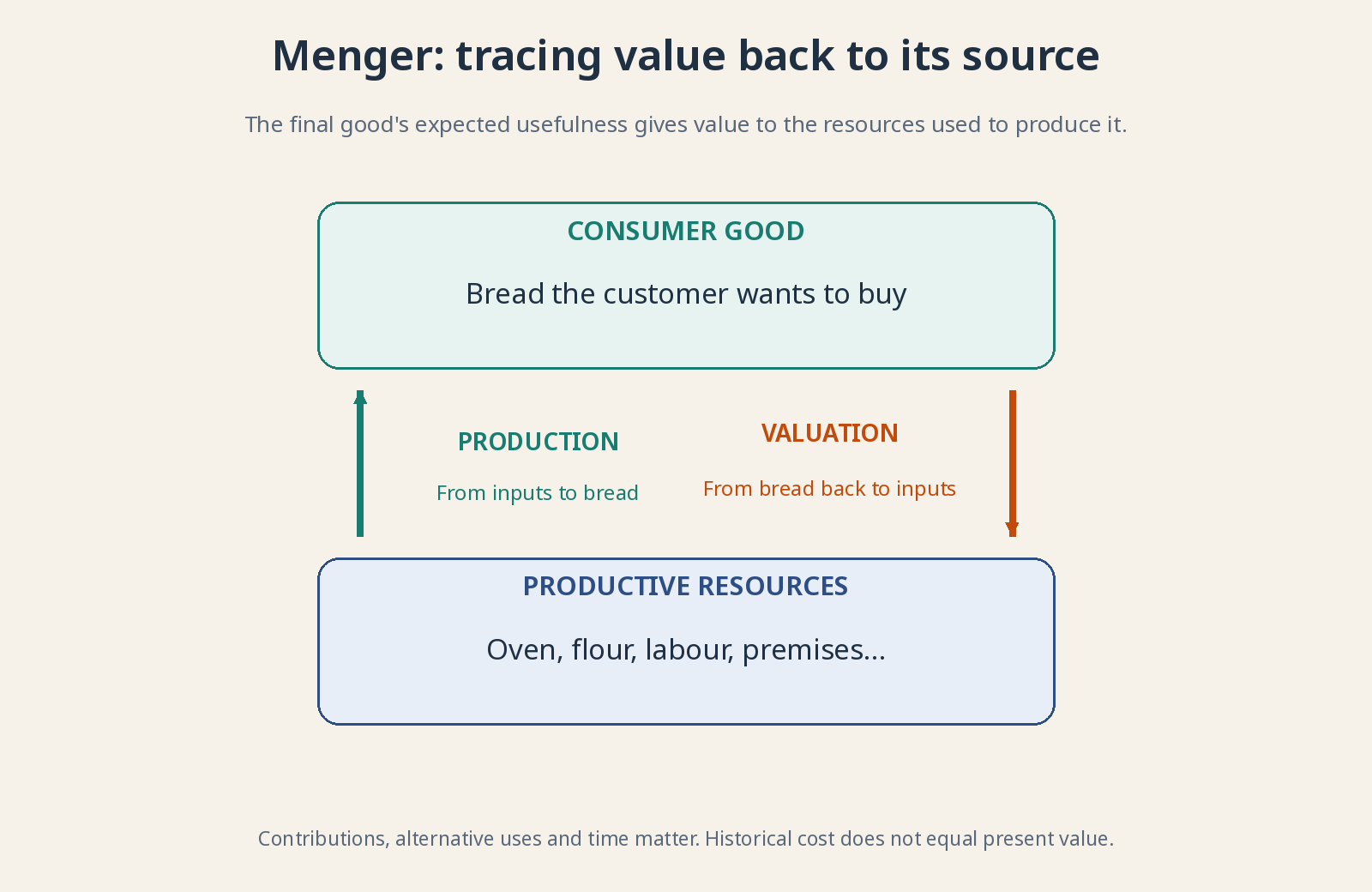
The oven contributes alongside flour, labor and other resources; it does not receive all the bread’s value. Production runs toward the consumer. Imputation explains resource value from the consumer backward.
Customers don’t buy your hours. They buy what helps them 🛒
Spend a hundred hours making an umbrella full of holes and those hours still cost you something. They don’t force customers to enjoy getting wet. A record of your effort cannot oblige someone else to value the result. Production costs and the buyer’s willingness to pay are not the same thing.
Don’t jump to the opposite extreme: costs matter greatly. They affect whether supplying a product is worthwhile, how much can be produced and what alternative uses of resources are forgone. If bread costs more to make than customers will pay, the business has a problem. Costs constrain supply; they don’t guarantee demand.
An oven isn’t worthless just because you sold no bread today 🔧
Nor does imputation mean every ingredient becomes worthless when one cake fails. Unused flour can make another product, an oven can be sold to another bakery, and a van can transport something else. Value depends on expected useful opportunities, not whether today’s particular batch succeeded.
Check alternative uses, useful life, necessary costs and the time before cash arrives. A machine built exclusively for an abandoned product may be hard to redeploy. Well-located premises may have other tenants or uses. Similar purchase prices can therefore hide very different remaining economic values.
Don’t assign the entire loaf’s value to every input separately. Inputs work together, like musicians in an orchestra. Their contributions depend on substitutes, combinations and expected output. There isn’t a universal sticker assigning a fixed share of every sale to each screw. Imputation is an explanation of relationships, not permission to count value repeatedly.
Money already spent doesn’t get to boss around your next dollar 💸
Opportunity cost, from lesson 1.1, is the best alternative you give up when choosing. It looks forward: what else could today’s resources achieve? That question helps compare options still available, whether you are buying equipment, continuing a project or deciding what to do with investment capital.
A sunk cost is a past outlay you cannot recover regardless of your next decision. The sunk-cost fallacy is continuing merely because you have already spent a lot. The past cost is real, but it cannot make a poor future option better. Remaining choices must be judged by their future consequences. Sitting through a terrible film solely because you paid for the ticket is the everyday version. The ticket money is gone either way; the remaining evening is still yours to allocate.
“We’ve already invested two million” doesn’t establish that a third million should follow. Finishing may create more value than abandoning; it may not. Compare the future receipts and payments of each option. Don’t hold a ceremony for money already spent and mistake it for an investment case.
The same applies to shares. Paying €80 does not require the business to remain worth €80. Holding only to recover your purchase price lets an irrelevant historical number make the decision. Consider current prospects, risk, valuation and alternatives instead. Your entry price records what you did; it doesn’t tell the company what to earn.
Why does this matter to you as an investor? 📈
Because fundamental analysis—studying the business behind a stock, including its customers, profits and debt rather than only its price chart—asks a question close to Menger’s: what is this worth because of what it can deliver? In particular, look at cash generation for owners, allowing for risk and reinvestment needs. Cash means money actually arriving and remaining available, not simply accounting profit. Imputation isn’t a modern valuation formula, but it shares the insight that productive assets derive value from what they enable, not money buried in them.
An expensive factory may be worth little if nobody wants its products. Book value—the net amount recorded for assets after liabilities—and market value—what investors will pay—can therefore differ sharply. A business with few physical assets, such as software, can be valuable if it solves a problem and converts sales into cash. Good products still don’t guarantee good investments: competition, debt and your purchase price matter too.
We look for clues such as ROE above 15%, net margin above 10% or gross margin above 40%, where appropriate for the sector. ROE relates profit to shareholders’ equity. Gross margin is what remains from revenue after direct product costs; net margin is what remains after all expenses, including overhead, interest and taxes. These aren’t commandments or automatic valuations. They help test whether resources become value. A debt-inflated ROE can mislead: a small equity base makes a given profit look enormous. Cash generation and earnings quality keep the picture honest. Owner alignment matters too: managers with meaningful personal ownership have skin in the game. A founder-led business may offer that alignment, but neither a founder nor a high ownership stake replaces good governance, financial quality or a sensible valuation.
Before falling for a factory, a patent or a polished presentation, ask: who needs what comes out of this business, and what cash remains after serving them? The consumer votes at the checkout.