
1.3 Economic systems: Capitalism, Socialism and Mixed Economies
Who decides what gets made, at what price and for whom?
This isn’t about picking a team. It’s about understanding the rules of the game...
In the previous lesson, the economy looked like a roundabout: households, businesses, government and the rest of the world passing around work, goods and money. But who sets the traffic rules? Who decides what gets produced, how it gets produced and who receives it?
That is what an economic system is about. Not a football team or a slogan to throw across the dinner table: a collection of rules, laws and customs governing ownership and decisions when, as we already know, we can’t have everything. Think of a sport’s rulebook. It won’t tell you who wins, but it will tell you what is allowed, who referees and what happens when somebody cheats.
Three questions—and two ways to answer them 🧭
Every society has to answer three questions, whether it is a small community or an economy as large as the European Union. Scarcity doesn’t disappear because a country is rich; it changes which choices people face:
-
What should be produced? More homes, hospitals, phones or bread? Choosing more of one thing uses resources that cannot simultaneously go somewhere else.
-
How should it be produced? With which technology, how many workers and which materials? The same output can be made in ways with very different costs and consequences.
-
For whom? Who receives the result: whoever can pay, whoever needs it, or whoever a public plan selects? This is a question about allocation, not just about making things.
Broadly, there are two coordinating mechanisms. Markets let buyers and sellers make decentralized decisions, with prices communicating scarcity and encouraging alternatives. Planning assigns decisions to an authority that sets priorities and directs resources. Real economies combine the two in different ways. The useful question is who decides what—not which label wins an argument.
First things first: What are the “means of production”? 🏭
Means of production are the resources used to produce other goods and services, apart from labor itself: factories, farmland, machinery, workshops and equipment. Your toothbrush is a personal possession; a machine used to make toothbrushes is productive equipment. The distinction concerns economic use, not whether something looks expensive.
Ownership matters because it gives people rights over how resources are used and who receives the resulting income. Karl Marx made ownership of productive resources central to his analysis in the nineteenth century. Asking who owns the factory is therefore also asking who makes decisions, takes risks and receives the residual return.
Capitalism: The market as a traffic light 🚦
In capitalism, productive assets are predominantly privately owned. Owners can be individuals or companies whose shareholders may include you. Firms compete for customers and seek profit: revenue left after costs. They can also make losses. That possibility matters because mistakes use real resources, and somebody must bear the consequences rather than merely announce a successful plan.
An incentive is a reason to act: a reward for getting something right or a cost for getting it wrong. A baker who gains customers by improving bread has a reason to improve it. Incentives also explain less admirable behavior when rules reward cutting corners. Private ownership alone doesn’t guarantee good outcomes; the surrounding rules matter.
Prices are signals as well as bills. A rising avocado price can encourage growers to supply more and shoppers to choose another food. Nobody needs to collect every household’s preference in one office. Prices help coordinate scattered decisions, although they do not tell you whether everybody can afford what they need. The bakery’s queue and the baker’s profit margin provide clues about demand and whether making more bread is worthwhile.
Let’s be honest: markets aren’t saints. A monopoly can weaken competition. A factory can impose pollution costs on neighbors. A buyer may lack information needed to judge a product. These are market failures: situations where decentralized transactions don’t fully account for relevant costs or benefits. They help explain regulation, public provision and competition policy—not a claim that every intervention works. Pure laissez-faire capitalism is more common as a debating position than as a complete description of an actual economy.
Socialism: When the planner takes the wheel 📋
In its classic economic sense, socialism concerns collective or state ownership of productive assets, not merely the existence of public healthcare. Planning plays a substantial role in deciding output and allocation in the centrally planned version discussed here. Socialist traditions differ, so the label alone doesn’t identify every institution or policy.
Under central planning, public authorities set production targets, allocate inputs and determine many prices. Think of instructions specifying steel output or shoe production instead of firms responding mainly to customer orders. The Soviet system is the familiar historical example. Concentrating decisions can coordinate priorities, but also concentrates the consequences of bad information and mistaken targets. Its five-year plans specified targets over that planning horizon.
The historical aim was often to limit concentrated private wealth and guarantee basic needs. The practical difficulty is coordinating enormous numbers of changing preferences, resources and local circumstances. Suppressed price signals make shortages and unwanted surpluses harder to detect. Weak incentives and administrative targets can reward meeting a quota rather than making something people actually want. Mises and Hayek developed influential versions of this argument in the economic-calculation debate, which asked how planners could compare competing uses of resources without market prices.
Textbook socialism vs. the version argued about at the pub 🍺
Keep the textbook definition separate from political shorthand. Calling public schools “socialism” uses the word much more loosely than describing twentieth-century central planning. A country can have private companies, a stock market and property rights while also financing schools, healthcare or pensions publicly. Those features do not make its entire economy centrally planned.
In that second case, the finance ministry isn’t deciding how many shirts Inditex must make or what your local café should charge for its fixed-price lunch. Private businesses still make those decisions within public rules. The result is a mixed economy, not proof that a centrally planned system has quietly taken over.
Mixed economies: The blend most countries actually use 🍲
A mixed economy combines markets and private ownership with government taxation, regulation, public services and attempts to address market failures. It wasn’t invented in an office and installed everywhere from a single blueprint. Different arrangements developed through history, bargaining, crises and political choices. The mix is an institutional reality, not a mathematically perfect compromise. Public services expanded in many Western economies after the Second World War without eliminating private markets.
Spain makes the combination easy to see: private businesses, competition and securities markets coexist with taxes, labor regulation, healthcare, education, pensions, roads and environmental rules. All four agents from the circular-flow lesson remain active. Their relative influence changes with policy and circumstances, but the system does not become purely market-led or purely planned overnight.
You find different versions in the United States, Germany, Japan and the Nordic countries too. Some rely more on markets; others collect more taxes and provide more public services. Rather than asking which country has a perfectly pure system, ask where the boundary lies, who can move it and what that means for businesses.
That boundary moves. Price caps, nationalization—transferring a business into state ownership—tax changes and new regulations alter incentives, revenue and risk. These aren’t merely television arguments. They change the conditions under which companies operate and the claims investors actually own.
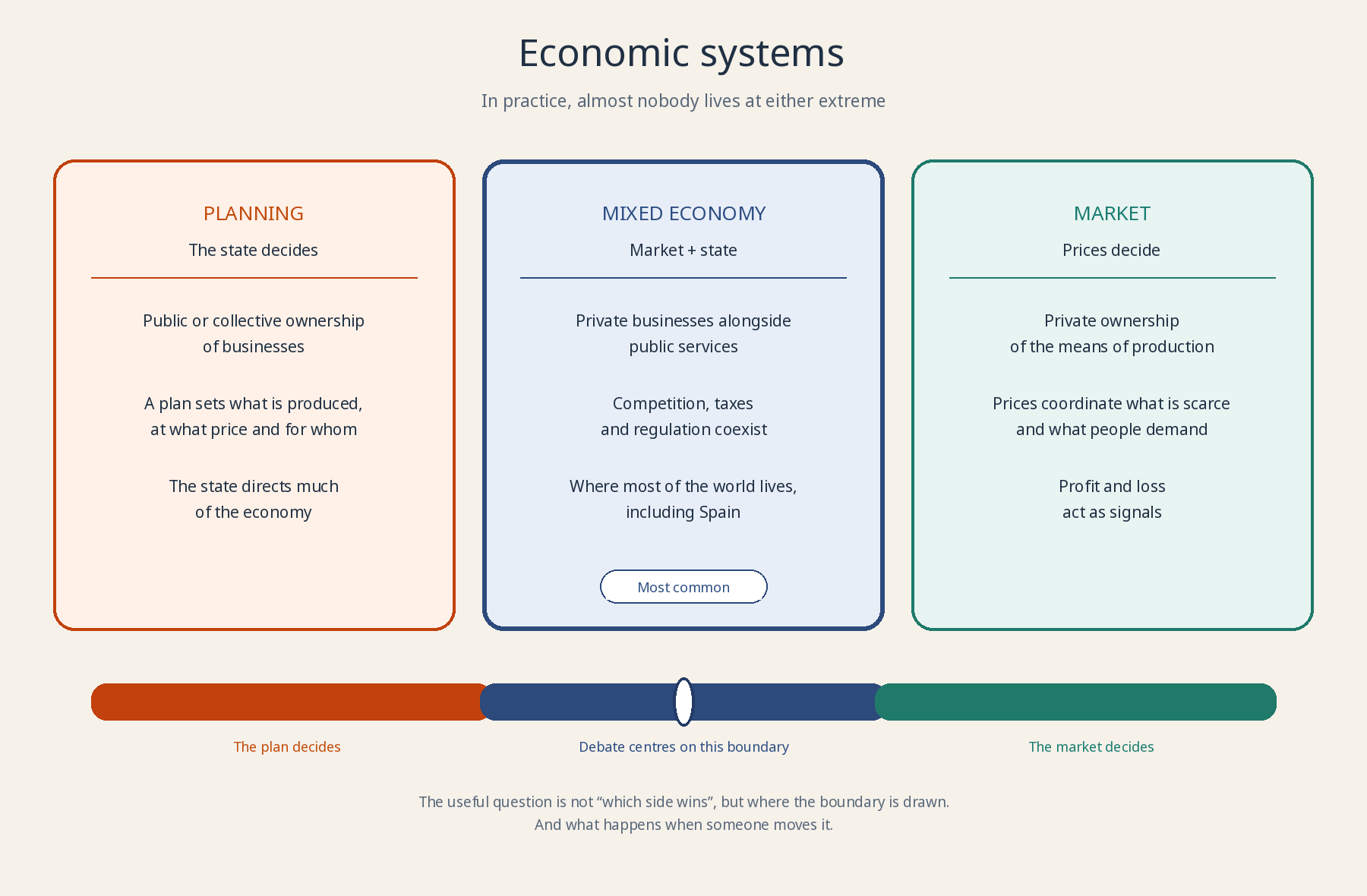
A conceptual spectrum, not a ranking of countries or a claim that any system exists in pure form.
Why does this matter to you as an investor? 📈
Because you don’t invest in an ideology. You invest in businesses operating under rules. A system that respects property, contracts and the possibility of both gains and losses is a different playing field from one that improvises expropriations, freezes prices or changes the rules halfway through. Regulatory or political risk means a government decision can abruptly change your investment’s value.
Before falling in love with a company’s numbers, inspect the playing field. Does it depend on households choosing freely, other businesses, or public budgets? A government-dependent business can do wonderfully—until the administration or the public finances change. Regulated sectors such as energy, banking, healthcare and telecommunications, where public authorities determine many rules, prices or permits, aren’t analyzed quite like a bakery.
Don’t mistake a stock-market crash for proof that “capitalism has failed,” or a subsidy for “the market speaking.” Listed businesses operate under a system’s rules—almost always a mixed system—which can shift in either direction. Understanding those rules helps you avoid surprises absent from last year’s income statement.
Next we’ll examine how different schools interpret these questions. For now, keep the practical picture: the economic system is the board, companies are the pieces, and you should know which game you’re joining.