
Economic schools: Keynesians, Austrians and beyond
Why do two economists see the same crisis and prescribe opposite cures?
One wants to hit the accelerator. The other wants to know who removed the brakes...
Let’s be honest: if you were hoping to find a subject where every expert agrees, you’ve enrolled in the wrong course. Faced with a recession—a sustained decline in economic activity that usually costs jobs—one economist wants more government spending, another wants less intervention, and a third points at the central bank. Same traffic jam, three diagnoses and an argument that probably won’t end well. The familiar “two consecutive quarters of falling GDP” is a common shorthand, not a universal legal definition of recession.
An economic school is a way of interpreting decisions, markets and what should happen when something goes wrong. It often grows around an author or a book that changes how people look at the world. Later generations debate, correct and extend it. Lesson 1.3 showed us the playing field; now we’re looking at the different lenses people use to study it. Don’t confuse a school with a political party. Each family contains disagreements and evolves over time, and many modern economists borrow tools from several.
A few tools before we start 🧰
Three ideas will keep appearing in this discussion. Before comparing schools, make sure the tools themselves are clear:
-
The economic cycle is the uneven movement of activity through expansion, slowdown, contraction and recovery. Sales, jobs and credit don’t grow in a straight line. Seasons are a useful analogy, provided you throw away the calendar: neither the duration nor the next turning point is fixed in advance.
-
Intervention means public authorities changing the conditions under which markets operate: spending more, adjusting taxes or interest rates, regulating activity or supporting a troubled sector. The serious question isn’t simply intervention versus no intervention. It is what problem a measure addresses, how it works, when it is used and what it costs.
-
Fiscal policy concerns government revenue and spending, decided through the relevant government and parliamentary institutions. Monetary policy belongs to the central bank—the ECB for the euro area—and influences interest rates, money and financial conditions. They can interact, but they are not interchangeable controls on one machine.
The fault lines: Markets, money and cycles 🧭
The disagreements aren’t mainly about who can write the most equations. They concern which problems matter most, how decisions are coordinated and how reliably markets or institutions can correct mistakes. Knowing that starting point helps you understand why apparently sensible economists recommend opposite policies.
-
Markets and intervention: do prices and incentives correct mistakes quickly enough, or can unemployment and weak spending persist without outside support? The answer affects how urgently a school recommends action and how much confidence it places in policymakers.
-
Money and inflation: how do money creation, productive capacity and expectations interact? Expectations are what people think will happen—and those beliefs can change spending, wage demands and prices today. Schools differ over which links deserve the most attention.
-
Economic cycles: does a crisis begin with collapsing spending, badly directed credit, distributional conflicts or some combination? Calling everything a crisis doesn’t explain its cause. The diagnosis matters because repairing one mechanism may leave another untouched.
These questions overlap. If you see insufficient spending as the main problem, your prescription differs from that of someone who sees too many uneconomic projects financed by cheap credit. Understand the competing explanations before applauding the remedy. A policy can be internally consistent with a theory and still fit the circumstances poorly.
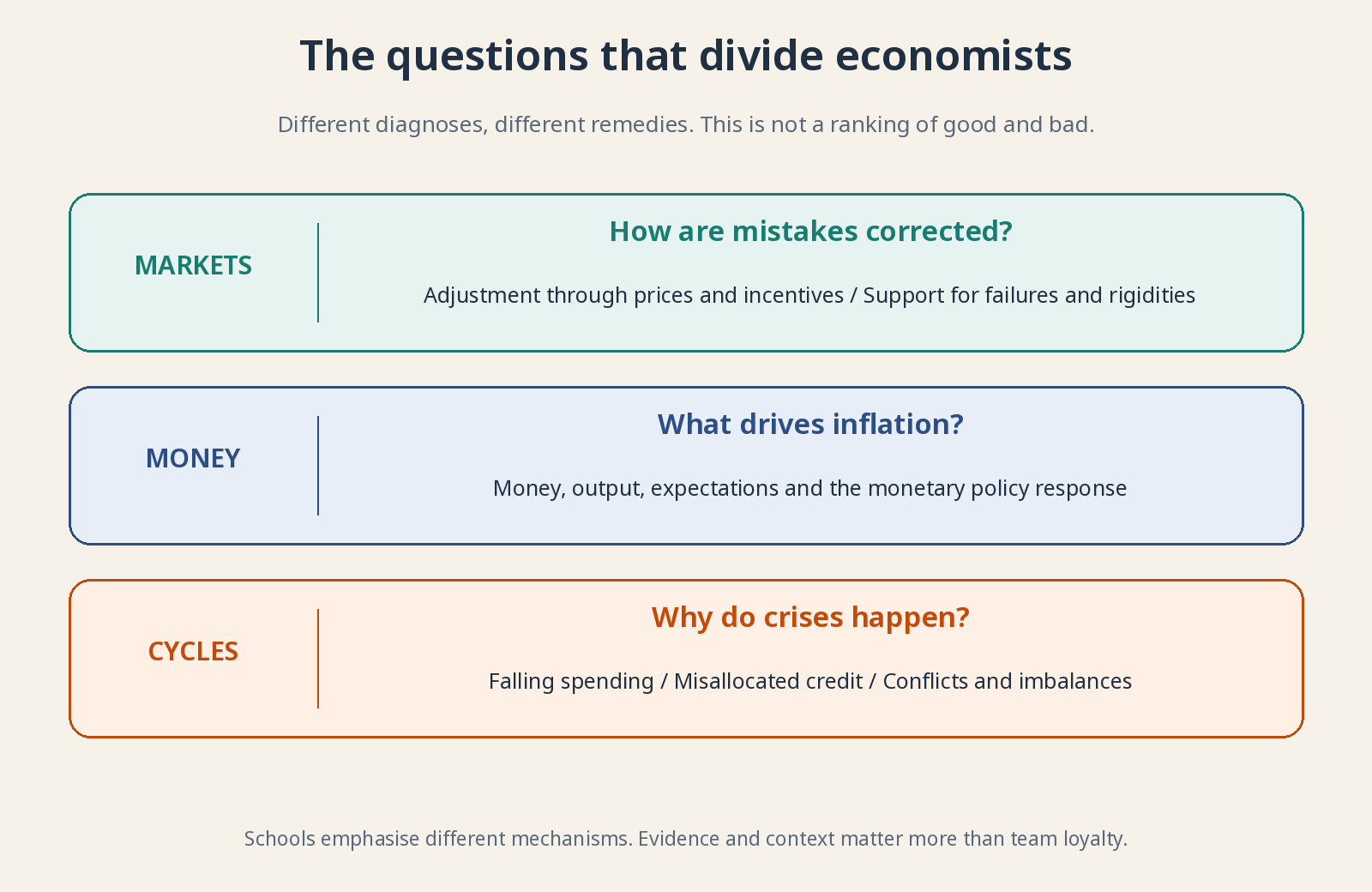
Evidence and context matter more than the label on your team jersey.
Classical and neoclassical economics: The market’s toolkit 🛠️
Classical economics developed alongside modern economic analysis. Adam Smith’s The Wealth of Nations appeared in 1776; David Ricardo followed in the early nineteenth century. Production, specialization, trade and distribution were central concerns. Specialization means people concentrating on particular tasks, allowing cooperation and exchange to raise what the group can produce.
Smith’s invisible hand describes how pursuing a private interest can unintentionally serve others within an appropriate institutional setting. The baker gets up early to earn a living, yet the neighborhood receives breakfast. That is an argument about coordination—not a promise that every selfish act benefits society or that rules and competition are unnecessary. Smith himself warned about merchants colluding to raise prices. Supporting markets is not the same as blessing monopolies or price-fixing.
Neoclassical economics emerged around the marginalist revolution of the 1870s. It examines choices between alternatives and what an additional unit contributes. Marginal utility is the satisfaction from that next unit; equilibrium describes a situation in which the modeled decisions are mutually compatible. These tools help analyze prices and allocation, not just production costs. Alfred Marshall and Léon Walras are important figures in this tradition. Think of the first glass of water after a run versus the tenth: the extra satisfaction changes even though both contain water.
Models simplify, like a road map that omits potholes. Trouble starts when their assumptions are mistaken for the world itself. Imperfect information, market power and people who don’t calculate like spreadsheets can change the result. Modern economists often use and modify these tools rather than accept one frictionless-market model as the whole subject.
Keynesians and monetarists: Spending vs. monetary stability 🚦
Keynesian economics takes its name from John Maynard Keynes, whose General Theory appeared in 1936 during the Great Depression. An economy can remain stuck with weak demand and unemployment. If everyone cuts spending to save more, income can fall collectively: the paradox of thrift links individual prudence to the circular flow in lesson 1.2.
Aggregate demand is total spending on domestically produced goods and services: household consumption, investment, government purchases and net exports. Keynesian approaches emphasize supporting demand when private spending collapses, including public action where appropriate. A budget deficit—spending exceeding revenue—may be part of that response, but its usefulness depends on circumstances, design and financing.
Monetarism, associated especially with Milton Friedman in the 1960s and 1970s, emphasizes money and the dangers of unstable monetary policy. Persistent money growth beyond what production and money demand can absorb can undermine purchasing power. Monetary stability matters; repeatedly trying to fine-tune the economy can introduce uncertainty rather than remove it.
This doesn’t mean every temporary oil-price increase is simply a printing-press story. The question is how a broad inflation process persists and how money and expectations accommodate it. People expecting higher prices may seek higher wages or change spending. Expectations can reinforce the process, which helps explain the emphasis on a credible monetary framework. Both traditions have evolved, and actual policy often combines tools associated with different schools.
Austrians and Marxists: Critiques from very different corners 🔍
The Austrian school developed in Vienna with Carl Menger in 1871 and later Ludwig von Mises and Friedrich Hayek, a Nobel laureate in 1974. It emphasizes subjective value, knowledge dispersed across people and the entrepreneur’s role in discovering opportunities. Value depends on what a good does for someone, not simply the hours spent making it; lesson 1.5 explores that argument.
In the Austrian account of cycles, interest rates coordinate saving and investment across time. Rates pushed below levels consistent with underlying preferences can encourage long projects that available resources cannot sustain. The eventual adjustment exposes those mistakes. This is a particular explanation of credit-driven cycles, not proof that every low rate is artificial or every recession has one cause. Critics argue that the account offers less practical guidance once an economy is already deeply depressed.
Marxist economics, rooted in Karl Marx and Capital, whose first volume appeared in 1867, centers ownership, accumulation and conflict between capital and labor. It asks who controls production and receives its surplus, and how those relationships generate inequality and instability. Its influence on twentieth-century political history was enormous. Understanding its questions does not require accepting every conclusion or treating later policy regimes as identical.
Why does this matter to you as an investor? 📈
Because ideas eventually reach budgets, regulation and interest rates. More public spending can support certain orders. Monetary tightening—raising rates to curb inflation—makes financing more expensive and changes what investors will pay today for profits arriving years from now. Knowing the ideas behind a decision helps you understand it, not predict the next market candlestick. Those colored chart bars merely summarize price movements over a day, an hour or another interval.
Your job isn’t to swear loyalty to a tribe. It is to examine incentives, balance sheets and valuations. A good theory doesn’t make an expensive stock cheap. And if leading economists can’t agree on the next crisis, perhaps guessing the perfect market entry or exit isn’t your best plan either. Regular contributions and time don’t require winning that argument.
In lesson 1.5 we’ll join Menger at the bakery counter: why the oven’s value depends on what customers want, not how proud its manufacturer feels.