
Monetary policy: Conventional interest rates vs. unconventional QE/QT
When cutting rates isn’t enough, what else can a central bank do?
From lending facilities to QE and QT: Changing financial conditions isn’t giving away wealth.
Let’s be honest: “the central bank is injecting money” is a sentence that covers almost everything and explains remarkably little. Lending for a week? Buying a bond? Paying interest on banks’ deposits? Mailing you a check? Those are different operations, even if the news illustrates all of them with the same photograph of a printer.
Today I want to open the monetary-policy toolbox. First, conventional tools: policy rates and routine operations. Then the measures called unconventional, including QE and QT. Unconventional doesn’t mean illegal or necessarily improvised. It means extending the usual toolkit for circumstances in which the main tool may not be enough.
Policy rates: Different prices for different operations 🎛️
A policy rate is an interest rate set by a central bank for a particular operation or balance. There isn’t one gigantic contract called “the price of money.” The Eurosystem has rates for refinancing operations and standing facilities. Their names sound administrative because they are: each comes with rules on maturity, access and collateral.
Refinancing operations let eligible banks obtain central-bank liquidity against accepted collateral, subject to requirements. Refinancing means renewing or replacing financing, not forgiving debt. A bank can need reserves to settle payments without being insolvent. Keep liquidity separate from solvency and you won’t label every central-bank loan a bailout.
The deposit facility lets eligible banks place funds overnight and earn the applicable rate. The marginal lending facility provides overnight financing against eligible collateral and under specified conditions. “Facility” names a standing mechanism, not an unlimited free bar. Its rates help guide the money market—the market for short-term financing.
Modern policy needs more than a picture of one tap 🏦
When reserves are abundant, central-bank remuneration strongly influences the rates banks accept for short-term lending. Why lend far below an accessible safe alternative? Frictions and differences in access mean the relationship isn’t perfect. In a scarcer-reserves framework, liquidity provision and market operations play a different role. The plumbing depends on the operating design.
The Fed sets a target range for the federal funds rate and uses administered tools to guide short-term rates. Its facilities aren’t identical to the ECB’s. Both aim to influence financial conditions in pursuit of a mandate, but their institutional details aren’t interchangeable. You don’t need to memorize every window at every central bank.
Expansionary policy eases conditions; contractionary or restrictive policy tightens them. As lesson 4.1 explained, the effects depend on expected inflation, risk, credit and economic circumstances. Raising a rate doesn’t automatically destroy a fixed proportion of deposits. Cutting it doesn’t force a bank to lend. Credit needs creditworthy customers and willing banks, not just an announcement.
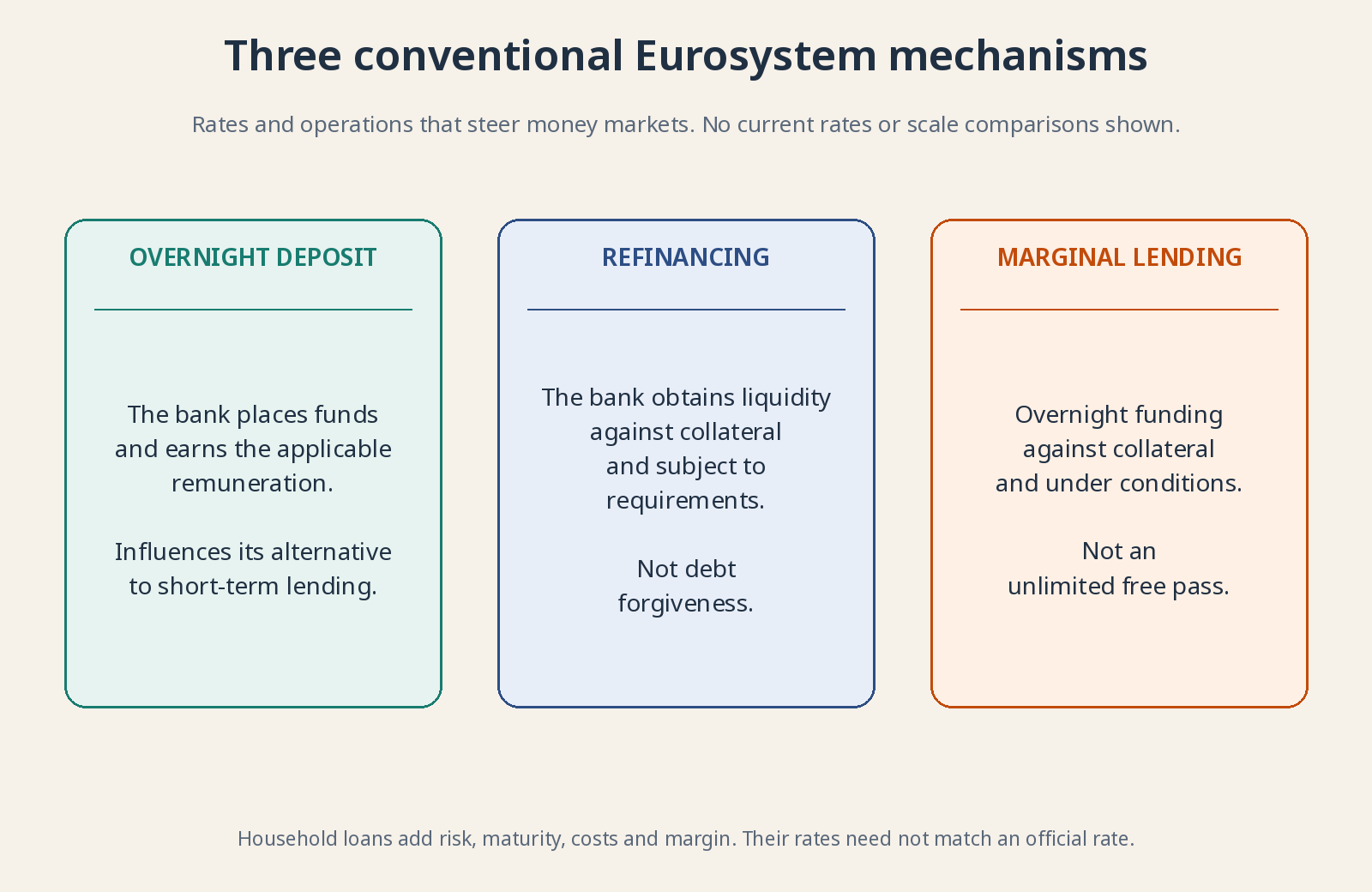
Policy rates influence financing conditions; they are not mandatory mortgage or savings-account rates.
The limits of rate cuts: The floor isn’t an endless trapdoor 🧊
In a deep crisis, short-term rates may approach their effective lower bound: a level below which further cuts encounter major difficulties. That isn’t necessarily exactly zero—negative rates have existed. But rates cannot be assumed to fall indefinitely without changing incentives, funding and behavior. Meanwhile, long-term rates can remain high or credit can stay blocked.
A longer-term interest rate reflects expectations of future rates and compensation for bearing risk over a longer period. That compensation includes the term premium, which is not constant. If the short-term tool no longer eases conditions sufficiently, the central bank can try to influence those other components and market functioning.
QE: Buying assets and paying with reserves 🧾
QE stands for quantitative easing. The central bank buys assets, often bonds, on a substantial scale to ease monetary conditions. A bond is a debt security: its issuer promises contractual payments. The central bank acquires that claim as an asset and pays by creating reserves—banks’ balances at the central bank.
If it buys from a bank, the simplified result is a swap: the bank exchanges a bond for reserves. If it buys from a fund or another nonbank seller, the seller’s bank receives reserves and credits a deposit to its customer. The deposit effects differ between the two cases. Reserves aren’t transferred directly into your personal account as though you held an ordinary checking account at the ECB.
The operation expands the central bank’s balance sheet, the snapshot of assets and obligations. It doesn’t itself create a factory, energy or knowledge. It changes financial assets and the conditions under which others finance spending and investment. Lesson 7.3 follows the accounting footprints in detail; here the goal is to understand the operation, not repeat the whole practical exercise.
Where it came from: Japan first, broader adoption later 📚
Japan adopted quantitative easing in 2001 amid economic weakness and deflation risks, shifting its operating target toward banks’ balances at the Bank of Japan. The idea wasn’t invented from scratch in the United States in 2008. Asset purchases have earlier precedents; these programs were distinguished by their scale, circumstances and monetary-easing purpose.
After the 2008 financial crisis, several major central banks expanded asset purchases while confronting crises and very low rates. The ECB used broad programs against excessively low inflation and impaired transmission. Designs, assets and rules differed. Not every purchase program has exactly the same purpose, and not every emergency loan is QE.
What it aims to do: More than “there’s more money” 🔄
Buying bonds adds demand for those securities. Other things equal, that tends to raise their price and lower their yield—the return implied by buying at the current price and receiving the expected payments. A fixed-payment bond’s price and yield move in opposite directions: pay more for the same cash flows and the yield falls.
Purchases also remove some longer-term interest-rate risk from private portfolios and may compress the term premium. Sellers may rebalance into other assets: the portfolio-rebalancing channel. Purchases can also signal a persistent policy stance. These mechanisms can support credit and spending, but their strength depends on expectations and financial conditions. “Can” isn’t filler. It marks the limit of the claim.
When buying government debt in the secondary market, a central bank buys from an existing holder, not necessarily the issuing Treasury. In the ECB framework, the prohibition on monetary financing and program rules constrain purchases. Debt doesn’t vanish because it changes hands. Easier financing is not cancellation of the issuer’s obligation.
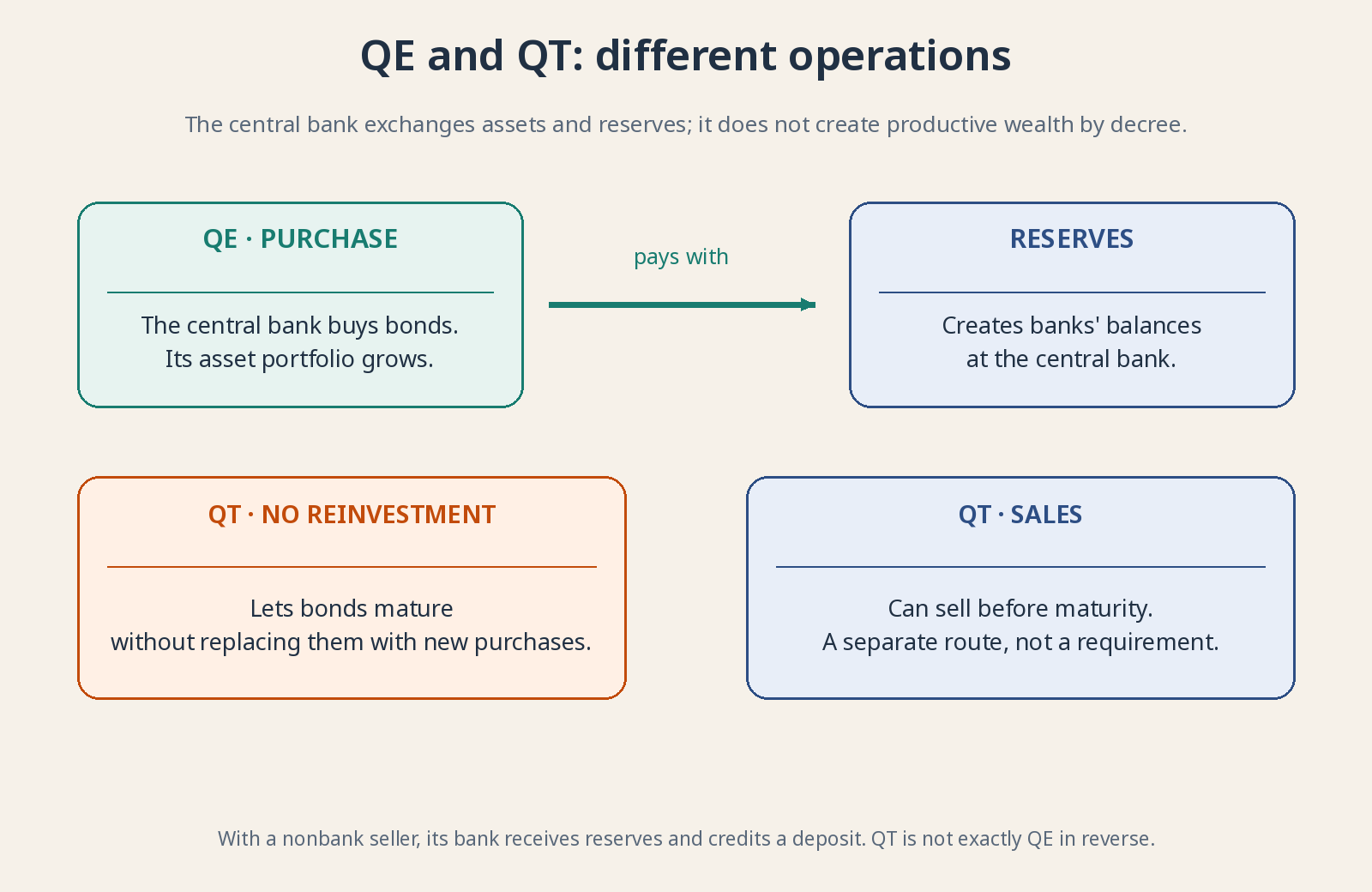
No automatic loan multiplier and no guaranteed stock rally. A balance-sheet operation is not a free gift.
QE is not helicopter money or a hidden check 🚁
“Helicopter money” comes from a metaphor about distributing money directly, rather than buying an existing asset in exchange as QE does. In economic debate it usually means money-financed transfers, with widely differing designs and restrictions. It isn’t something to recreate at home by borrowing to invest, or a synonym for every stimulus policy.
A budget-funded check to a household is a fiscal decision. A central bank buying a bond is a different operation. Both can occur together and affect each other, but merging their names hides who decides, who receives what and which obligations remain. QE also isn’t a bank receiving money for nothing: it delivers an asset, and reserve remuneration follows its own rules.
QT: Shrinking a portfolio doesn’t always mean selling in a rush 📉
QT stands for quantitative tightening. It reduces acquired asset holdings or the relevant part of the balance sheet. One route is letting bonds mature—reach their repayment date—without reinvesting the proceeds. Another is selling before maturity. These have different schedules and effects. Don’t translate every QT announcement into “mass selling tomorrow.”
Under simplified conditions, those operations withdraw reserves when they settle. In practice, Treasury accounts, other balance-sheet items and other central-bank operations also matter. Reserve changes therefore needn’t match a published portfolio reduction one-for-one. Lesson 7.3 returns to precisely this caution when moving from a diagram to actual accounts.
QT can tighten conditions and return some debt risk to private investors, but it is not a QE movie played perfectly backward. Predictability, pace, asset demand and available reserves matter. A system may absorb reductions for a while before frictions appear. Nor is every balance-sheet decline QT: a bank can repay a liquidity loan without any bond being sold.
Communication, side effects and limits 🗣️
Forward guidance communicates how policy decisions might evolve under stated conditions. It influences expectations but isn’t an unconditional promise that rates will never change. If the circumstances change, defending a misunderstood commitment can worsen the problem.
Purchases can support asset prices and risk-taking, alter incentives and create financial risks or accounting losses. Interest paid on reserves and earned on assets also affects central-bank income. None of that proves QE is always useless—or always harmless. Evaluation requires comparing benefits, costs and the alternative scenario, not simply how far stocks rose.
Why does this matter to you as an investor? 📈
Because these tools change financing conditions and required returns without guaranteeing company profits or permanently rising asset prices. Ask which tool is being used, why, at what pace and what the market already expected. Easing introduced to fight a crisis can coexist with miserable sales prospects.
Don’t turn QE into permission to borrow personally, or QT into an automatic sell order. Understanding the mechanism reveals financing dependencies and overly comfortable expectations. Your long-term plan needs to survive more than one central-bank configuration, not remain attached to an imaginary magic printer.
For further reading: Bank of England: QE and QT · ECB: asset purchases · Bank of Japan: 2001 decision.