
4.1 Interest rates, money supply and economic policies: An introduction to intervention
Who touches the controls when the economy starts overheating?
Rates, money and budgets: Before arguing over the prescription, find out who can do what.
Let’s be honest: economic debates often mix up the ECB, the finance ministry, taxes and “the printing press” as if they were buttons on the same remote control. They aren’t. A central bank doesn’t approve your personal income tax—Spain calls it IRPF—and an individual euro-area government doesn’t set the euro’s policy rate. Confuse the pilots and you’ll struggle to explain why the aircraft is turning.
Today I want to map economic intervention: public decisions intended to influence activity, jobs, prices and stability. We won’t assume intervention always fixes everything, or that leaving things alone always prevents trouble. Instead, ask what fault a policy is trying to correct, which tool it uses and what side effects may follow.
Why intervene? Stabilizing isn’t creating prosperity by decree 🛠️
Millions of private decisions connect through the economy. If families all cut spending together, firms sell less, reduce hiring and reinforce the original fear. If credit suddenly freezes, even viable projects can stall. And if inflation becomes persistent, planning and purchasing power suffer. What looks sensible for one household can become a problem when everyone does it simultaneously.
Stabilization aims to soften those swings and keep the system working. Building long-term productive capacity is a different job, involving education, competition, useful infrastructure and reliable institutions. Giving demand a temporary push is not the same as making an economy permanently more productive. You can press the accelerator without installing a larger engine.
Intervention also addresses market failures, such as pollution not reflected in prices, and objectives involving redistribution or public services. These aren’t all jobs for monetary policy. Public action can fail too, through poor information, incentives, delays or political choices. “Intervene” is the start of an argument about design, not proof that a policy will work.
Interest rates: What it costs to use somebody else’s money today 💶
An interest rate is the price of borrowing money for a period—or the return for lending it. Borrow €1,000 at 5% annually, with no fees and repayment after one year, and the simple interest is €50. Real contracts add repayment schedules, fees and other conditions. Read the full cost, not just the attractive number on the poster.
The nominal rate is the quoted percentage. The real rate accounts for inflation. For a decision today, expected inflation over the loan period matters because tomorrow’s outcome is unknown. Roughly, real interest equals nominal interest minus expected inflation. A 4% nominal rate can therefore be more or less restrictive under different inflation expectations.
Policy rates apply to specified central-bank operations and bank balances. They influence very short-term market rates and, through them, broader financial conditions. They are not compulsory prices for every mortgage, business loan or bond. Your lender still considers maturity, credit risk, funding costs, competition and its own balance sheet.
A spread is the gap between two rates—for example, a company’s borrowing yield above a lower-risk reference with a similar maturity. In a crisis that extra risk premium can rise enough to offset a policy-rate cut. “The ECB cut rates” does not necessarily mean that a struggling firm can now borrow more cheaply.
Monetary policy: Changing borrowing and financial conditions 🏦
Monetary policy is the central bank’s use of interest rates and other tools to fulfill its mandate. In the euro area it is conducted by the Eurosystem: the European Central Bank, ECB, and euro-area national central banks. Its primary objective is price stability, expressed as 2% inflation over the medium term. It does not manage every country’s budget.
The US Federal Reserve, or Fed, has a mandate including price stability and maximum employment. It operates under a different institutional framework in a different economy. Dollar finance gives its decisions worldwide reach, but the Fed is not the government of the entire planet. Distinguish influence from jurisdiction.
An expansionary stance aims to ease conditions and support spending when appropriate to the mandate; a restrictive stance aims to restrain excessive pressure. A rate change alone doesn’t fully define the stance. Consider the starting level, inflation expectations, credit conditions and other tools. Cutting a very high rate can still leave borrowing expensive.
Money supply: Not a tap pouring directly into everyone’s pockets 🚰
Money supply means the amount of money under a specified definition. M1, M2 and M3 group instruments with different degrees of liquidity, as lesson 2.3 explains. Definitions vary across jurisdictions, so don’t silently substitute a US aggregate for a euro-area one. First establish what the container holds before comparing its size.
The monetary base—currency and commercial-bank reserves at the central bank—is not the same as household and business deposits. Reserves help banks settle payments and meet other needs within the monetary system. They are not piles of banknotes automatically delivered to everyone’s kitchen table after a central-bank operation.
Commercial banks create deposits when they lend, within capital, funding, regulatory and risk constraints and the availability of creditworthy demand. The central bank influences these conditions; it does not select every borrower or dial M3 to an exact target. Modern money creation is a constrained balance-sheet process, not an unlimited printing trick.
Fiscal policy: Different controls, different decision-makers 🏛️
Fiscal policy uses public spending, taxes and financing decisions to influence activity and pursue collective objectives. Governments and legislatures decide it within their responsibilities—not the ECB. Fiscal refers to public finances, not just tax collection. Lesson 4.3 separates its instruments, deficits and debt from central-bank asset purchases.
A budget-funded payment supporting household income is fiscal. A policy-rate cut is monetary. A bank lending to a business is a financial-intermediation decision, influenced by both but identical to neither. If you put all three into a box labeled “money injected,” you lose the mechanisms that explain their different effects.
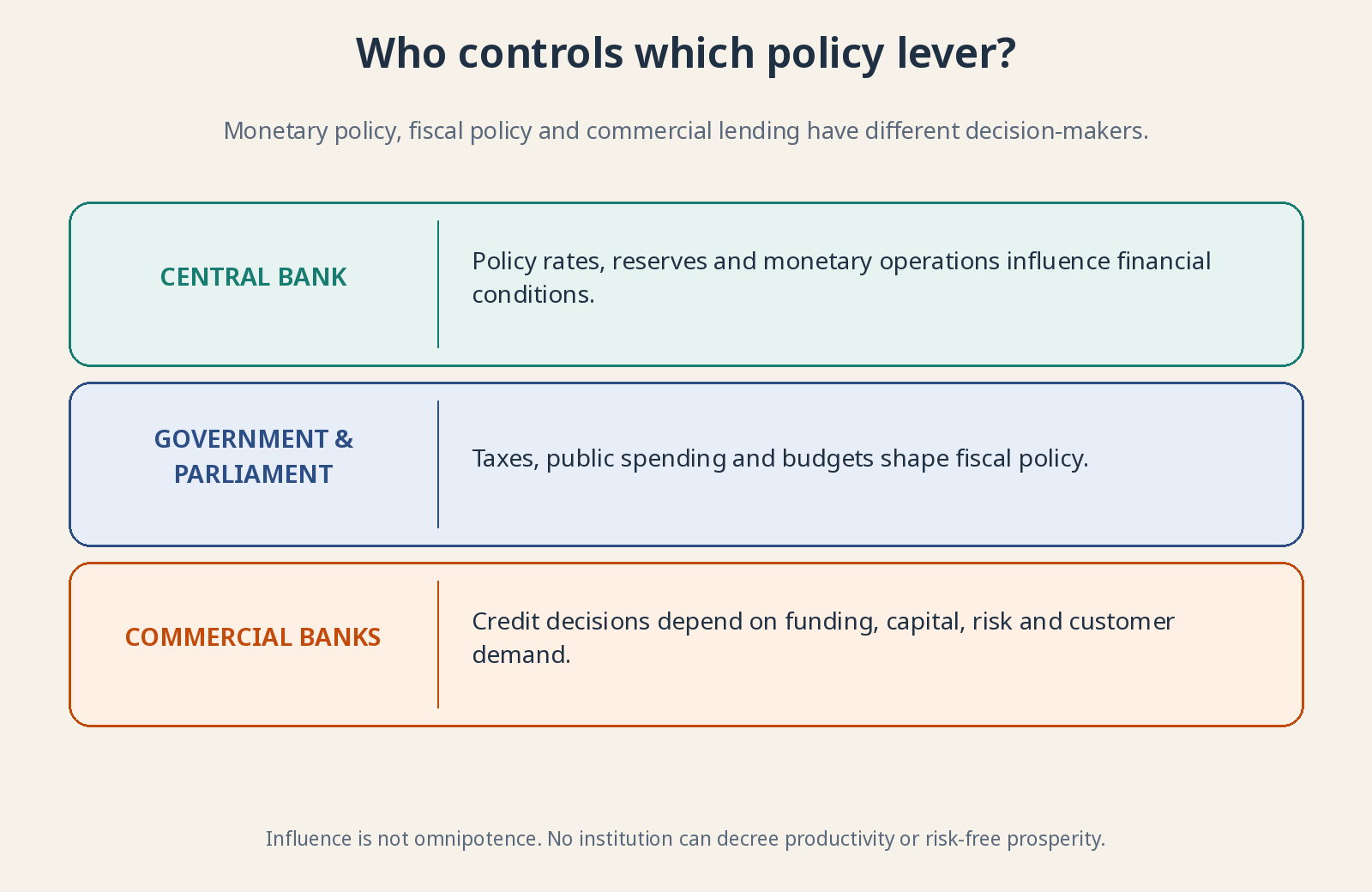
Influence is not omnipotence. No institution can decree productivity or risk-free prosperity.
How a decision reaches consumption and investment 🔄
A transmission channel is the route from a policy decision to economic behavior. Through credit, higher rates increase the cost of new borrowing and variable-rate resets, potentially reducing big purchases and business investment. Here productive investment means equipment, premises or development—not merely buying existing shares in an app. Financing changes what projects look worthwhile.
Saving and spending incentives change too. Some savers earn more interest, while borrowers facing larger installments have less left to spend. The combined result depends on who owes, who saves and how each responds. A household with a floating-rate mortgage and a debt-free retiree do not receive the same financial message from a rate rise.
Rates also affect present value: what a future payment is worth today after allowing for time and risk. Higher required returns generally reduce that value if other things stay equal. But expected cash flows and risk premiums also change. One interest-rate arrow cannot explain every move in a share price.
Exchange rates and expectations: Effects cross borders too 🌍
An exchange rate is one currency’s price in another. Higher expected returns on assets in one currency can attract demand and support appreciation. Can, not must: risk, growth expectations and already anticipated decisions matter. Exchange rates reflect relative conditions, not an instruction to rise whenever one central bank increases its rate. Appreciation can make foreign-currency imports cheaper and weaken some exporters’ price competitiveness, depending on their costs and contracts.
Communication works through expectations—what people believe policy and the economy will do next. If a decision was widely expected, markets may already have adjusted before the announcement. A seemingly backward price response can reflect different expectations about the future path. Read the surprise relative to the forecast, not just the headline decision.
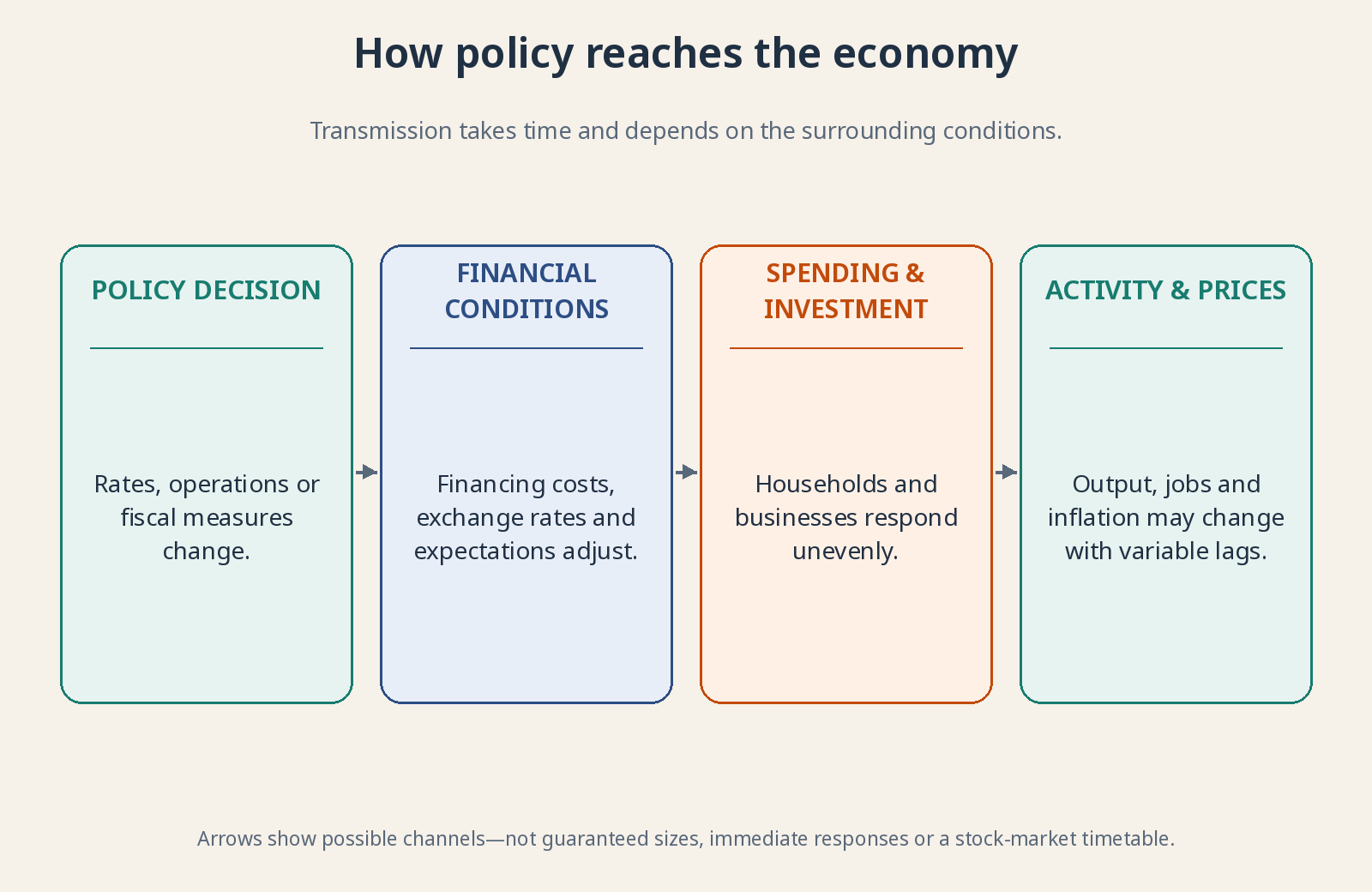
Arrows show possible channels—not guaranteed sizes, immediate responses or a stock-market timetable.
Lags and limits: Driving with a map that updates late ⏱️
Policy works with lags because contracts, wages and projects don’t all reset on announcement day. Data arrive late and are revised too. Policymakers are steering with an imperfect map that keeps updating. Acting late or overcorrecting can amplify the cycle rather than smooth it; timing policy is difficult even for institutions with large research teams.
Higher interest rates cannot manufacture missing energy. Monetary policy may contain a supply shock’s spread into spending, contracts and expectations, while fiscal and capacity measures address other parts of the problem. The tools can complement or conflict with one another. No single lever fixes every economic fault, however confidently somebody points at it.
Why does this matter to you as an investor? 📈
Because your businesses live among customers, costs and financing. Knowing who operates each control helps explain changing loan terms, squeezed household budgets or temporarily higher revenue from public support. Companies have different debts and customers, so the impact differs too.
Lesson 4.2 opens the monetary toolbox, 4.3 the fiscal toolbox and 4.4 the employment–inflation relationship. The goal isn’t predicting the next announcement, but avoiding fragile assumptions. A long-term plan shouldn’t require central banks always to provide cheap money or governments always to sustain sales.
For further reading: ECB: monetary policy strategy · ECB: monetary policy transmission.