
Fiscal policy: Spending, taxes, public debt and sustainability
Does a government with debt mean a government going bust? Not so fast
Spending, taxes and debt: Watch the whole payment story, not a number on a protest sign.
Let’s be honest: two claims settle every argument about government finances at the dinner table and almost nothing in real life. “A government is just like a household.” And “a government can borrow without limits.” The first ignores essential differences. The second forgets that resources, confidence and repayment capacity aren’t infinite. We can do better without appointing ourselves finance minister for the afternoon.
Today I want to discuss fiscal policy: how public authorities choose to spend, raise revenue and finance themselves. “Fiscal” comes from the world of public finance; it doesn’t mean merely filling in a tax return. These decisions distribute resources and risks across people, activities and time. Understanding the mechanism is a better starting point than choosing a team.
Spending and taxes: Not every public dollar does the same job 🏛️
Public spending includes services such as healthcare and education, investment such as infrastructure, and transfers such as pensions or benefits. A transfer provides income without purchasing current production in return at that moment. A hospital buys labor and supplies; a pension payment supports its recipient’s income. Both affect activity, but through different routes.
Taxes apply to different bases: income, consumption, wealth and other legally defined categories. The tax base is the amount or activity to which the rate or rule applies. Change the rate or the base and you change incentives as well as revenue. The percentage alone does not tell you who ultimately bears the burden. Raising a rate does not guarantee proportionally higher receipts: the tax base, compliance, cycle and behavioral response also change.
Public revenue also includes social contributions and other receipts. You don’t need to memorize every budget line to see the central question: how much is raised, from whom, how reliably and with what effects? Two systems collecting the same total can distribute costs differently and create different incentives to work, invest or spend. A one-off receipt cannot permanently finance an ongoing commitment.
Deficit vs. debt: The running tap and the water already in the bath 🛁
A public deficit occurs when expenditure exceeds revenue during a period under the relevant accounting rules. A surplus is the reverse. This is a flow, measured over a year or quarter. Public debt is a stock outstanding at a point in time. Confusing the two is like confusing this month’s overspending with the balance already on your loan.
In a deliberately simple example, government starts with debt of 500 units, receives 100 and spends 110. The deficit is 10. If entirely debt-financed, with no other adjustments, debt ends at 510. Actual accounts involve cash-versus-accrual differences, financial transactions and other adjustments, so debt changes need not exactly equal the headline deficit.
The primary balance excludes debt-interest expenditure. It shows the fiscal position before servicing inherited borrowing. A government can run a primary surplus yet still have an overall deficit if interest costs are larger. Both measures are useful; neither replaces the other. Ask which one a discussion is using.
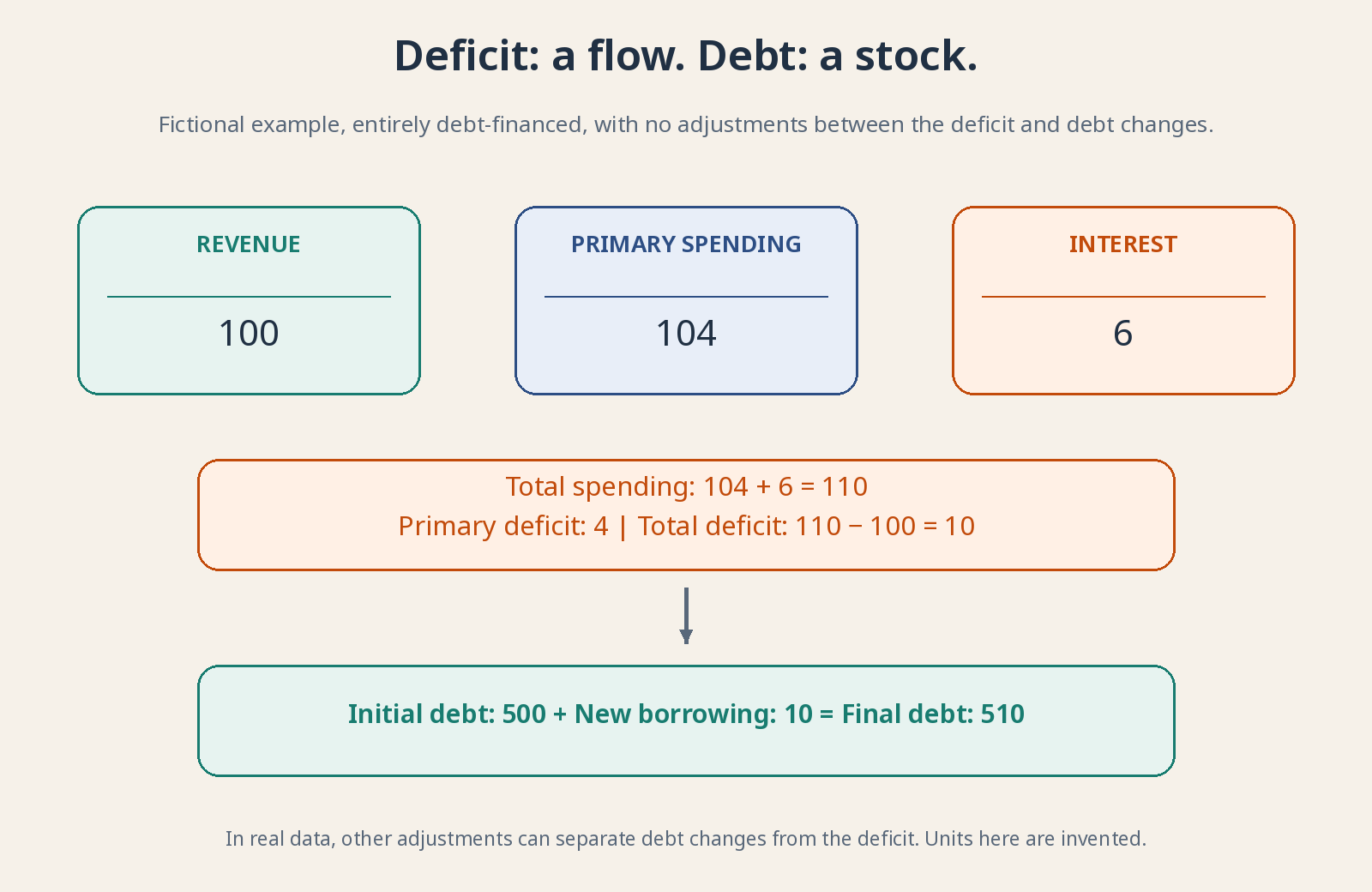
The deficit is a flow over a period. Debt is a stock at a date.
Who lends to governments—and why refinancing matters 📜
Treasuries issue bills, notes and bonds: securities through which the state borrows and promises specified future payments. Names and maturities vary by country. Spain distinguishes letras, bonos and obligaciones across short and longer maturities. Investors buying them hold a claim on the issuer; they do not become shareholders in the state. Domestic and foreign households, funds, banks and other institutions can all be buyers.
Maturity is when principal—the outstanding amount borrowed—must be repaid. Governments often issue new debt to repay maturing debt, a process called refinancing or rollover. This is not automatically a default warning. But it depends on continued access to funding on manageable terms. A routine practice can become a vulnerability when confidence disappears.
Gross financing needs broadly combine new borrowing requirements with maturities to be repaid, subject to the measure’s accounting adjustments. Two governments with similar debt totals may face very different risks if one must refinance much more soon. Check the repayment calendar, not just the total written at the bottom.
Sustainability: Paying the bills without an annual miracle 🧭
Debt sustainability means meeting obligations under plausible policies and conditions without politically or economically unmanageable adjustments or impossible financing assumptions. Debt-to-GDP is a useful scale comparison, not a complete diagnosis. A larger ratio warrants questions; it does not, by itself, answer all of them. The ratio divides outstanding debt by annual nominal GDP; it is not a payment deadline or the government’s personal salary ratio.
Growth, revenue, the primary balance and the effective interest cost all matter. Effective cost is the average cost across the debt stock, not merely the latest auction yield. Strong growth in income and revenue can make a given stock easier to service. A stagnant economy with weakening receipts faces a different arithmetic. Higher new-issue yields usually work into the average gradually as debt is refinanced, rather than repricing the entire stock on one policy-announcement day.
Currency, maturity, investor base and institutional credibility also matter. Borrowing in a currency the issuer cannot control differs from borrowing under its own monetary framework. Spain shares the euro and cannot unilaterally instruct the ECB to finance its budget. Even monetary sovereignty does not remove inflation, exchange-rate or real-resource constraints.
Contingent liabilities are obligations that become payable under specified conditions, such as a public guarantee being called. Future spending pressures and the political capacity to adjust count too. The headline debt figure does not contain every possible claim on tomorrow’s budget. Looking beyond it is caution, not an invitation to invent hidden totals. Nor should every projected future expense simply be added as though it were debt due tomorrow. Consistent accounting conventions matter.
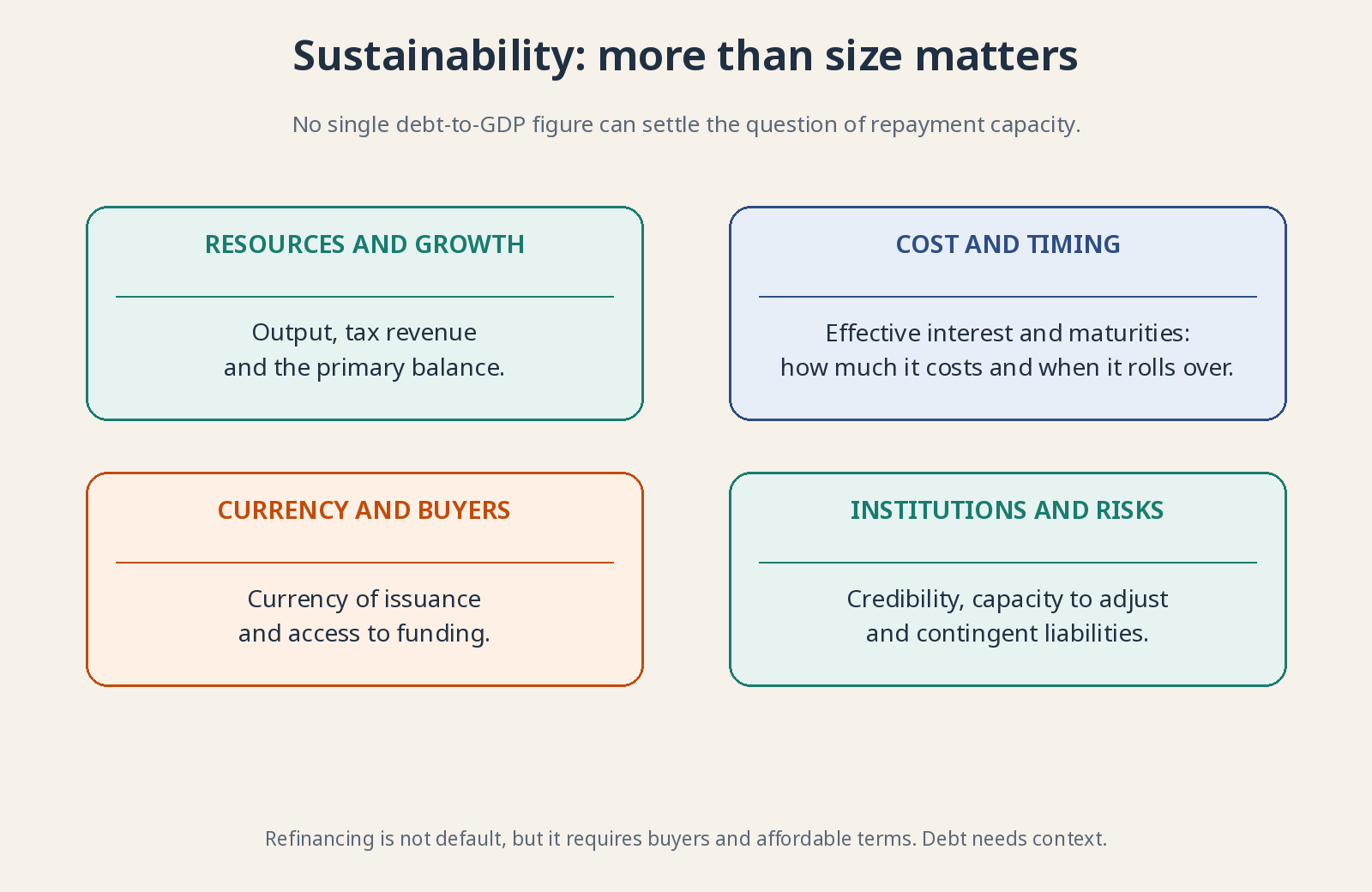
There is no universal debt ratio that flips every country from safe to insolvent.
Growth, interest and inflation: Three interlocking pieces ⚙️
If the effective interest cost persistently exceeds nominal economic growth, stabilizing debt relative to GDP generally requires a stronger primary balance, other things equal. You don’t need a formula tattoo to understand why: obligations growing faster than the income base need an offset. Interest, growth and budget decisions interact rather than working separately.
Inflation can raise nominal GDP and reduce the real weight of some fixed-rate nominal debt. There is no free escape hatch. Refinancing rates, indexed spending and social pressures may rise, while confidence deteriorates. Revenue and interest costs do not necessarily adjust together. Inflation can change the burden without solving the underlying fiscal problem.
The fiscal multiplier: A dollar may go around more than once—or not 🔄
A fiscal multiplier estimates the change in activity caused by a fiscal change over a specified horizon relative to an alternative scenario. If one extra spending unit raises GDP by 1.2 units in a hypothetical case, the multiplier is 1.2. That is neither a guaranteed financial return nor automatic Treasury revenue of 1.2 units.
The mechanism follows the circular flow of income: one payment supports income that may support further spending. But some income is saved, spent on imports or paid in taxes. When labor and materials are already stretched, extra demand may raise prices more than real output. The same initial payment need not produce the same chain reaction everywhere.
The multiplier therefore depends on the cycle, policy design, monetary response, financing and confidence. Useful investment can expand capacity; an unnecessary project can consume resources without comparable benefits. Counting euros spent is easy. Establishing what they achieved, compared with what would otherwise have happened, is the harder and more relevant question.
Stimulus and austerity: Debate the design, not just the label ⚖️
Fiscal stimulus supports demand through spending, transfers or tax reductions. Fiscal consolidation, often called austerity, aims to improve the balance through higher revenue or lower expenditure. Both labels cover very different packages and distributional effects. The name does not tell you whether a measure is timely, effective or fairly shared. Removing support abruptly during a deep downturn can worsen it; persistent deficits without credible financing can create another crisis.
Automatic stabilizers respond without requiring a new decision each month. During a downturn, tax receipts can fall while some benefit payments rise, cushioning income and worsening the balance automatically. Discretionary policy means an additional deliberate change. Distinguishing them prevents every recession-driven deficit from being mistaken for a newly announced stimulus program.
Cutting useful maintenance is not equivalent to removing ineffective expenditure. Nor is a tax reduction for someone likely to spend it identical to one for someone likely to save it. Timing, duration and recipients matter. You can support temporary crisis help and still question permanent commitments without reliable financing. Those positions are not contradictory.
Spain and the EU: Shared rules, national circumstances 🇪🇺
The EU has fiscal rules and surveillance procedures. The framework reformed in 2024 uses medium-term fiscal-structural plans and country-specific net expenditure paths, with safeguards and corrective mechanisms. Net expenditure is a defined aggregate with specific exclusions and adjustments. It does not simply mean all public expenditure minus all public revenue.
Applying that framework requires reading the relevant plan and recommendations, not reciting one number as a verdict on every budget. This lesson does not claim to assess Spain’s current compliance. Its purpose is to explain the mechanism: shared rules meet national budgets, economic conditions and political decisions. Those details determine how the framework actually operates.
Why does this matter to you as an investor? 📈
Because government is a customer, regulator, tax collector and borrower. Its decisions can support sales or alter costs, while stressed public financing can spread to credit and activity. Temporary aid isn’t a permanent competitive advantage, and a large government-debt stock alone doesn’t determine every domestic company’s outcome.
Examine revenue quality, dependence on public contracts and resilience to tax or demand changes. You don’t need to bet on every budget. You need to notice when your investment thesis requires easy financing and exceptional public support to last forever. Usually, “forever” is the most expensive part of that sentence.
For further reading: Council of the EU: reform of fiscal rules · Council of the EU: economic governance framework.