
2.4 The interbank market (Euribor, SOFR): A fear thermometer
What happens when banks stop trusting one another?
Why your mortgage’s thermometer also checks the financial plumbing...
You check your account to see whether you can make it to payday. Banks manage incoming and outgoing payments too—except their version of “month-end” can arrive several times a day. Transfers, withdrawals and maturing obligations don’t balance themselves just because the building has marble columns.
Today I want to talk about the plumbing through which banks lend to one another, and two names you’ll encounter around it: Euribor, familiar to many Spanish mortgage borrowers, and SOFR, which sounds like a painkiller but is one of the world’s most important interest-rate benchmarks. We’ll see what they measure, where they came from and why comparing them carelessly is a bad idea.
The interbank market: Banks lending to banks 🔄
The interbank market is exactly what its name suggests: banks lending to one another, usually for short periods—a day, a week or a few months. Not a building full of shouting traders, but transactions between treasury desks over phones and electronic platforms. It belongs to the wider money market, where short-term loans and debt, broadly up to a year, also involve funds, large businesses, insurers and governments. Not very photogenic—until the plumbing jams and makes the news.
Why do banks need it? Recall the reserves lesson: payments between banks settle in central-bank money. After millions of transfers, direct debits and card payments, one bank may have spare balances while another is short. Rather than forcing the second to sell assets immediately, the first can lend its surplus overnight and charge interest. Like a neighbor lending you sugar until Monday, except with contracts and millions involved.
Secured or unsecured: Trust me—or give me collateral 🤝
There are two basic forms of lending here. The distinction is central to the lesson:
-
Unsecured: bank A lends to bank B against B’s promise to repay. If B fails, A can lose money. The rate therefore depends partly on A’s confidence in B. Think of lending to a friend on their word alone.
-
Secured: B provides assets as collateral, typically high-quality bonds. If B defaults, the collateral can protect A, subject to the contract and enforcement rules. Think of a pawnshop: leave a watch, receive cash, repay and recover the watch. Collateral reduces risk; it doesn’t eliminate every possible loss.
A common secured transaction is a repo, short for repurchase agreement. The mechanism resembles a loan packaged as a sale: I sell you bonds today and agree to repurchase them tomorrow at a slightly higher price. Economically, you supplied overnight cash backed by my bonds. The difference between the sale and repurchase prices supplies the financing return.
Because collateral reduces the lender’s exposure, a repo rate will often be below an otherwise comparable unsecured rate at the same maturity. Not every loan is overnight, and the money market is not exclusively bank-to-bank. Maturities, collateral and participants differ. Comparing two rates as if they measured identical risk is asking for trouble.
Maturities and tenors: One day isn’t the same as one year 📅
You’ll also see maturity or tenor: simply how long the loan runs. Overnight means roughly one business day—lend today, receive repayment tomorrow. Other tenors include a week, one month, three months, six months and twelve months.
The longer the horizon, the more can happen: policy rates change, a borrower gets into trouble or you need your money earlier. A twelve-month rate therefore reflects expectations about policy during the coming year as well as other premiums. Comparing an overnight rate with a twelve-month rate resembles comparing a one-day car rental with a year-long lease.
Euribor: The benchmark that lands in Spanish mailboxes 🏠
Euribor, the Euro Interbank Offered Rate, is a benchmark published each business day. It measures unsecured euro wholesale funding costs for banks in the EU and EFTA countries—Norway, Switzerland, Iceland and Liechtenstein. Wholesale means large institutional transactions, not you visiting your branch. It isn’t an investment product. It is a thermometer used as a reference in other contracts.
First published on December 30, 1998, shortly before the euro’s launch, Euribor supplied a common reference for the new currency. Brussels-based EMMI, the European Money Markets Institute, administers it for five tenors: one week and one, three, six and twelve months. Publication is shortly after 11:00 Europe/Madrid time (CET/CEST). Historically it relied on panel submissions; its hybrid methodology, introduced in 2019, prioritizes transactions and uses other inputs when data are insufficient. Benchmark-manipulation penalties in the early 2010s explain why reform mattered. Since 2016, EU authorities have classified Euribor as critical because so many contracts depend on it.
Why does it appear in mortgages? A bank making a twenty-five-year floating-rate loan needs an objective reference for periodic adjustments. Euribor reflects wholesale funding conditions. In Spain, twelve-month Euribor is the most common floating mortgage reference, often using the monthly average published by the Banco de España. The contract adds a fixed spread—say Euribor + 1%—and specifies resets, commonly every six or twelve months. Higher or lower benchmark readings can change repayments at the reset, depending on the agreed terms.
For example, Euribor at 3% plus a 1% spread gives a 4% nominal rate. That isn’t Spain’s TAE, the annual percentage rate measure incorporating fees and payment frequency for loan comparison. Nor is it the entire cost of the arrangement. Fees, linked insurance and other conditions matter. There’s a reason the contract is longer than the advertisement.
One warning: the ECB doesn’t set Euribor directly. Expected policy rates strongly influence it, but liquidity and credit premiums matter too. Euribor can therefore move before the central bank acts: the market is already pricing the expected decision in.
LIBOR: The old benchmark that ended up in court ⚖️
To understand SOFR, first meet the benchmark it helped replace. LIBOR, the London Interbank Offered Rate, was a major global reference for decades. Developed in London in the 1980s, it covered several currencies—including dollars, sterling and yen—and several tenors. Trillions in loans, mortgages and derivatives depended on it.
Its weakness lay in the recipe: panel banks reported what they believed unsecured borrowing would cost, rather than the benchmark relying solely on a broad set of observed transactions. After 2008, manipulation emerged: some submissions tried to make banks look healthier, while others favored trading positions. Banks faced large fines and some traders lengthy legal proceedings. Meanwhile, declining unsecured term lending left the reference supported by fewer real transactions.
In 2017, the UK regulator said it would not ensure LIBOR’s continuation beyond 2021, prompting currency-specific transitions. For dollars, the Alternative Reference Rates Committee, ARRC, had been convened in 2014 and selected SOFR in June 2017. Dollar LIBOR was removed from new contracts, and the last panel-based dollar settings ended on June 30, 2023. The panel-based qualification matters: the transition also involved temporary arrangements for legacy contracts.
SOFR: Dollars, overnight and backed by Treasury collateral 🇺🇸
SOFR, the Secured Overnight Financing Rate, is not a bill, bond or stock you can buy. It is a benchmark measuring the cost of overnight dollar borrowing secured by US Treasury securities. Treasuries are government debt regarded as high-quality collateral. Each part of the name matters: secured describes collateral, overnight the tenor, and financing rate the cost of funding.
The source is the dollar repo market. Banks, money-market funds and other large participants exchange overnight cash against Treasuries. The New York Fed, working with the US Treasury’s Office of Financial Research, collects a large transaction sample and calculates a volume-weighted median: the middle rate when transaction size determines the weight. It publishes the previous business day’s rate around 14:00 Europe/Madrid time, normally, and around 13:00 during the temporary US–European daylight-saving mismatch weeks. Publication began on April 3, 2018.
SOFR was chosen for features LIBOR lacked: a large base of actual transactions and high-quality collateral. That makes it harder to manipulate and much less a measure of one bank’s unsecured default risk. It has become the dominant dollar reference for many loans and derivatives formerly linked to LIBOR. Contracts needing a rate for several months can use SOFR averages or term versions derived from derivatives markets. The underlying SOFR benchmark remains overnight.
Other currencies adopted other replacement references; not all former LIBOR contracts became SOFR contracts. For the euro, the ECB has published €STR since 2019, an unsecured overnight reference. Reformed Euribor continues alongside it. Same currency does not mean same tenor or same instrument.
SOFR is not simply “America’s Euribor” 🚫
Calling SOFR “America’s Euribor” is tempting—and misleading. Put their features side by side:
-
Currency: Euribor concerns euro financing; SOFR concerns dollars. ECB and Fed policy can move in different directions.
-
Collateral: Euribor concerns unsecured funding and contains bank credit risk. SOFR uses Treasury collateral, greatly reducing that particular exposure.
-
Maturity: Euribor has several tenors up to twelve months and incorporates expectations over those periods. SOFR itself is overnight.
-
Method: Euribor combines transactions with other inputs where data are insufficient. SOFR draws on a very large volume of observed repo transactions.
Comparing their levels without adjusting for currency, maturity and collateral can produce nonsense. SOFR at 4% against twelve-month Euribor at 2% would not mean US banks are twice as frightened. Different Fed and ECB policy settings might explain much of the difference.
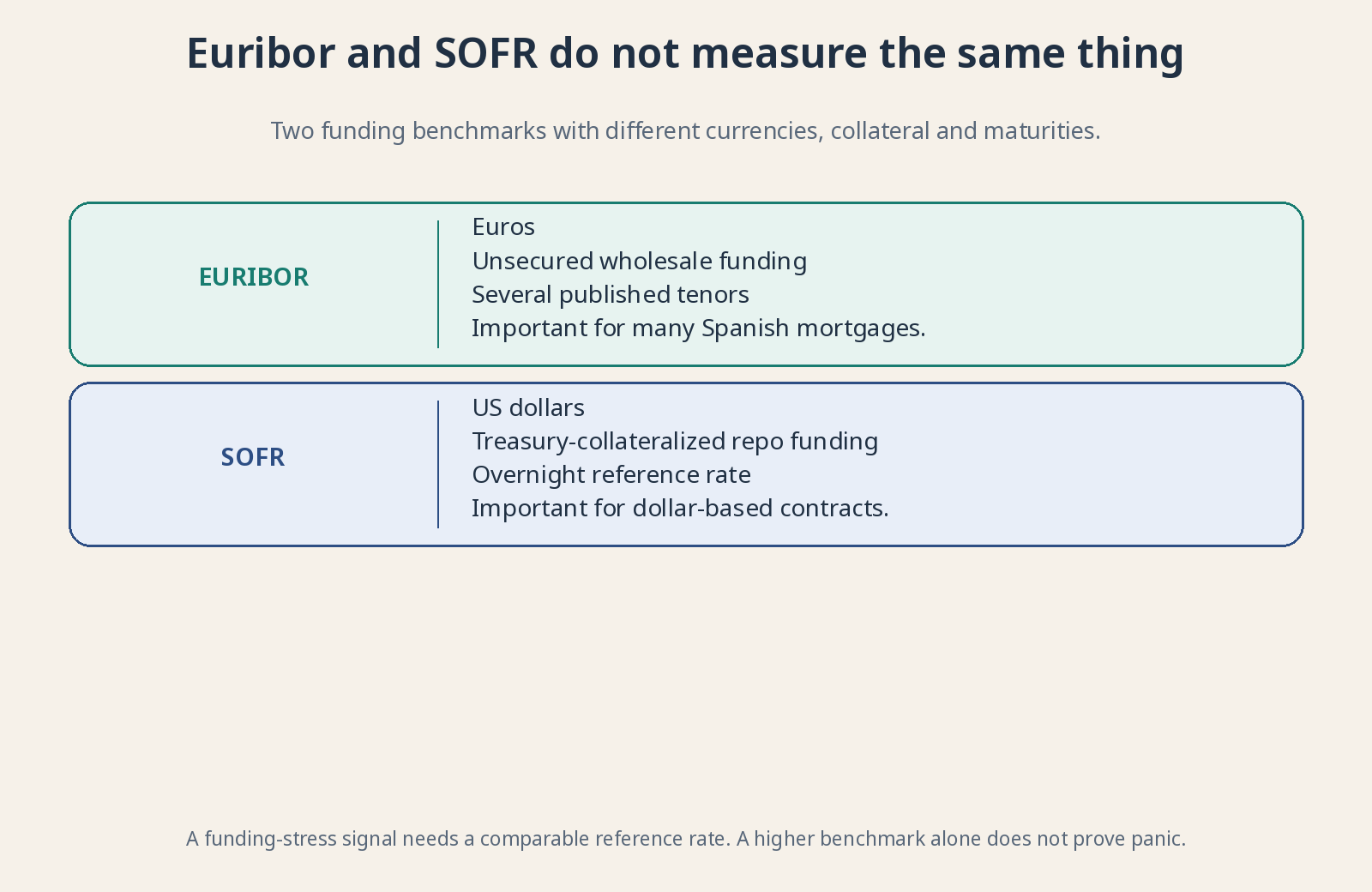
A funding-stress signal needs a comparable reference rate. A higher benchmark alone does not prove panic.
A fear thermometer needs a reference temperature 🌡️
If bank B looks risky, A may demand more interest or refuse to lend. Funding spreads can widen: the gap between unsecured bank borrowing and an appropriately comparable low-risk reference at the same maturity. A narrow spread suggests confidence; a sudden widening suggests a problem. These gaps became prominent in 2008. Sometimes the signal isn’t a high price at all—it is nobody willing to transact at any price.
So “Euribor is high; there must be panic” won’t do. Policy rates may simply be high to restrain inflation while markets function normally. Look for stress by separating policy expectations from additional premiums and examining volumes, collateral and financing access.
SOFR isn’t a pure bank-fear detector either. Treasury collateral limits the direct bank-credit-risk component. Its movements can instead reflect temporary cash scarcity, collateral supply or dealers’ intermediation capacity. The September 2019 repo disruption illustrated this kind of market-functioning problem rather than a straightforward bank-credit panic. Every thermometer needs the right placement. Hold one under a hot tap and it will read high too.
Why does this matter to you as an investor? 📈
Because strained interbank financing can lead to tougher mortgage and loan terms and more expensive company refinancing. Housing, construction and heavily indebted businesses tend to feel the transmission. Lesson 1.2’s circuit can slow even when the original blockage is far from consumers. And if you have a floating-rate Spanish mortgage linked to Euribor, you now know where the changing reference number comes from.
For a bank, examine its funding sources: stable deposits from many customers, or wholesale funding that can disappear in days? How market-dependent is it, and when do obligations mature? For an ordinary company, ask what happens when refinancing stops being cheap. Higher rates don’t always mean bigger bank profits either: deposit costs and defaults can increase too.
You don’t need to bet on the next Euribor reset. You need to understand that confidence has a price and easy financing isn’t an acquired right. A thermometer helps identify fragility; each decimal point is not a buy-or-sell instruction.