
2.1 Money: From barter and gold to fiat money
Why would you accept a piece of paper in exchange for your work?
Why the waiter prefers euros to three chickens and a promise...
Let’s be honest: money is a rather strange collective agreement. You spend hours working and accept banknotes or numbers on a screen in return. Then you hand over those numbers at the supermarket and somebody lets you take home actual food. It works because you expect the next person to accept them too.
After choices, agents and rules, we turn to the tool that keeps lesson 1.2’s roundabout moving: money. It isn’t wealth by magic, or a bag containing guaranteed future goods. It helps us exchange things, compare prices and carry purchasing power through time. Today we’ll explore where it comes from, the forms it has taken and what stands behind the euro in your wallet. Spoiler: there isn’t a gold bar with your name on it.
Barter: Finding a customer was already hard enough 🐔
Barter means exchanging goods or services directly without money: your bicycle repair for the baker’s bread. The difficulty is a double coincidence of wants. You must find a baker who needs that repair at the moment you want bread. Finding a customer is hard enough without also requiring that customer to supply your dinner.
You also need exchange ratios. Is one repair worth twenty loaves or thirty? How do you divide an indivisible item? And will the goods keep while you negotiate? Barter can work in particular circumstances, but it becomes cumbersome as specialization and the number of possible exchanges grow.
This explains why money is useful, not one universal historical sequence. Anthropologists and historians also find credit arrangements, recorded obligations and social relationships in early economies. Don’t turn a teaching model—barter, then money—into a claim that every society followed exactly that route. Actual monetary histories are more varied.
One tool, three jobs 🧰
To identify money, look at its functions rather than whether it shines or carries a famous face. The standard three explain why the tool is useful and why some assets work better as money than others:
-
Medium of exchange: you accept it as payment and use it to pay someone else. Selling your labor no longer has to coincide with buying your dinner. You can trade with different people at different times without finding the perfect barter partner.
-
Unit of account: it provides a common measuring scale for prices, wages and debts. Comparing the monthly rent on two apartments in euros is easier than converting one into sacks of flour and the other into hours of plumbing.
-
Store of value: it carries purchasing power into the future. You receive money now and spend later. This function can deteriorate: keeping the same number of euros does not guarantee that they will buy the same basket. A stable-looking account balance can conceal a real loss of purchasing power.
Assets perform these jobs unevenly. Gold may preserve value over some horizons but is awkward for buying coffee. A home can be valuable without paying today’s grocery bill. Liquidity concerns how readily something can be used for payment or converted into money without a substantial loss. Valuable, liquid and suitable as money are different properties.
Commodity money: Money with another use of its own 🪙
Commodity money has a nonmonetary use or value as well as serving in exchange. Historical examples include salt, livestock, shells and cacao, as well as tobacco in confined communities. Metals became particularly important because properties such as durability and divisibility made them practical. There was no single object used everywhere. Salary’s etymology is linked to salt, but the familiar story that Roman soldiers were routinely paid in salt should not be treated as established historical fact.
Scarcity alone wasn’t enough. People needed acceptance, reliable measures and confidence in quality. Minted coins used official marks to certify weight and purity. Clipping metal from coins or debasing their content undermined that confidence. Changing the material doesn’t remove the incentive to cheat; people still need to trust what they receive.
Representative money and the gold standard: Paper as a claim 🧾
Carrying metal is inconvenient and risky. Depositing it with a trusted custodian could produce a paper receipt entitling the holder to withdraw it. If others accepted the receipt, it could circulate as representative money. Think of a claim ticket that becomes transferable. If too many holders demanded gold at once and it was unavailable, the system faced the kind of problem explored in lesson 2.5.
Under a gold standard, a national currency was defined in relation to a fixed amount of gold, with convertibility obligations. Its classic international period ran roughly from 1870 to the First World War. Convertibility constrained issuance but also limited responses to banking stress and changes in money demand. It did not eliminate inflation, deflation or bank runs. A metallic anchor wasn’t a cure for every economic problem.
The Bretton Woods agreements were reached in 1944, during the Second World War, to shape the postwar monetary order. Many currencies were linked to the dollar, with official dollar–gold convertibility for foreign monetary authorities. The US suspended that convertibility in 1971. This was a major stage in a longer transition, not the day every country or private citizen simultaneously abandoned an identical gold arrangement.
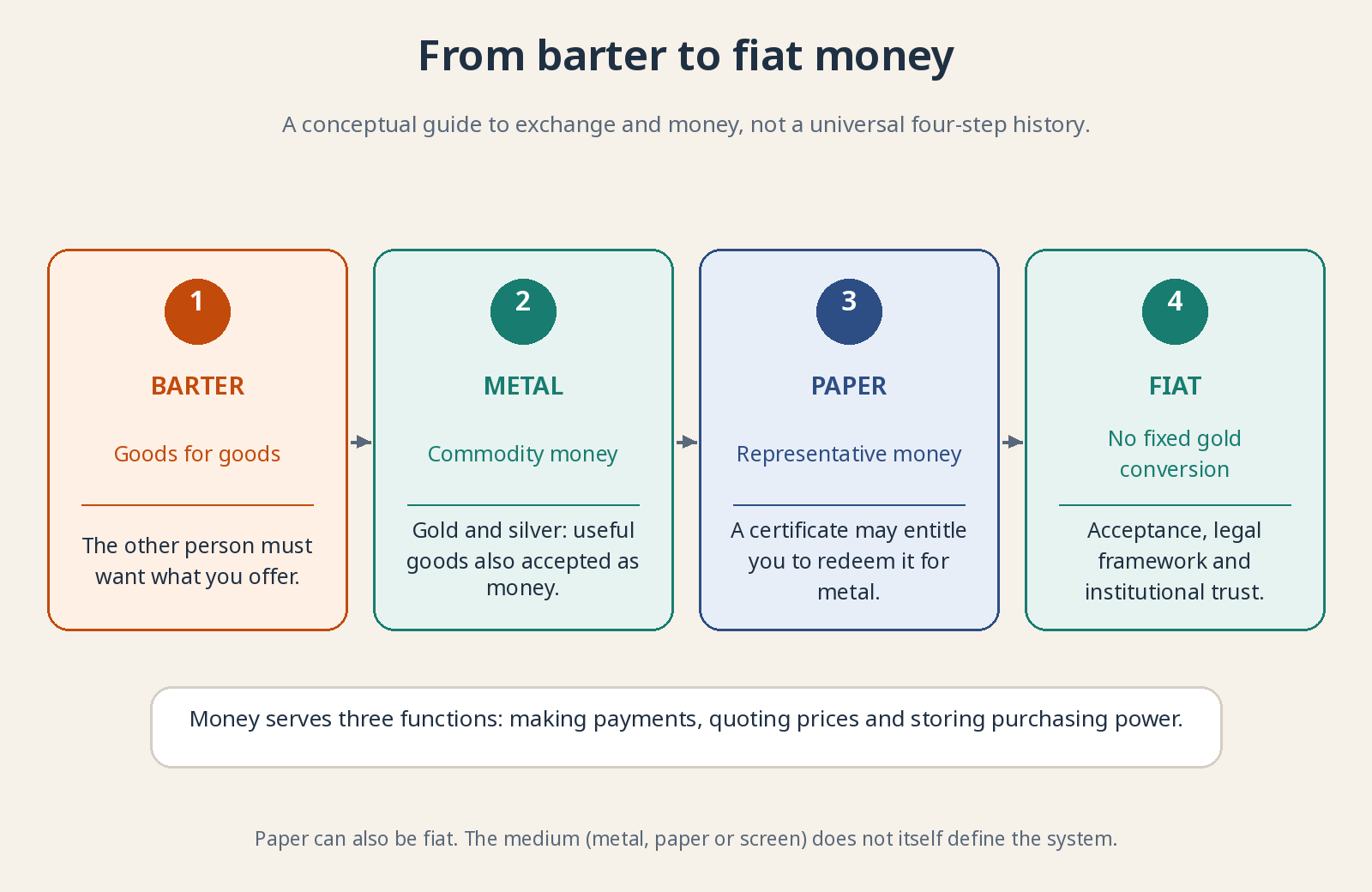
Money serves as a medium of exchange, a unit of account and a store of purchasing power.
Fiat money: Trust won’t fit inside a vault 🏦
Today’s euro is fiat money. Fiat means “let it be done”; the related language of fiduciary money emphasizes trust. A €20 note does not entitle you to a fixed quantity of gold. Acceptance rests on institutions, the legal and tax framework, the payments system and the expectation that other people will accept euros too.
Legal tender is part of that framework. Euro banknotes and coins generally serve to discharge euro-denominated payment obligations under the applicable rules. That doesn’t remove agreed contractual conditions, statutory exceptions or limits on cash payments in particular transactions. Legal tender is a legal status, not a promise that every possible payment must accept unlimited cash.
“No fixed gold backing” is not the same as “nothing supports its acceptance.” There is a productive economy, taxation, institutions and a functioning payments network. What is absent is a fixed metal-conversion promise. Greater flexibility can help during a crisis, but responsible management matters: money remains useful only if confidence and purchasing power are not persistently undermined.
Seigniorage: The economics of issuing money 👑
Seigniorage is income associated with issuing money. The term comes from rulers retaining a margin on coinage. In a modern system, banknotes cost little to produce while their issuance is associated with assets such as loans and securities that may earn interest. Central-bank income depends on expenses, other interest costs and losses too. Distributions to public authorities follow the relevant rules; they are not guaranteed free profit.
That helps explain a longstanding temptation: creating money can appear easier than raising taxes. Abuse can contribute to severe inflation when nominal claims outrun what the economy can supply and confidence collapses. Euro-area central-bank independence and the prohibition on direct monetary financing of governments are important institutional safeguards, not a claim that every monetary operation is fiscal spending.
Digital money doesn’t necessarily mean a different currency 📱
Digital describes a form, not automatically a new currency. Most euros you use are already bank-account entries. Paying by card or phone changes how they move, not the unit of account. Cryptoassets have different issuers or governance structures and risks; being digital does not make them stable, universally accepted money. Large price swings can make an asset particularly awkward as a unit of account.
Why does this matter to you as an investor? 📈
Because inflation attacks money’s store-of-value function. Inflation is a broad, sustained rise in prices; Spain’s statistics office, INE (Spain’s National Statistics Institute), measures it using a representative consumer basket. If that basket rises from €100 to €105, your €100 is still a hundred—but buys less. The loss is real even if the bank app displays the same balance. Low positive inflation is part of the ECB’s framework: its medium-term target is 2%.
That doesn’t make cash the enemy. Emergency savings—a few months of accessible expenses for a broken car or a lost job—and near-term bills need liquidity and stability. Leaving decades of savings motionless is different. An unchanged balance isn’t the same as no risk. Security also means what you can buy tomorrow, particularly if retirement depends partly on your own savings rather than only promises from a state pension system. Spain, for example, largely uses a pay-as-you-go system: current contributions finance current pensions rather than building an individual pot with your name on it. Demographics, employment and future policy affect what can be paid. Other countries organize pensions differently, but treating any public promise as your entire retirement plan deserves skepticism.
Long-term investing aims to preserve and grow purchasing power while accepting reasonable risks—not escape inflation by buying anything available. Diversification, patience and regular contributions help more than chasing the latest fashionable refuge. DCA, dollar-cost averaging, means investing a fixed amount at regular intervals regardless of market movements. First understand what your money preserves; then decide which portion can be put to work.