
2.2 Central banks, commercial banks and fractional reserves: How credit works
Does a bank lend somebody else’s savings—or create money too?
Your mortgage doesn’t come from a box with your name on it. It doesn’t come from a magic wand either...
In lesson 2.1 we saw why we accept money. Now for a less comfortable question: where do the euros in a bank loan come from? If you picture the manager entering a vault and handing out another customer’s banknotes, your mental diagram needs an update.
Banks connect saving, payments and financing. But they also do something else: granting credit can create deposits—in other words, new money. To understand this, we need to separate two characters the news often mixes together: central banks and commercial banks. They share a name, not a job. One is the banks’ bank; the other is yours.
Assets, liabilities and balance sheets in two minutes 📒
A balance sheet is a snapshot at a particular date. Assets are what a business owns or is owed; liabilities are its obligations. Equity is the owners’ residual claim after liabilities. The equality is assets = liabilities + equity. These aren’t three unrelated boxes: every transaction must leave the accounts balanced.
Your home provides a simple example. If it is worth €200,000 and the mortgage is €150,000, your equity in it is €50,000. Banks use the same accounting relationship, although their assets include customer loans and their liabilities include customer deposits. Whether something is an asset or liability depends on whose balance sheet you are reading.
The central bank: The banks’ bank 🏛️
A central bank manages the monetary system of a country or currency area. It issues central-bank money, influences monetary conditions and supports payment-system functioning. Commercial banks can hold accounts there; ordinary households generally cannot open the equivalent of a normal checking account. Its job is different from the bank handling your salary and mortgage.
Central banks developed over time rather than arriving with one identical mandate. Early examples include Sweden’s Riksbank and the Bank of England, founded in 1694. Spain’s institutional history includes the Banco de San Carlos, founded in 1782. The US Federal Reserve was established in 1913 after banking panics; the ECB was established in 1998 before the euro’s launch.
The ECB and euro-area national central banks, including the Bank of Spain, form the Eurosystem. It conducts monetary policy for the euro. Its primary objective is price stability, expressed through a symmetric 2% medium-term inflation target. That is not a promise about every price or every month, and it is not a target for stock-market returns. The Fed’s mandate includes price stability and maximum employment; the institutional objectives are not identical.
Central-bank money includes banknotes and banks’ balances at the central bank, known as reserves. Policy rates determine terms for specified balances or operations and influence other financing conditions. They are not compulsory prices for every mortgage or deposit. The reserves lesson next explains why banks’ settlement money is different from the deposit in your account. Central banks can also lend against eligible collateral and buy or sell assets such as bonds.
A central bank can also act as lender of last resort when a funding panic threatens payments. Walter Bagehot’s nineteenth-century discussion stressed lending freely to solvent banks against good collateral at a penalty rate during a panic. This addresses liquidity, not a guarantee that every insolvent institution or shareholder will be protected. Stabilizing payments and guaranteeing investments are different jobs.
Commercial banks serve customers—and take risks 🏦
Commercial banks handle deposits, payments and lending to households and businesses. Many are privately owned, listed companies, although ownership models differ. They seek earnings while operating under banking regulation and supervision. Calling them banks doesn’t give them the central bank’s authority to set monetary policy or create its settlement money.
Your deposit is a liability for the bank and an asset for you. A €2,000 account balance is a claim on the bank, not a labeled box containing your personal banknotes. Understanding that promise explains both the convenience of bank money and why confidence, liquidity and deposit protection matter.
Banks receive interest and fees, pay funding and operating costs, and recognize provisions for expected credit losses. Net interest income is broadly interest earned less interest paid, not total profit after every expense. A bank can report attractive lending income while also facing expensive funding, defaults or other losses. Follow the full accounts, not one margin.
Banks often fund long-lived assets with liabilities customers can withdraw much sooner. This is maturity transformation. It makes long-term financing possible without requiring every saver to lock money away for thirty years. It also creates a vulnerability: a thirty-year mortgage won’t repay tomorrow just because depositors suddenly want cash. Liquidity management and confidence are essential.
A loan creates a deposit: Two entries, one obligation 🔄
Suppose a bank lends €10,000 to a bakery and credits its account. It records a €10,000 loan asset and a €10,000 deposit liability simultaneously. It hasn’t necessarily transferred that sum from a particular saver’s account. A new spendable bank deposit has been created, alongside a borrower’s obligation to repay.
This is ordinary banking accounting, not a secret printing conspiracy. The Bank of England described it in its 2014 article Money creation in the modern economy. Most money used by households and businesses takes the form of bank deposits rather than banknotes. That doesn’t give banks unlimited resources or remove the need to finance and manage their balance sheets.
The bakery has acquired debt, not free net wealth. If it pays an oven supplier at another bank, its bank needs reserves to settle the payment. It can obtain funding through deposits, markets, asset transactions or eligible central-bank borrowing. The loan creates a deposit; successful lending still requires liquidity, capital, risk management and a workable financing structure.
Repaying loan principal reduces the bank’s loan asset and the deposit used for repayment: that extinguishes bank money in the simplified transaction. Interest is different; it is income to the bank, with its own accounting consequences. Keep the amount borrowed separate from the price paid for borrowing it. Compare new lending with principal repayments: gross loan announcements alone do not show the net effect on bank money.
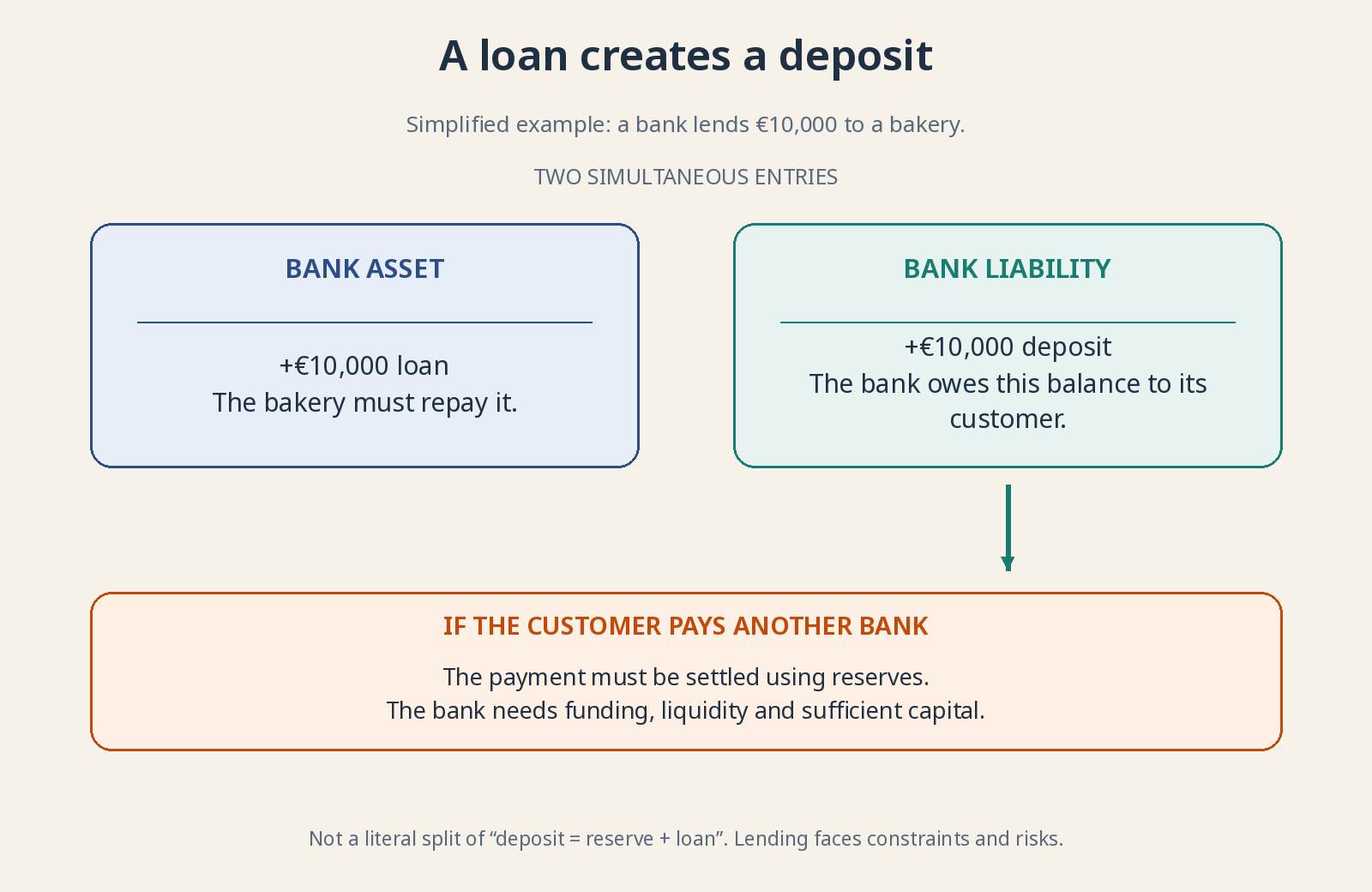
Not “deposit = cash set aside + loan.” Credit creation has constraints and risks.
Fractional reserves: A useful idea, a dangerous caricature 🧩
Fractional-reserve banking describes a system in which banks do not hold immediate settlement money equal to every deposit liability. Their assets also include loans and securities. The concept has historical roots in institutions issuing claims against reserves, but the modern system is not accurately described by imagining every deposit literally split into a cash pile and a loan pile.
Reserve requirements specify minimum reserves against particular liabilities where such rules apply. They differ across systems and dates. The Fed reduced its requirement ratios to zero in 2020; that did not abolish liquidity needs or capital regulation. A regulatory minimum is not the same as all the reserves a bank chooses or needs to hold.
The textbook multiplier example starts with €1,000, a hypothetical 10% reserve ratio and successive loans of €900, €810 and so on. Under its restrictive assumptions, deposits can reach €10,000. This illustrates a model, not a mechanical law describing how every modern loan is made. The assumed ratio is not a current universal requirement.
Modern banks commonly decide whether a loan is commercially and prudentially acceptable, create the deposit when lending, then manage the resulting funding and settlement needs. Constraints include capital, credit risk, regulation, liquidity and borrower demand. Reserves don’t automatically generate lending, and a willing borrower doesn’t automatically receive credit simply because a bank has spare reserves.
The monetary base consists of central-bank currency and banks’ reserve balances, subject to the statistical definition used. It supports settlement but is not tied to broad money by a permanently fixed multiplier. Large balance-sheet expansions after 2008 made that distinction particularly visible. Always ask which kind of money a chart measures before drawing conclusions.
Why does this matter to you as an investor? 📈
Because credit can finance spending and investment before all the required savings have been accumulated. In lesson 1.2’s circuit, a loan funding machinery can finance an investment injection. The loan itself isn’t production, and it doesn’t always fund new output: it might finance an existing home instead.
Sensible credit supports useful projects. Lending without examining repayment can inflate prices and accumulate future losses—Spain’s 2000s property boom is a familiar example. If lending then dries up, households and businesses brake together. The bakery loses customers even if its bread is still good.
Watch financing conditions and company debt, not just the ECB announcement. Lower rates don’t guarantee cheap loans for everyone, and more credit doesn’t guarantee better investments. Understanding the plumbing helps assess risk. It isn’t permission to borrow personally and chase the next rally. Personal leverage—investing with borrowed money—magnifies gains and losses. In this course, that is a clear red line.