
The balance of payments: International flows
Can a country buy more abroad than it sells without living on thin air?
Look at this month’s shopping—but also at who is financing the kitchen...
Let’s be honest: “balance of payments” sounds like a form requiring three copies and a staple. Actually, it tells a familiar story: what an economy exchanges with the rest of the world, and how it finances those exchanges. Spain buying energy, welcoming tourists, paying interest to a foreign investor or hosting a new German-owned factory—all have a place on the map. Not everything is trade, and not every inflow of money is a sale.
Today we’ll explore that map without turning you into a customs accountant. Picture a household with two notebooks: one for regular income and expenses, another for loans and asset purchases. Receiving a salary is not the same as receiving a mortgage loan. Both put money in the account; only one arrives without an obligation to repay it. Keeping that distinction clear helps you see through plenty of misleading headlines.
The balance of payments records relationships, not a pile of banknotes 🌍
The balance of payments records transactions between an economy’s residents and nonresidents over a period. Residence concerns the center of economic activity, not a passport. A foreign-owned company operating permanently in Spain can count as a Spanish resident. The flag doesn’t settle the accounting question.
Its three main accounts are the current, capital and financial accounts. Introductory explanations sometimes group the latter two when discussing financing. Useful at first, but keep their names straight: under the current classification, buying foreign shares belongs to the financial account, not the capital account. Everyday uses of “capital” don’t always match statistical categories.
The current account: More than containers at a port 🚢
The current account covers goods, services, primary income and secondary income. Goods are physical products: exporting olive oil or importing petroleum, for example. Goods exports minus imports are commonly called the trade balance. That is part of the movie, not the entire film. A goods deficit can coexist with offsetting receipts elsewhere.
Services include tourism, transport, consulting and software supplied as a service. A nonresident visitor paying a Spanish hotel generates a Spanish service export, even though nobody packs the room into a shipping container. As lesson 1.2 showed, exporting doesn’t require a factory chimney.
Primary income includes labor and capital income between residents and nonresidents, such as interest and dividends. Dividends paid by a Spanish company to foreign owners are an income payment abroad. Interest a Spanish resident receives on a foreign bond is income from abroad. Purchasing the bond and receiving its interest belong in different entries.
Secondary income covers current transfers: resources provided without a corresponding good or service in that transaction. Think of a resident sending a remittance to a relative resident abroad. “Secondary” doesn’t mean unimportant. It separates these flows from income earned through labor or capital.
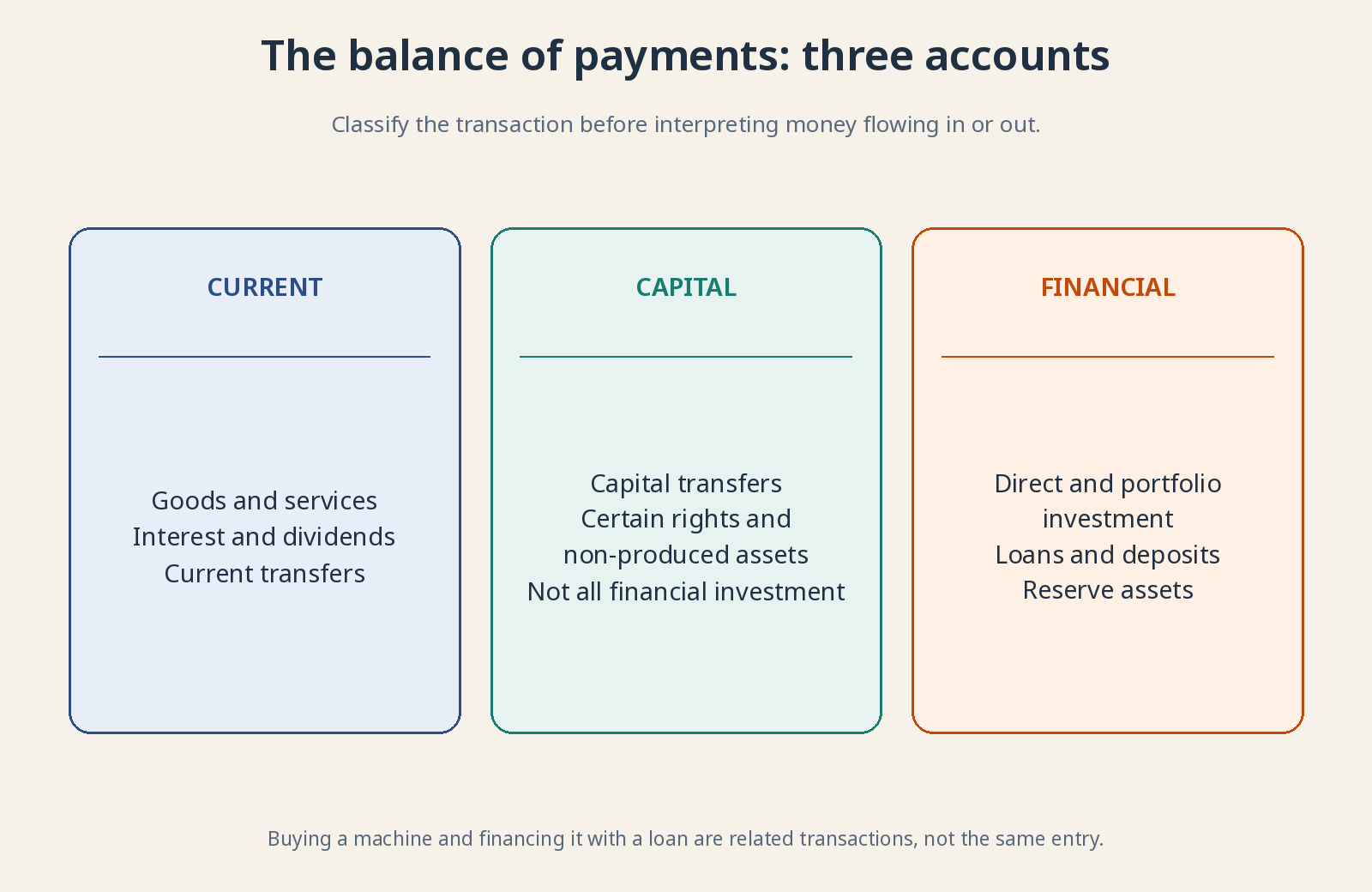
Transactions are recorded using double-entry principles. Statistical errors and omissions reconcile measurement gaps.
The other ledger: Assets and financing 📒
The capital account includes capital transfers, such as certain investment grants or debt forgiveness, and transactions in nonproduced, nonfinancial assets, including specified rights. No need to memorize the catalog. Just remember that not every international capital flow belongs here, and not all grants have the same classification.
The financial account records acquisitions of external financial assets and changes in liabilities to nonresidents. An asset is something owned or a claim to payment; a liability is an obligation. A foreign business acquiring a lasting interest and influence in a local company can generate direct investment. Foreign purchases of bonds or shares without that direct-investment relationship fall under portfolio investment.
Loans and deposits largely fall under other investment, alongside more specialized financial categories elsewhere in the account. These distinctions separate different behaviors. A factory cannot be dismantled as quickly as a fund can sell a bond. That doesn’t make every direct investment good or every portfolio investment dangerous. Purpose, maturity and conditions matter.
Return to the household notebooks. Earnings belong to regular income; borrowing changes liabilities; selling an investment changes asset composition; spending the proceeds can reduce wealth. Spending more than you earn can be financed by borrowing or selling assets. Economies have related counterparts, but the analogy has limits: a country combines millions of balance sheets and may issue its own currency. It isn’t one enormous family with one credit card.
Surpluses and deficits aren’t school grades ⚖️
A current-account surplus means current receipts from abroad exceed current payments abroad; a deficit means the reverse. A deficit alone doesn’t prove irresponsibility. It might reflect machinery imports building productive industry—or fragile foreign borrowing funding consumption and a housing bubble. Same sign, very different risk.
A surplus can reflect competitive exports and strong saving. It can also grow because households, firms and government cut spending so hard that imports collapse. Stop shopping because you lost your job and that spending balance improves; your life may not. An improving balance isn’t automatically improving well-being.
Ask why the imbalance exists, how persistent it is and how it is financed. Stable capital or debt maturing soon? Domestic- or foreign-currency obligations? Projects likely to generate enough income? Dollar borrowing against income in another currency adds a problem: a stronger dollar raises the local burden even when the dollar amount owed is unchanged.
Saving minus investment: The identity behind the headline 🧩
The saving–investment identity summarizes the link: current-account balance = national saving − domestic investment. An identity balances by definition; it doesn’t establish which variable causes which. National saving combines private and public saving using national disposable income. Investment means capital formation, including productive buildings, machinery and inventories—not buying an existing share.
In an invented example, saving of 80 and domestic investment of 100 produce a current-account deficit of 20. Abstracting from the capital account and statistical discrepancies, the counterpart is net external financing or a reduction in external assets. Saving of 120 with investment of 100 produces a surplus of 20: net acquisition of external assets or reduction in external liabilities.
Don’t conclude that stopping imports alone eliminates every problem. Import changes also affect prices, output, saving and investment. Nor does a government deficit automatically create an equal external deficit: private saving and investment can offset movements. Accounting equality describes the combined result. It isn’t a remote control with one button.
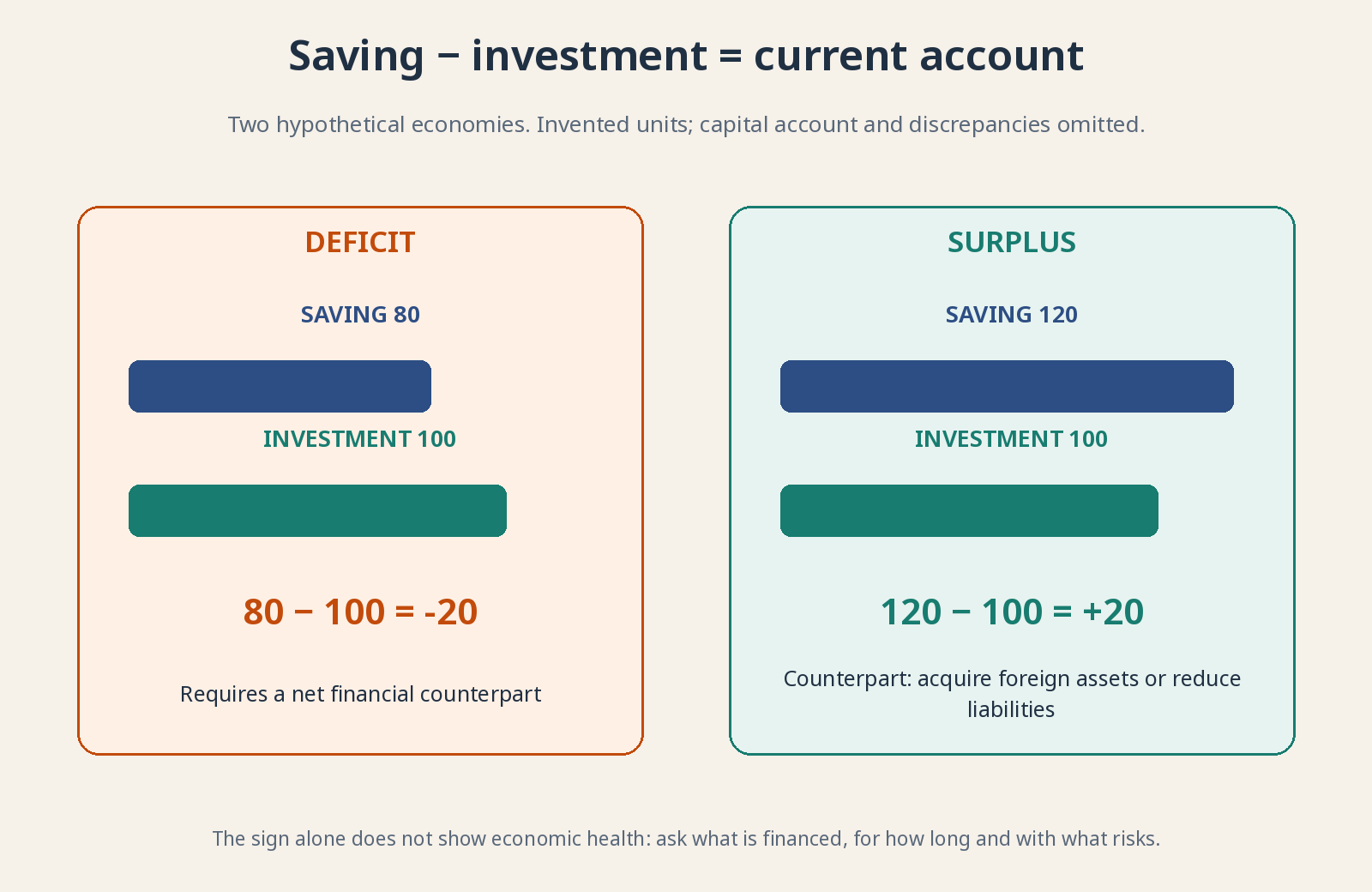
A surplus or deficit is not a moral grade. Financing structure and productive use matter.
How does the balance of payments balance if there’s a deficit? 🔄
The accounts balance because transactions use double-entry accounting. Import machinery and pay from an overseas deposit: record the import and the financial change. Use supplier credit instead and record a liability. Not every purchase requires a new loan; accumulated assets can also finance it.
Under the standard convention, current-account plus capital-account balances equal the financial-account balance, defined as net acquisition of financial assets minus net incurrence of liabilities, before statistical discrepancies. Some teaching diagrams reverse the financial sign and make the total zero. Read the convention before interpreting a negative figure. Real statistics also require errors and omissions to reconcile imperfect measurement of millions of transactions.
The international investment position is the snapshot of residents’ external financial assets and liabilities. The balance of payments is the transaction movie over a period. The snapshot also changes through asset-price and currency movements. Adding past deficits alone won’t reconstruct it exactly. Flows describe what happens during the year; stocks describe what is outstanding at a date.
Foreign-exchange reserves: The external first-aid kit 🧰
International reserve assets are external assets controlled by the monetary authority and available for external financing and intervention needs. They include foreign-currency assets and other components such as monetary gold. Foreign-exchange reserves, more narrowly, are the foreign-currency portion: deposits and liquid securities, not merely banknotes. These are distinct from commercial banks’ reserves at their central bank in module 2.
Why does this matter to you as an investor? 📈
Because a company can sell plenty while relying on foreign funding that disappears exactly when refinancing is due. Check where revenue comes from, which currencies debts are in and whether essential imports are needed. The balance of payments helps explain the environment. It doesn’t replace company accounts or turn surplus countries into a shopping list.
Finish with a useful question: if foreign financing became difficult tomorrow, who has room to maneuver and who needs to scramble? Separate this month’s shopping from the mortgage, flows from accumulated assets and the deficit from its financing. That small effort beats celebrating every surplus as though the country had won the league.
For further reading: Bank of Spain: Balance of payments and international investment position · Bank of Spain: Financial account and sign convention.