
6.2 Tariffs: How they work and why trade is controversial
If you build a fence at customs, who ends up paying for it?
“Make foreigners pay” is a slogan, not an economic explanation...
Let’s be honest: a tariff sounds wonderfully convenient. Tax goods coming from another country, protect your businesses and collect revenue. Three problems solved before coffee. The complications begin when your protected business uses foreign components, your consumer has fewer alternatives and the other country retaliates. Customs has an entrance, but the consequences escape through every window.
Today I want to discuss tariffs: taxes charged on goods crossing a border, normally when they are imported. They long predate the trade wars in today’s headlines. Customs duties were historically important sources of public revenue and protection for local activities. Now they coexist with trade agreements, international production chains and global rules. The tool is old; the kitchen has become more complicated.
The bill begins at customs 🧾
Imagine a Spanish shop importing a coffee machine. The importer must meet customs obligations and pay the applicable tariff, directly or through its representative. The foreign government does not receive a polite invoice asking it to cover the bill. Start with who legally pays; then ask who ultimately bears the economic cost.
The duty depends on the goods’ classification, origin and valuation rules. Customs value is the legally defined base for certain duties, not necessarily the final retail price. It may include specified transport or other adjustments. For a real shipment, guessing from the price tag is no substitute for identifying the correct customs treatment. Import VAT and a customs tariff are separate charges, even when the same shipment attracts both.
The EU is a customs union, with a common external tariff and goods circulating internally under the applicable conditions. Spain does not independently impose a general tariff on France. Origin rules also matter: an imported component does not necessarily acquire a new origin merely by passing through another country. Geography and legal origin are different questions.
Ad valorem, specific and compound: Three ways to calculate a tariff 🧮
Ad valorem means according to value: the tariff is a percentage of the customs base. In an invented example, a coffee machine with a customs value of €100 and a 10% duty creates a €10 charge. At a €200 base, the duty becomes €20. The amount varies with value rather than the number of boxes alone.
A specific tariff charges per physical unit, such as €2 per kilogram. Ten kilograms would attract €20 in this simplified example, whatever their price. The proportional burden is larger on cheaper goods: €2 on a €5 item is much heavier than €2 on a €50 item. A fixed charge does not create a fixed percentage effect.
A compound tariff combines a percentage with a fixed amount—for example, 5% plus €2 per unit. One unit with a €100 base would attract €7. Real schedules can add minima and special conditions. You don’t need a customs career to understand the mechanism, but you do need the actual schedule before pricing a real import.
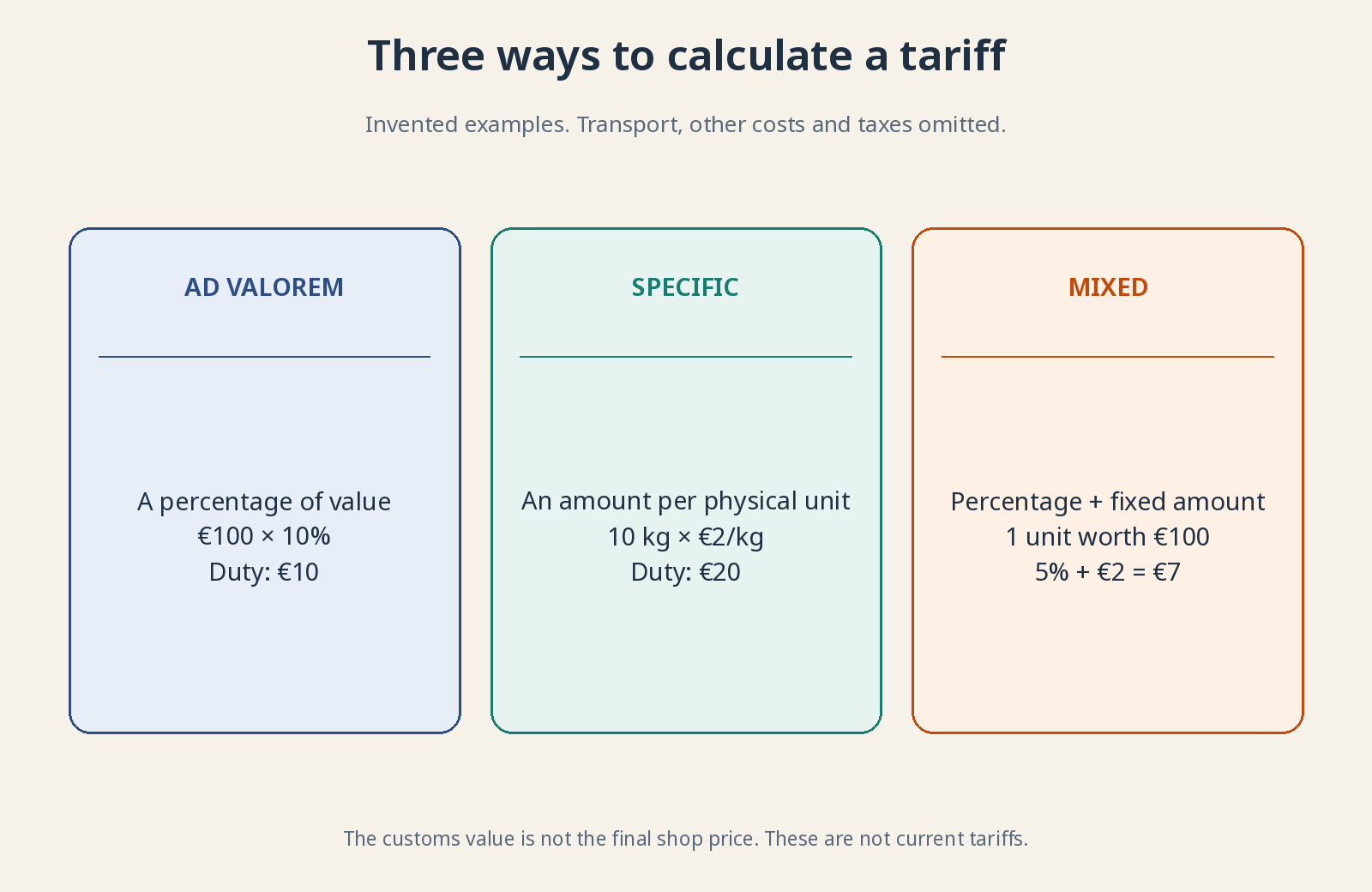
Customs value is not the final retail price. Other taxes, transport and costs are omitted.
Who hands over the money isn’t always who bears the cost 🤝
Economic incidence asks how a tax burden is ultimately shared. The importer pays at the border, but may raise selling prices. A foreign supplier may lower its price to retain business. Customers, distributors and suppliers can each absorb part. The legal payer and the person economically worse off need not be the same.
Suppose the supplier’s price is €100, ignoring other costs, and the duty adds €10. If the supplier does not discount and the shop cannot raise its selling price, the shop’s margin absorbs that €10. If customers accept higher prices, they bear part instead. Supplier discounts can shift another part abroad. Actual bargaining determines the split.
Price elasticity measures how strongly quantity demanded or supplied responds to price. If you can easily choose a different coffee machine, a price rise may send you elsewhere. If a production line requires one patented component, substitution may be harder. Alternatives help determine who can pass the cost on and who gets stuck with it.
Time matters enormously. A factory may be unable to change suppliers this week but redesign its process over several years. Supply chains—the stages linking raw materials and components to finished output—take time and money to reorganize. Short-run pain and long-run adjustment are not interchangeable, even if both eventually appear in the same policy debate.
Other fences: Quotas and barriers without a customs bill 🚧
A quota limits the quantity that may be imported. Scarce access can support higher prices, but the resulting gains need not become public revenue; permit allocation matters. A tariff-rate quota is different: a specified quantity receives one tariff treatment, often a reduced duty, and imports beyond it receive another. Quantity restrictions and taxes are related tools, not identical ones.
Non-tariff barriers include licensing, procedures, technical requirements and health rules that condition market access rather than simply imposing a border percentage. Some legitimately protect safety or the environment; others can obstruct trade unnecessarily. The presence of a rule alone tells you neither its justification nor its proportionality. Examine what it does and why.
Protectionism: What gets protected—and at what price? 🏭
Protectionism seeks to shield domestic activities from foreign competition. The infant-industry argument says a new sector may need time to learn, gain scale and compete with established producers. There is an economic argument to examine, but also a risk that temporary protection becomes permanent shelter from improvement. Ask how success and an eventual exit would be assessed.
Economic security provides another argument: dependence on one foreign supplier for medicines, energy or critical components can create vulnerability. Lowest cost this morning is not the only relevant objective. But total self-sufficiency and resilience are not synonyms. Diversified suppliers, stocks and other measures may address risk differently from a blanket tariff.
Trade remedies can address dumping or specified subsidies under legal procedures. Dumping compares export prices with a legally defined normal value; a cheap product is not by itself proof. Retaliation responds to another party’s measures to change its behavior, but can also hurt domestic firms that did not start the dispute. Investigation and legal rules matter more than the slogan.
Free trade: A bigger pie doesn’t guarantee a fair split 🍰
Free trade seeks fewer obstacles to exchange. Comparative advantage does not require being best at everything: specialization can help when activities differ in opportunity cost, the alternatives forgone. Trade can expand the total goods available. That aggregate gain does not guarantee every worker, place or business benefits automatically or equally.
A worker whose factory closes does not become an engineer in an exporting industry overnight. Skills, equipment and homes are tied to particular activities and places. Trade can improve the overall result while concentrating losses and adjustment costs. Recognizing both is more honest than pretending either the benefits or the disruption do not exist.
The serious debate asks how to support transitions, avoid dangerous dependencies and distribute costs. Neither “trade always harms workers” nor “every criticism of openness is ignorance” answers those questions. Protection also has beneficiaries and losers. Compare feasible alternatives and their consequences, not an idealized version of one system with only the failures of the other. Protecting one producer need not raise total employment if dearer inputs cause its industrial customers to cut back.
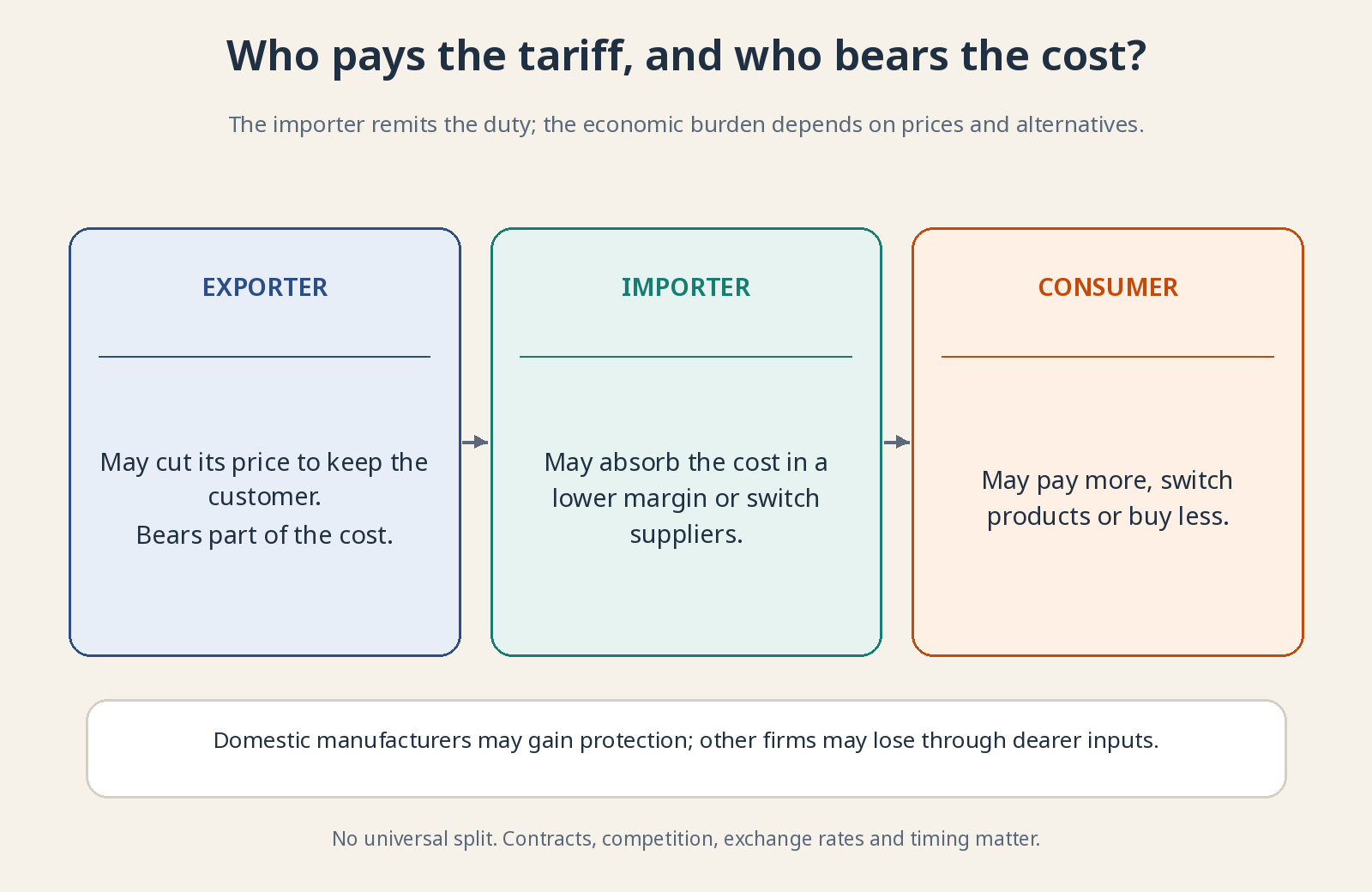
Bargaining power, competition, currencies and alternatives determine how costs spread.
Inflation, profits and retaliation: Several games at once 🌡️
A tariff can raise import prices and give domestic competitors room to raise theirs. It does not automatically raise the entire inflation rate by the same percentage. The consumer basket contains many goods and services; exchange rates, margins and substitution change the outcome. A one-off price-level increase also differs from continuing price acceleration.
Persistence depends on further measures and the responses of wages, expectations, businesses and monetary policy. A trade war can combine higher costs with weaker growth rather than the comfortable story of protecting jobs at no wider expense. Follow the supply chain and possible retaliation, including effects on firms using imported inputs to make exports.
US, Chinese and EU trade tensions have mixed industrial, technological and security concerns with tariff negotiations. The EU Council’s June 2026 announcement of rules implementing tariff commitments under the EU–US framework, including preferences and safeguards, provides a dated example. This illustrates negotiated, conditional treatment—not identical duties on every product. For a real shipment, verify the applicable law, product code and effective date rather than relying on an old headline.
Why does this matter to you as an investor? 📈
Because a company’s nationality doesn’t tell you where it produces, buys or sells. Before labeling it a “winner from protectionism,” inspect suppliers, customers, cost pass-through and the investment needed to reorganize production. Pricing power means raising prices without losing too many sales—not a chief executive announcing plans to do so.
Stress-test the story: what if a component costs more, the customer cuts orders and a competitor gets an exemption? No need to predict the next press release to ask those questions. A resilient business should withstand rule changes. A sensible investment plan shouldn’t require predicting every ministerial conversation. The flag on the packaging is no substitute for an income statement.
For further reading: Council of the EU: EU–US tariff commitments, June 2026 announcement.