
6.3 Foreign exchange (Forex) and currency wars
If the euro rises, why doesn’t everything rise along with it?
Exchanging currencies is an economic necessity. Gambling on them isn’t...
You’re booking a trip to the United States and discover that the same hotel costs more euros than it did a few months ago, even though its dollar price hasn’t moved. The receptionist doesn’t need to have anything against you. One currency’s price relative to another has changed. The same relationship affects manufacturers importing components, exporters collecting foreign revenue and your international investments.
Today I want to discuss the foreign-exchange market, also known as Forex. Its basic purpose is to enable payments, financing and risk management across economies using different currencies. It wasn’t invented so a retail trader could stare at six screens at three in the morning. Advertising may sell that movie. Businesses still need to exchange currencies even if nobody volunteers for the starring role.
An exchange rate is a price with two names 💱
An exchange rate expresses one currency’s price in another. In an invented example, EUR/USD = 1.10 means one euro buys US$1.10. The euro is the unit being priced; dollars express its price. If the quote rises to 1.20, each euro buys more dollars: the euro has appreciated against the dollar, which has depreciated against the euro.
A fall to 1.00 reverses the story. “The exchange rate rose” is incomplete unless you know the quotation convention. Express the price as euros per dollar and the numerical direction reverses. Two currencies cannot both strengthen against each other simultaneously, though both can strengthen against a third.
Your bank’s offered rate may differ from a news headline. It has buying and selling prices; the gap is the bid–ask spread. Fees may apply too. A reference quote doesn’t promise unlimited conversion at that price whenever you want. The shop-window display and the receipt don’t always match.
Spot: Trading now doesn’t mean settlement in one second ⏱️
Spot foreign exchange involves near-term delivery under the currency pair’s conventions. Many pairs normally settle two business days later, although exceptions exist. Settlement means completing the agreed currency deliveries, not deciding to trade. You can agree a price today while the actual exchange follows the market’s settlement calendar.
There is no single world currency exchange with one front door. Much trading is bilateral or occurs through platforms connecting intermediaries. This is an over-the-counter market, meaning outside a centralized exchange—not outside all rules. Regulation and customer protection depend on the instrument, intermediary and jurisdiction.
Forwards agree today on an exchange for a future date at a specified price. A business may use one to reduce uncertainty about future receipts rather than speculate. Forward pricing reflects factors including the currencies’ interest rates; it is not a free forecast of the future spot rate. This course is not a derivatives trading manual.
Who exchanges currencies—and why? 🏦
Banks convert currencies for customers and hedge exposures created by quoting prices. Businesses pay for materials, wages or acquisitions in foreign currencies. A European manufacturer owing dollars for machinery needs to obtain them. A hotel serving foreign visitors may be involved in currency conversions even while issuing its own bills in euros.
Funds and other institutional investors buy international assets and adjust currency exposure. Central banks manage reserves or intervene under their policy frameworks. Speculators participate too. The market brings together different needs; it isn’t a room where everyone is trying to predict the same chart candle.
Currency hedging aims to limit exchange-rate effects on a payment or investment. Think of agreeing a supply cost so you can budget—not buying insurance against every loss. Hedging can cost money, be incomplete and remove favorable as well as unfavorable currency effects. It also won’t fix a bad underlying investment. Hedging dollars doesn’t make a heavily indebted company healthy.
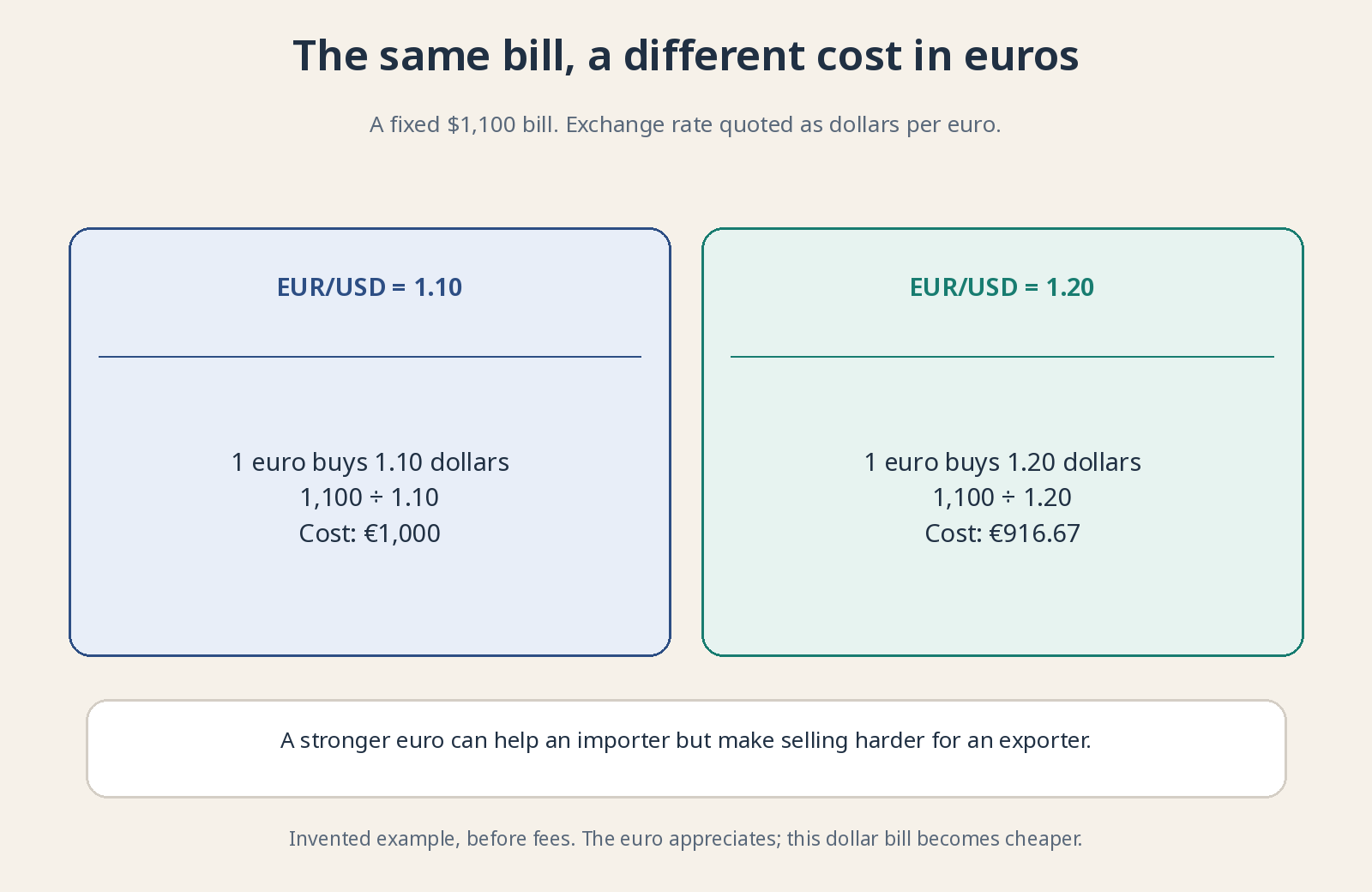
A stronger euro reduces this dollar bill—but can reduce translated returns on dollar assets.
Appreciation and depreciation: Different winners, even inside one company ⚖️
A stronger euro makes a fixed-dollar-price product cheaper in euros. That can help importers and reduce euro costs for dollar-invoiced energy. But an exporter maintaining its euro price becomes more expensive for US customers. Keep the dollar price unchanged instead, and translated sales bring in fewer euros. Same headline, different seats at the table.
A weaker euro can help some exporters while making imported components more expensive. A domestic manufacturer using foreign parts can gain competitiveness on one side and lose margin on the other. Margin is the share of revenue remaining after the relevant costs. A favorable exchange-rate headline doesn’t protect it automatically; contracts and hedges also matter.
A company collecting dollars and paying many dollar costs has a partial natural hedge: receipts and expenses offset some currency risk. This doesn’t eliminate everything or solve maturity mismatches. A business owing dollars while earning only local currency faces a heavier repayment burden when its local currency depreciates. No new borrowing is needed for the old debt to become harder to carry.
Your return needs translating too 🧮
Suppose you buy an investment worth US$1,100 at EUR/USD = 1.10. You spend €1,000 before costs and taxes. If its dollar price stays unchanged but the euro rises to US$1.20, that same US$1,100 is worth about €916.67. The local asset price hasn’t fallen; your euro value has. A weaker euro can make the translation work in your favor instead.
When both the asset and currency move, return factors compound: they multiply rather than simply add. Also look beyond the currency shown beside a fund or share price. Underlying businesses may sell and produce in many countries. Trading currency and economic exposure aren’t identical. Buying an investment quoted in euros doesn’t erase international currency risk.
Nominal vs. real: A new price tag doesn’t transform competitiveness 🛒
The nominal exchange rate is the currency price we just used. A real exchange rate adjusts it for the compared economies’ price levels. It asks how much one country’s basket costs relative to another after converting currencies. This separates the monetary unit from what it buys. It is not a second counter where you exchange banknotes.
Conceptually, a currency decline can initially make domestic production cheaper for foreigners. But sharply rising domestic costs and prices can erode that advantage. Nominal depreciation doesn’t guarantee a lasting real improvement. Real effective exchange-rate indices extend the comparison across several trading partners, weighted by their importance, rather than only the euro–dollar pair.
Index conventions differ. Before celebrating a falling real exchange-rate index, check whether that source defines the movement as appreciation or depreciation. Competitiveness also includes quality, reliability, productivity and service. You can cheapen a currency; you cannot manufacture industrial trust by pressing the same button.
Currency wars: Trying to sell more with a cheaper currency 🥊
Strictly speaking, devaluation is an official reduction in a currency’s value under a fixed or managed exchange-rate arrangement. Depreciation describes a fall in value, commonly under floating exchange rates. Headlines mix the terms. A currency war means attempts to gain advantage through competitive weakening, potentially provoking responses abroad. It doesn’t mean every currency decline.
A government may want stronger exports and more expensive imports to shift demand toward domestic production. Monetary authorities can buy foreign assets or pursue policies affecting exchange rates. But a rate cut intended to fight recession doesn’t itself prove an attempt to hurt trading partners. Claims of manipulation need objectives, instruments and context—not just a downward red arrow.
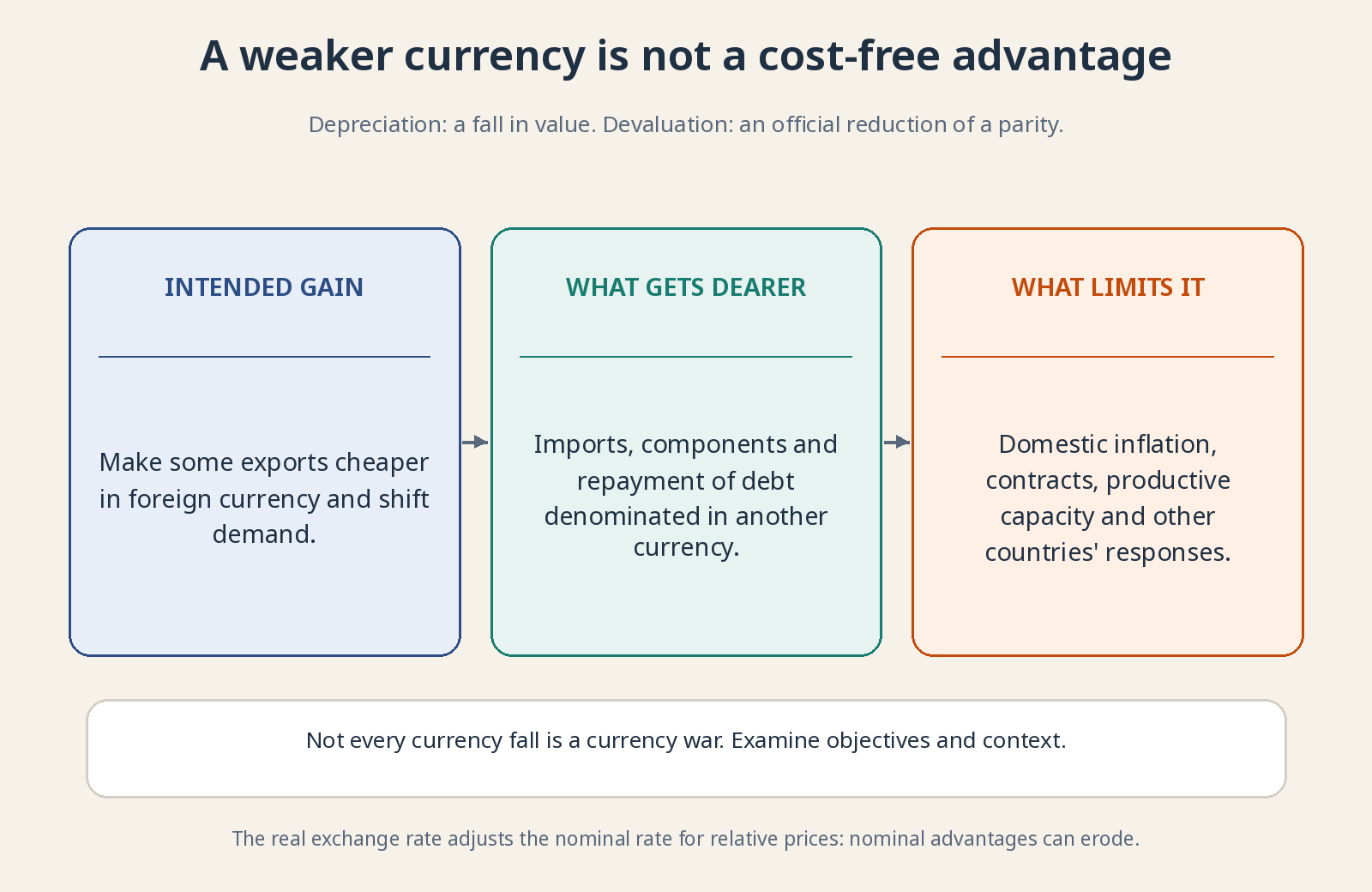
Explain the mechanism; do not confuse it with a strategy for leveraged retail Forex or CFDs.
Risks include imported inflation, lost confidence, capital outflows and heavier foreign-currency debt burdens. Exports may respond slowly because of existing contracts, capacity constraints and imported-input needs. If every country tries to weaken against everyone else, they cannot all succeed simultaneously. Competition can end in trade retaliation and greater uncertainty.
Leveraged retail Forex is not patient investing 🚫
Leverage lets you control an exposure larger than your own contribution, through borrowing or instruments reproducing that effect. Small adverse moves are magnified. A CFD, contract for difference, settles price changes without necessarily giving you ownership of the currency or asset. Costs, financing charges and forced closeouts can worsen losses. This is not the same as converting euros to pay for a holiday.
Don’t confuse holding diversified productive assets for years with betting on short-term currency moves. Exchanging currencies doesn’t itself generate a company’s operating profits or equivalent business reinvestment. Leveraged retail Forex is high-risk speculation, not a shortcut to compound interest. We won’t teach intraday entries or hunt for a supposedly prudent leverage multiplier. Personal leverage is a clear red line here.
Why does this matter to you as an investor? 📈
Because your companies, future expenses and portfolio may operate in different currencies. Identify where cash is collected, where costs are paid and the currencies of obligations. Understanding the crossings helps interpret results and risks without becoming a currency trader. You don’t need a bet on the euro to understand why a business earned fewer euros.
Keep three questions: how is the rate quoted, who gains or loses from the move, and which part of the exposure is genuinely offset? Then return to your plan’s horizon. Currency is one piece of the board—not an invitation to abandon the long game and chase every move.