
Dollar hegemony, the petrodollar and dedollarization
Does the dollar dominate because of oil—or because the world speaks its language?
Replacing a dominant currency isn’t like changing your Wi-Fi password...
Let’s be honest: “the end of the dollar” ages remarkably well as a headline for people who keep publishing it. Sometimes it points to genuine changes. Sometimes it bundles an oil sale, a diplomatic meeting and a prediction of universal collapse into one story. To understand what is changing, separate a currency’s functions. Buying, borrowing, saving and keeping accounts aren’t quite the same thing.
Today I want to discuss dollar hegemony: its predominant role in several international financial and commercial functions. This doesn’t mean the entire planet uses only dollars, or that the exchange rate must always rise. A currency can remain central to payments and financing while losing value against the euro. Dominance of use and the return on a currency bet are different questions.
Reserve currencies: A usable store of assets, not a medal 🏦
A reserve currency is one in which monetary authorities hold foreign assets for payment needs, confidence and intervention. That need not mean warehouses full of banknotes. Holdings can include deposits and securities. A reserve asset must be usable when needed; international status is not a medal awarded for having a large economy. The dollar is important in official portfolios, but the euro and other currencies also serve reserve roles.
Businesses and banks also want assets with which to settle obligations, transact and hold funds. US Treasuries, government debt securities, matter because their market provides a large pool of dollar-denominated claims. The dollar’s role involves both the currency used for payments and the financial assets available to hold between those payments.
Market depth means capacity to absorb substantial trades without disproportionate price changes. Liquidity means buying or selling quickly at reasonable cost. They are connected: emergency access to usable funds matters to a reserve manager. A valuable asset that takes months to sell is a poor match for a payment due tomorrow.
Bretton Woods: How the dollar took center stage 🕰️
The 1944 Bretton Woods agreements designed a postwar international monetary system. Many currencies maintained exchange parities against the dollar, and the US offered official gold conversion to foreign monetary authorities at the specified price. Parity was a managed exchange relationship, not a guarantee that anyone anywhere could redeem every dollar freely for metal.
US productive capacity and financial strength helped support that anchor. In 1971 the US suspended official dollar–gold convertibility; the wider fixed-exchange-rate system subsequently broke down. Today’s dollar is fiat money, as lesson 2.1 explains, not an ordinary promise to deliver gold. Its international role survived the end of that promise.
That survival is the interesting part. Contracts, deposits, intermediaries and conventions already used dollars extensively. The network continued after gold conversion ended. So gold alone cannot explain continuing dollar use—and neither can oil alone. A functioning financial ecosystem is harder to replace than a single pricing convention.
Network effects: Using what everyone else already uses 🔗
A network effect makes something more useful as more people use it. If suppliers, banks and customers invoice and borrow in dollars, using dollars reduces conversion steps and helps find counterparties. Two companies outside the US can choose dollars because both can transact in them readily. Convenience reinforces existing use.
The process feeds on itself: invoicing creates payment needs, payments support deposits and financing, financing creates demand for dollar assets, and those assets facilitate more transactions. Hedging markets add support. To hedge is to reduce a specified exposure through an offsetting position; it does not mean eliminating every risk or guaranteeing a profit.
Institutional confidence, capital mobility and a supply of relatively safe assets matter too. Relatively safe does not mean invulnerable. Treasury prices can fall when yields rise, and inflation can reduce purchasing power. Distinguish confidence in eventual nominal repayment from a guarantee of stable market price or real value. If you measure your spending in euros, dollar exposure also creates exchange-rate risk. Reserve-currency status does not guarantee a positive euro return.
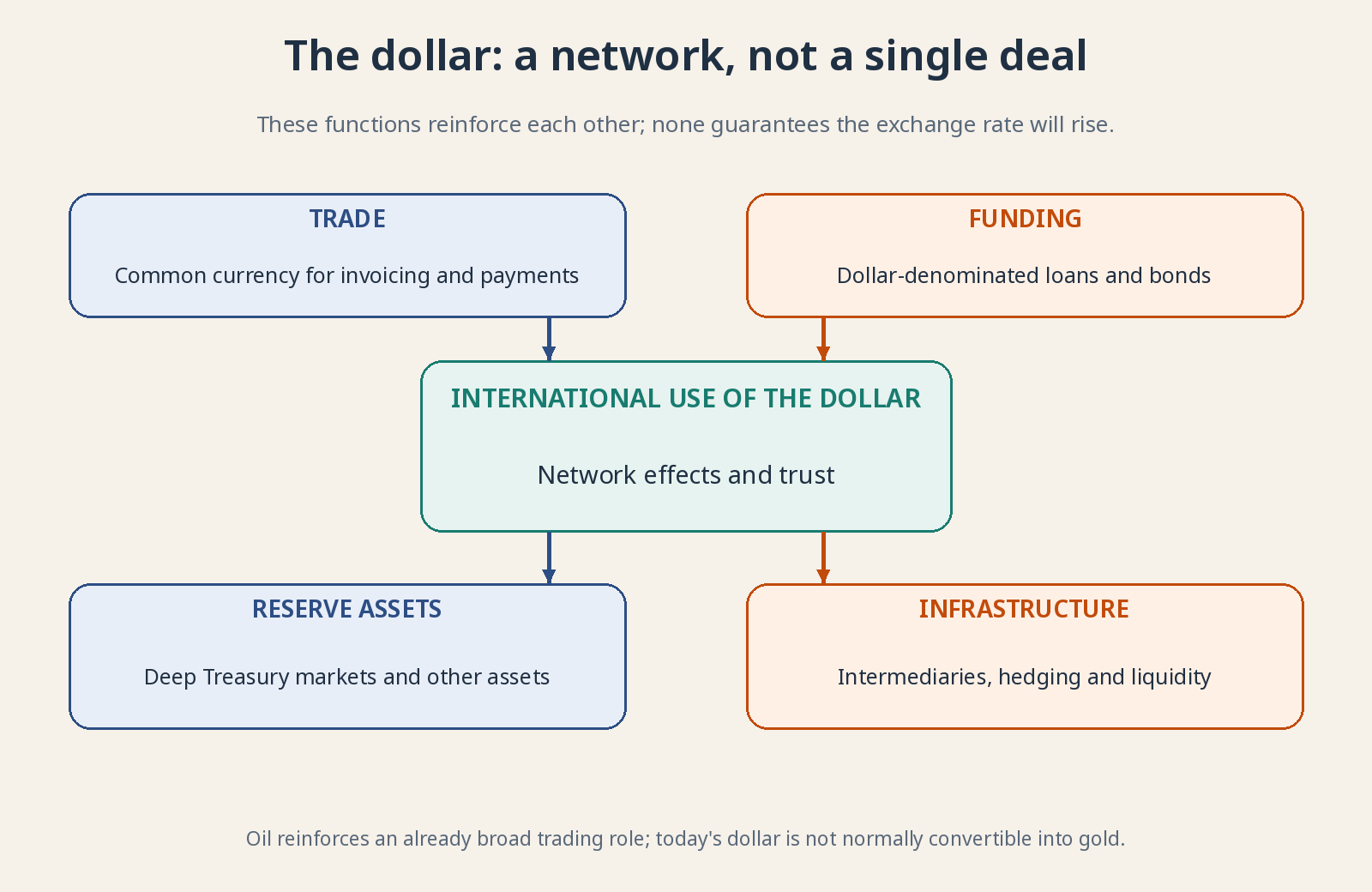
Oil is part of the network—not its only foundation and not physical backing for dollar banknotes.
The petrodollar: What it means—and what it doesn’t 🛢️
A petrodollar usually means a dollar earned from oil exports. The petrodollar system refers more broadly to dollar invoicing of much oil trade and the subsequent financial use of the proceeds. It is not a separate currency, a gold substitute or a special kind of banknote available only to oil producers.
Separate the invoicing currency, in which the price is quoted, from the settlement currency used to pay and the currency in which the seller later saves. An exporter can use a dollar reference, accept another currency and reinvest elsewhere. One transaction may therefore involve several distinct currency decisions.
Petrodollar recycling describes oil exporters reinvesting receipts through banks, loans, bonds and other assets. It became particularly significant after the oil-price increases of the 1970s. Revenue did not simply remain in a vault; it entered financial channels. The important questions are which claims were acquired and where financing flowed afterward.
Real history is less convenient than a magic agreement 📜
The US and Saudi Arabia developed economic and financial cooperation in the 1970s within a broader geopolitical relationship. That is relevant context for oil and the investment of export proceeds. It does not justify explaining global dollar demand through a magical agreement forcing every oil transaction everywhere into one currency.
A 2024 story claimed a supposed fifty-year oil pact had expired. The AFP fact-check cited in the source, drawing partly on official US documentation, explained that the cooperation agreement did not establish the claimed universal obligation or expiry. The lesson is not that strategic agreements never exist. It is to read the actual document before building an entire monetary theory on a headline.
An oil sale settled in another currency deserves context: size, repetition and contractual arrangements. It does not show that all oil has abandoned dollars or that the buyer no longer needs dollars to service debt. One visible transaction can be interesting without representing the whole system. Scale and function determine its significance.
Dedollarization: Several stories hiding inside one word 🔍
Dedollarization means reducing dollar use or dependence in a specified role. It can involve diversifying official reserves, invoicing bilateral trade in local currencies, issuing debt differently or building alternative payment channels. These are related but separate changes. Progress in one does not establish equal progress in all the others.
Motives can include lower conversion costs, fewer currency mismatches, diversification or reduced sanctions exposure. Financial sanctions are legal restrictions that can limit transactions and access to assets. They can encourage alternatives without making those alternatives easy to build. The incentives to change and the infrastructure available for change are different questions.
The euro has a large economy and important markets behind it, but public debt is spread among different issuers rather than one equivalent Treasury market. China’s renminbi is supported by a major trading economy, while capital controls and other restrictions affect international use. Naming a rival currency does not explain which assets thousands of institutions can readily buy with it.
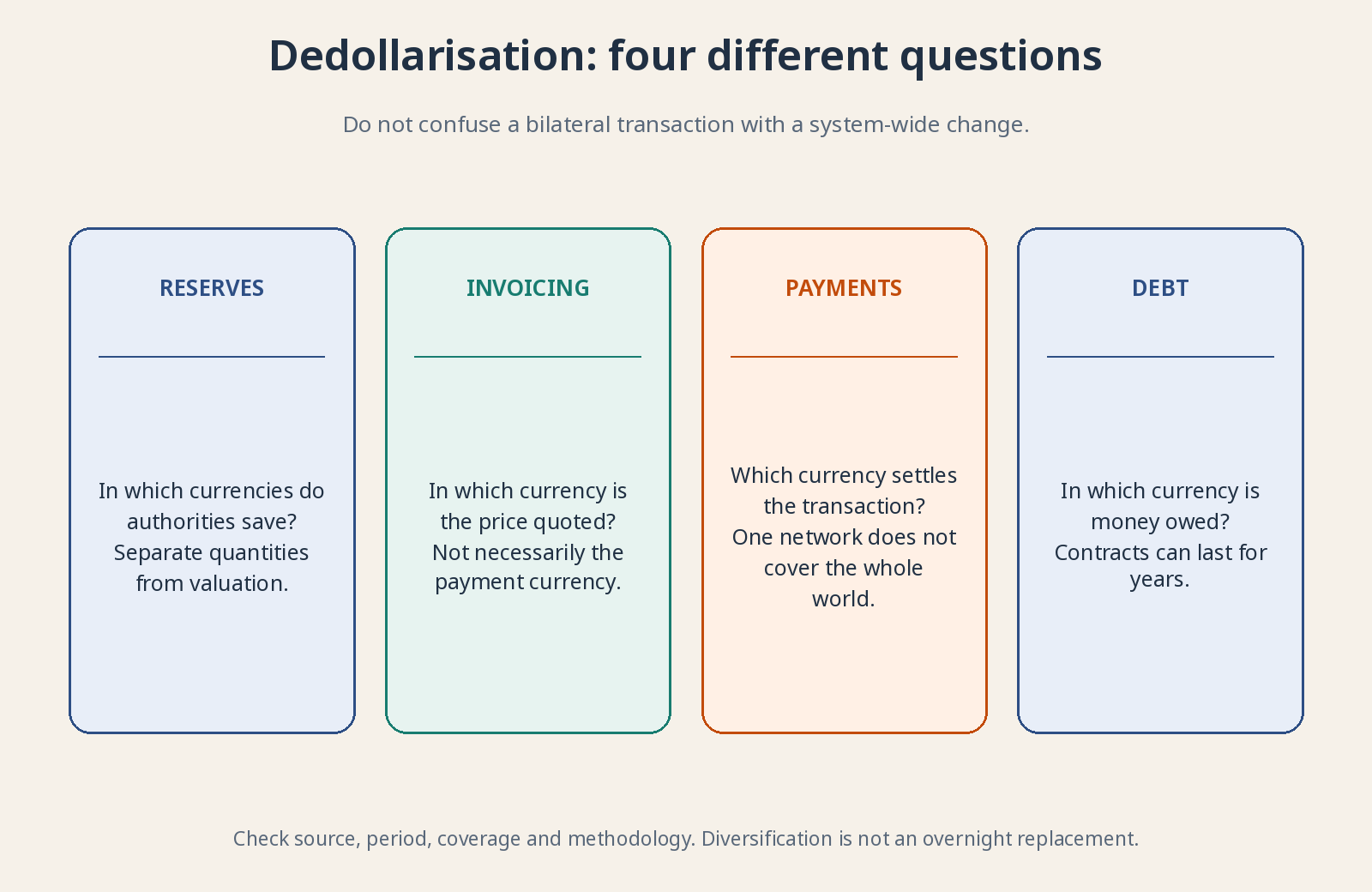
Check coverage, exchange-rate valuation and time period before declaring the end of a monetary system.
What to watch without confusing a falling share with a collapse 📊
For reserves, COFER is the IMF’s data set on the currency composition of foreign-exchange reserves. A currency share can fall because other holdings grow faster, portfolio valuations change or actual sales occur. A lower percentage alone does not identify the cause or prove an equivalent decline in the absolute amount held. COFER covers foreign-exchange reserves, not gold; changes in gold’s price and physical holdings require separate analysis.
The Bank for International Settlements, BIS, publishes international banking and foreign-exchange statistics. Payment discussions also cite SWIFT financial messages, which do not capture every transaction worldwide. A message, an invoice and a loan are different units. Treating their currency shares as if they came from one identical survey creates a misleading comparison.
As a dated reference, the Fed study published in July 2025 documented long-run reserve diversification alongside continuing dollar predominance in several functions. Its authors noted data lags when assessing that year’s developments. This is not a live measurement for November 2026. Updating the picture requires checking the publication date, observation period and methodology.
Why does this matter to you as an investor? 📈
Because the dollar links commodity prices, financing and company results well beyond the United States. A company receiving local currency while owing dollars can suffer without ever selling in America. A multinational can feel translated profits change. A euro-quoted portfolio can have economic dollar exposure even if no dollar symbol appears on your statement.
Don’t conclude either “the dollar can never fall” or “get out before its end.” Both turn institutional analysis into a binary bet. Review the currencies of your obligations and businesses, avoid concentrations you don’t understand and distinguish structural change from a weekly headline. Understanding a network reveals dependencies. It doesn’t date the next monetary empire’s demise.
For further reading: Federal Reserve: The International Role of the U.S. Dollar, July 2025 edition and data limitations · AFP: fact-check of the alleged fifty-year oil pact.