
3.4 Extreme scenarios: Deflation, stagflation and hyperinflation
What if prices fall too far—or stop making sense altogether?
Deflation, stagflation and hyperinflation: Three different breakdowns, not three names for the same crisis.
Let’s be honest: after months of rising bills, “prices are falling” sounds like a paid holiday. A cheaper individual product can indeed be excellent news. Trouble starts when prices fall broadly because sales, incomes and jobs are collapsing, while the debts keep arriving as reliably as the building’s maintenance bill.
Today I want to discuss three extreme scenarios: deflation, stagflation and hyperinflation. They aren’t compulsory stages on a calendar or inevitable destinations after one bad data release. Each describes a different combination of prices, activity and confidence. Understanding the differences keeps you from prescribing the same medicine for opposite illnesses.
Deflation: Not the January sales 🧊
Deflation is a broad, persistent fall in the price level. One cheaper television, a shop sale or a month of lower energy prices is not enough. Disinflation means prices are still rising, but more slowly. Lesson 3.2 separated those ideas; here the distinction changes the economic problem, not just the vocabulary.
Productivity improvements can make goods cheaper while increasing availability and real income. That differs from prices falling because demand has collapsed. Ask why the decline is happening: are we producing more efficiently, or have customers lost the income and confidence to buy? The same direction of prices can conceal very different conditions.
In a severe contraction, households cut purchases, firms sell less and investment and hiring weaken. Expected further price falls can encourage postponing purchases that are easy to delay. People don’t stop eating because bread may be cheaper next month; a car or expensive equipment is a different decision. Falling income and spending can reinforce each other.
The debt trap: You owe the same amount, but earning it gets harder 🪤
Many debts are fixed in nominal terms: the amount written in the contract. Owing €10,000 does not automatically become a smaller principal because prices fall. If sales receipts or wages decline, meeting the same payment becomes harder. The real burden rises relative to what the borrower earns or can sell.
Take a shop owing €10,000. At €10 per item, that principal equals revenue from 1,000 sales, before any costs. At €8, it requires 1,250 sales. This is a revenue illustration, not a profit calculation. If demand also weakens, the borrower must sell more units just when finding buyers is harder.
Irving Fisher’s debt-deflation mechanism describes a feedback loop. Borrowers cut spending and sell assets to repay; those actions depress income and prices; the remaining debt becomes harder to carry; defaults and distress increase. It requires vulnerabilities and transmission channels. Not every fall in an individual price starts a debt-deflation spiral.
Banks are exposed too. Borrowers lose income, collateral values can fall and credit losses increase. Banks respond by tightening lending, adding pressure to spending. The banking-crisis anatomy in lesson 2.5 connects directly: one borrower’s trouble can reduce another’s financing. Balance sheets link the participants rather than keeping their problems in separate rooms.
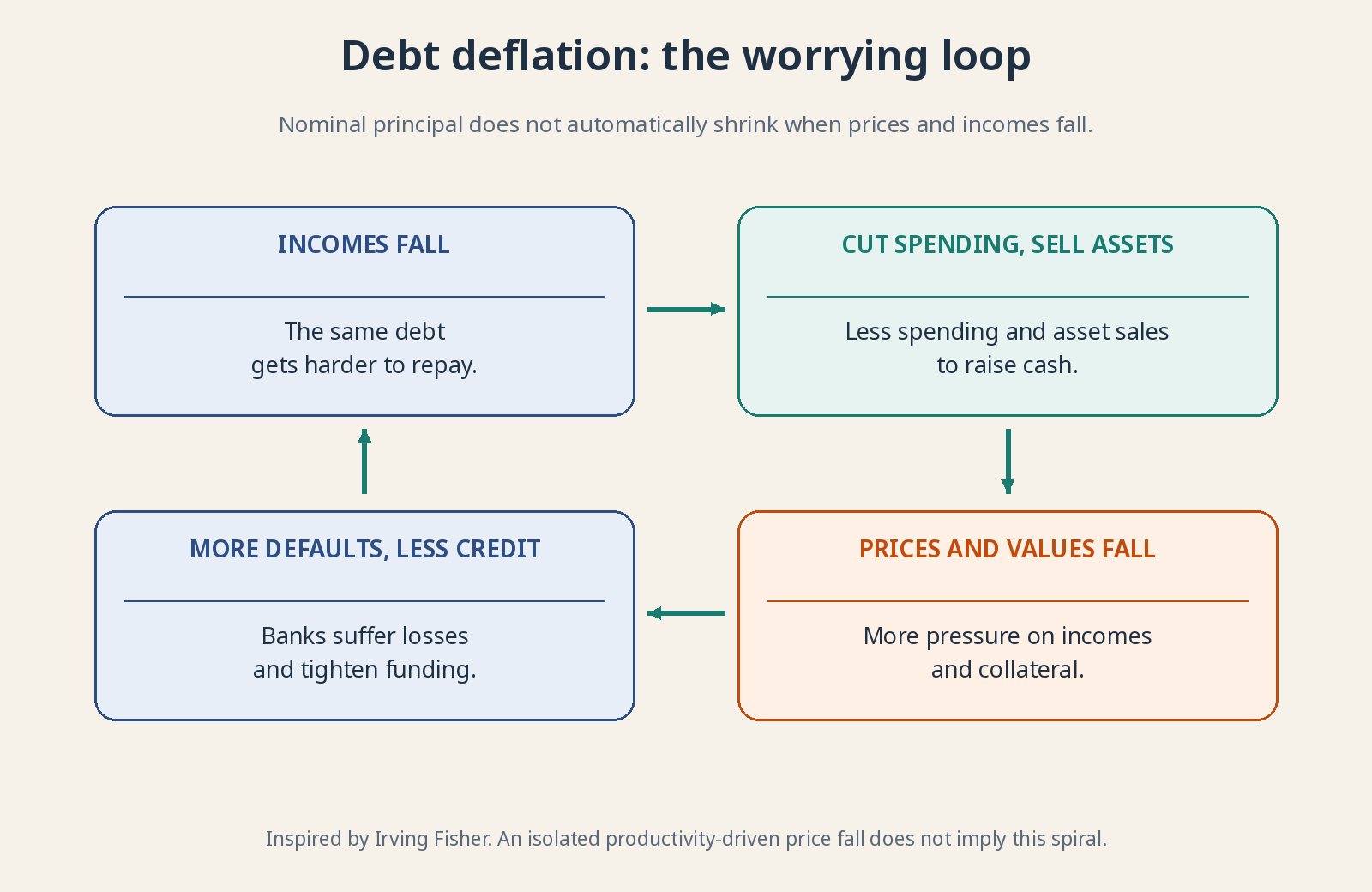
Diagram inspired by Irving Fisher’s debt-deflation framework. Not every price decline starts this spiral. Debt fragility and transmission mechanisms matter.
Why escape is difficult: Low rates may not release the brake 🏦
A near-zero nominal rate need not mean cheap borrowing in real terms. Roughly, the real rate equals the nominal rate minus expected inflation. Negative expected inflation can leave the real rate positive even when the nominal rate is very low. Falling borrower income adds another difficulty. The advertised rate is not the whole repayment burden.
Central banks can cut rates and provide liquidity, but cannot force frightened households to borrow or make every project viable. The Great Depression is the classic historical combination of collapsing activity, deflation and banking stress. Understanding the interaction is more useful than assuming that one low policy rate must immediately restart spending.
Stagflation: The engine stalls while fuel gets more expensive 🛢️
Stagflation combines stagnant or weak activity with high inflation, often alongside labor-market difficulties. The name joins stagnation and inflation. There is no single universal decimal threshold that makes diagnosis effortless. Its importance lies in the uncomfortable combination: households face higher bills without a strong economy providing relief.
An adverse supply shock illustrates the mechanism. If essential energy becomes scarce or expensive, production and transport cost more. Firms may raise prices while reducing output and hiring. The same shock pushes the price level upward and activity downward. This is not simply too many enthusiastic shoppers bidding for existing goods.
The 1970s provide the familiar historical example. Oil shocks contributed to stagflation in several economies, alongside monetary decisions, expectations and wage-setting arrangements. Oil mattered, but it was not a complete explanation of every country’s experience. A helpful historical analogy still needs its differences and institutional context.
This undermines the simple claim that accepting more inflation always purchases lower unemployment. An essential input shock can worsen both. Expectations and supply conditions shift the relationship represented by the Phillips curve, as lesson 4.4 explains. There is no permanent menu from which policymakers select any comfortable combination they like.
Two pedals pulling in awkwardly different directions ⚖️
Raising interest rates to contain inflation can further weaken spending and employment. Easing to support activity can risk more persistent price pressure. The trade-off depends on the shock and how expectations respond. Calling one pedal the obvious solution ignores what the other part of the engine is doing.
Fiscal policy can protect vulnerable households or support productive capacity, but the design and funding matter. Temporary targeted help differs from indefinitely subsidizing everyone’s consumption. Support can ease hardship without removing the underlying scarcity. Ask who receives it, what incentives remain and how the public cost is financed.
Hyperinflation: Holding the currency becomes a race against time 🔥
Hyperinflation is not merely inflation you consider annoyingly high. It is extreme price acceleration that seriously disrupts money’s roles as a reference unit and store of purchasing power. Research uses quantitative conventions to classify episodes, but understanding the institutional breakdown matters more here than memorizing a threshold and diagnosing it from one release.
Episodes often combine productive disruption, fiscal crisis, persistent monetary financing and collapsing confidence. Monetary financing means creating money to support public obligations; it is not synonymous with every central-bank transaction. The mechanism depends on how spending, production, money demand and trust interact, not simply the size of one balance-sheet row. If production and tax revenue shrink while obligations are increasingly financed through issuance, the pressure can intensify; a flight from holding the currency adds to it.
Weimar Germany, Zimbabwe and Venezuela are well-known examples with very different political, productive and external settings. They should not be compressed into one slogan or illustrated with an undated spectacular number. What they share is an extreme failure of monetary stability; the path into that failure must still be explained case by case.
In Weimar Germany, wartime financing and subsequent fiscal difficulties interacted with increasing reliance on the central bank and an inadequate goods supply relative to monetary expansion. The episode cannot be explained as an isolated rise in one commodity price. Public financing, production and confidence reinforced one another.
Zimbabwe combined lost productive capacity with severe fiscal imbalances and money creation, including central-bank activities resembling public expenditure. In Venezuela, oil dependence, declining production and revenue, and monetary deficit financing help explain the process. These are important mechanisms, not complete histories or evidence that every ordinary government deficit ends in hyperinflation.
People shorten contracts, spend receipts quickly or seek alternative reference currencies and assets. That flight makes ordinary business and public administration harder. The damage is not simply expensive coffee. Pricing, saving, planning and meeting obligations become unstable when nobody trusts the unit in which promises are written. Owning shares or real assets does not automatically protect you against controls, market closures or collapsing activity.
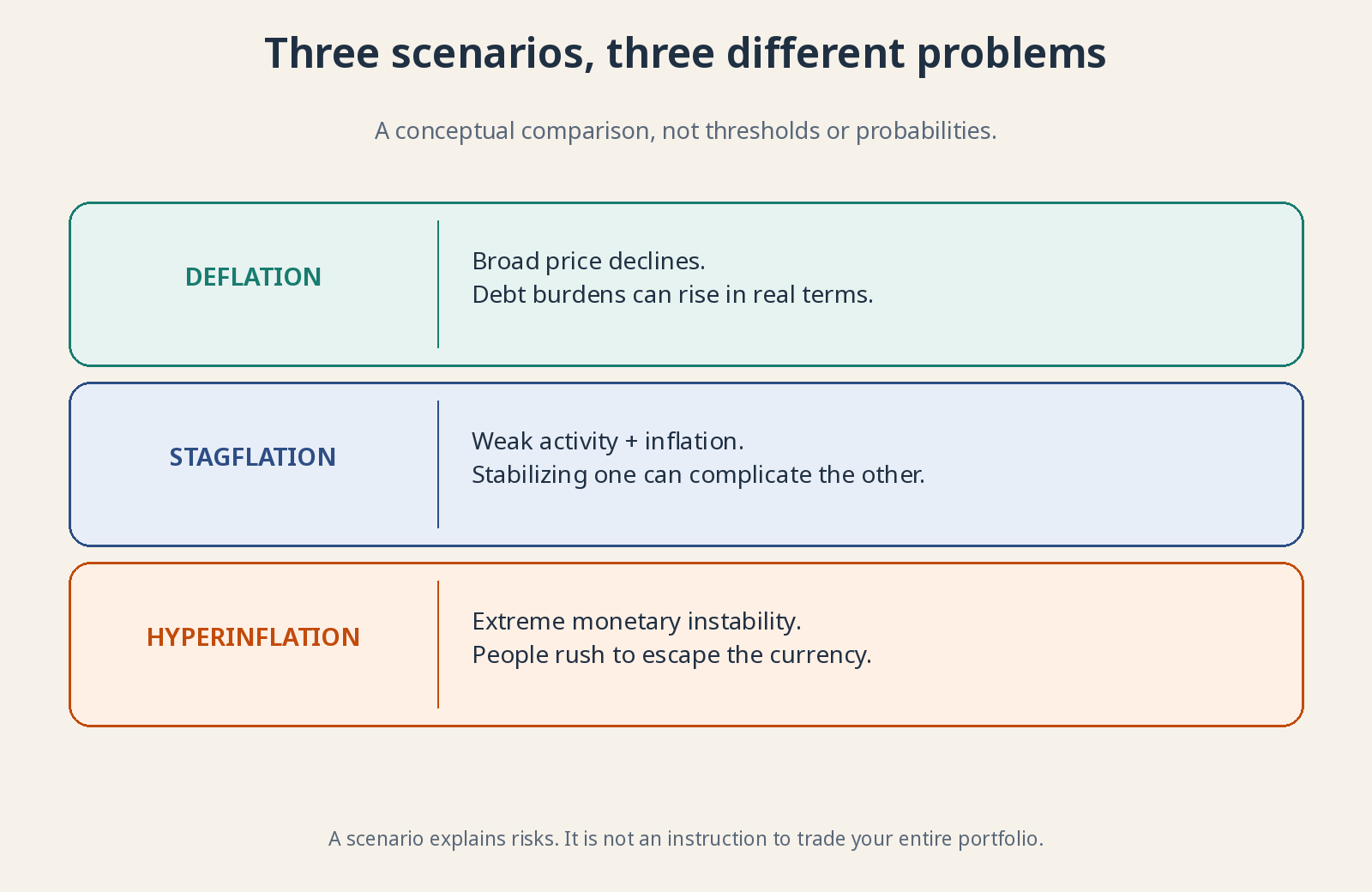
A scenario explains risks. It is not an instruction to trade your entire portfolio.
An economic scenario is not a portfolio trading instruction 🧭
One monthly price decline does not prove a depression. Weak growth plus an inflation rebound does not guarantee another 1970s, and a larger central-bank balance sheet does not establish hyperinflation. Examine persistence, breadth, production, credit and institutions together. Scenarios are diagnostic tools, not headlines to turn directly into an all-or-nothing portfolio bet.
Nor does inflation automatically benefit every borrower. Fixed versus floating rates, debt currency, maturity and the path of income and interest costs matter. Inflation can reduce a fixed nominal claim’s real value while refinancing becomes more expensive or foreign-currency debt harder to repay. “Debt wins” is too simple to describe that balance sheet.
Why does this matter to you as an investor? 📈
Because business resilience depends on the interaction of sales, prices, costs and debt. In deflation, obligations may not shrink with income. In stagflation, costs rise while customers buy less. In hyperinflation, the framework for receiving payments, paying bills and storing value can itself break down. Different risks—not a list of guaranteed winning assets.
Examine liquidity, maturities, customer retention and currency exposure. Don’t turn fear into an excuse for leverage or betting everything on an extreme scenario. Understanding these breakdowns should help identify fragility and build a more cautious long-term view—not predict tomorrow’s headline.
For further reading: Federal Reserve: the Great Depression · Federal Reserve: high inflation and its causes · Fisher: debt deflation · Bundesbank: German hyperinflation.