
Practical analysis: QE/QT, central-bank balance sheets and markets
The central bank’s balance sheet got bigger. Now open it before drawing conclusions
Buying bonds, lending to banks and revaluing gold don’t tell the same story...
Lesson 4.2 explained QE and QT: net asset purchases and portfolio reductions that change the size and composition of a central bank’s balance sheet. We won’t repeat the manual here. We’ll open the hood and see where those decisions appear in the accounts. Looking only at the total makes it remarkably easy to confuse a running engine with a larger spare tire.
Let’s be honest: “the Fed is printing” and “the ECB is withdrawing liquidity” are convenient phrases, but they don’t tell you who bought what, which liability changed or which risk moved. We’ll use invented balance sheets, expressed in units, to learn the mechanics. Then we’ll take the questions to real reports—without imagining a machine that turns reserves into automatic stock-market gains.
Two sides and one equality: The basic snapshot 📒
Assets are what an institution owns and its claims to future payments. A central bank’s assets may include government debt, loans to banks and foreign assets. The Fed also holds MBS, mortgage-backed securities: instruments with payments linked to pools of mortgages. Its portfolio includes securities backed or guaranteed by specified US agencies and institutions. These are not mortgages the Fed personally granted to your neighbor.
Liabilities are its obligations. Reserves are banks’ balances at the central bank. Banknotes are liabilities too, although they no longer promise conversion into gold. Treasury deposits and temporary cash-absorption operations can also appear. Equity completes the equation: assets = liabilities + equity. Reserves are not that equity, or a commercial bank’s loss-absorbing capital buffer.
Lesson 2.2 explained why a commercial bank’s balance sheet grows when it creates a loan and deposit. Here we are studying another institution and different assets. Similar words don’t make your deposit and your bank’s reserves entries on the same balance sheet. That distinction supports the entire exercise.
Step one: A starting balance sheet that actually balances 🧮
Suppose a central bank has 100 units of assets: government bonds of 80 and loans to banks of 20. The other side contains reserves of 50, banknotes of 40, a Treasury deposit of 5 and equity of 5. Add them up: 100 on each side. We have omitted many real-world items, but not the equality. If one side grows and the other doesn’t, an entry is missing—or you haven’t explained what declined elsewhere.
You aren’t measuring wealth created for society. You’re locating claims and obligations. The bond is a liability for its issuer; reserve liabilities are assets for the banks holding them. Studying one balance sheet alone can hide what happened on the others. Monetary analysis follows both ends of the transaction, not just the number of zeros.
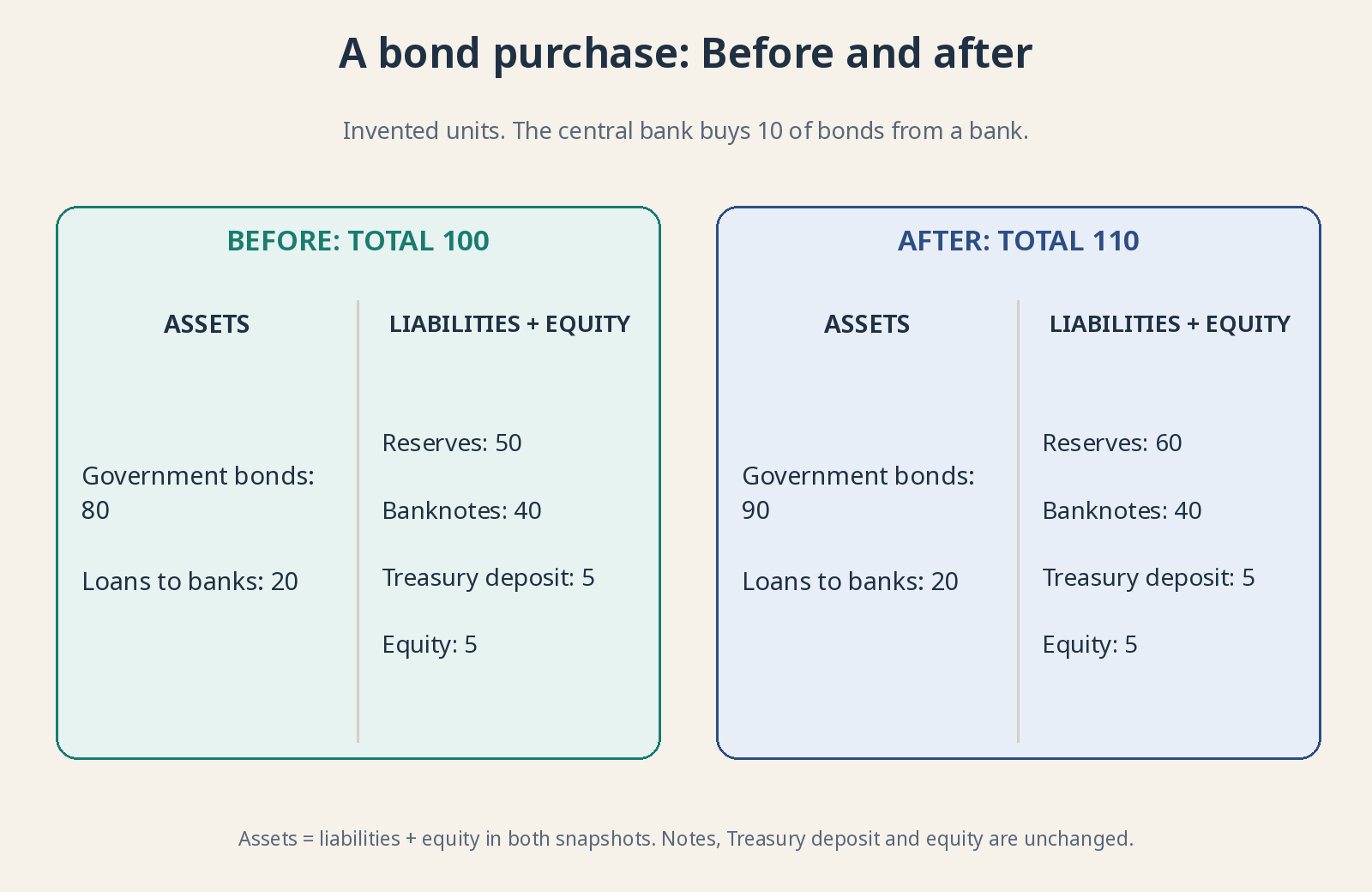
Assets = liabilities + equity in both snapshots. Notes, Treasury deposit and equity are unchanged.
Step two: Bond purchases and the matching reserves 🔄
The central bank buys 10 units of government bonds from a bank. Bond assets rise from 80 to 90; reserve liabilities rise from 50 to 60. The total becomes 110. The selling bank loses 10 of bonds and gains 10 of reserves. It swapped assets; it didn’t receive a free profit of 10. Purchase prices and prior valuations can create additional accounting effects, omitted here.
If the seller is a nonbank fund, its bank intermediates. The fund delivers the bond and receives a deposit; its bank receives reserves and recognizes the customer deposit. Bank money can increase, but the fund does not acquire a reserve account at the central bank. Nor must the bank grant a new mortgage. Lending still depends on risk, capital, demand and financing.
Portfolio rebalancing becomes relevant because the seller may use its balance to buy another asset. Reducing the bonds private investors must hold can influence yields and premiums. But the seller may instead retain cash or repay debt. An exact accounting change doesn’t imply one compulsory investment response. The arrow from the accounts to stocks is behavior, not double-entry bookkeeping.
Step three: A purchase is not a loan 🏦
Now suppose the central bank buys no bonds and instead lends 10 to a bank against collateral. Loans rise on the assets side and reserves on the liabilities side. The total again increases by 10. But the bank must repay, and its collateral is pledged. Risks, maturities and the exit route differ from an outright bond purchase. Same final size, different operation.
If the loan responds to banking stress, the balance sheet can grow while stocks fall and credit tightens. That doesn’t prove the support is useless; it may be preventing something worse. But automatically calling it “new QE for stocks” confuses funding support with asset purchases. Ask which item grew, and why, before applying the label.
Step four: Letting assets mature isn’t selling everything 📉
Return to the initial total of 100. To isolate the mechanism, assume 10 of central-bank-held government bonds mature. The Treasury funds repayment by issuing debt bought by private investors using bank deposits, with no offsetting transactions. At the end, bond assets and system reserves both fall by 10. The total is 90. Real transactions pass through the Treasury account, and the steps may occur on different dates.
That is runoff without reinvestment, not an active sale. With runoff, the issuer repays and the central bank doesn’t replace the asset. With a sale, it transfers a security to the market before maturity and receives payment. Both can shrink holdings, but schedules, market effects and accounting consequences differ. QT doesn’t require emptying the portfolio in one go.
For MBS, principal repayments depend partly on mortgage payments and prepayments. A change in mortgage repayment speeds changes portfolio runoff. An announced runoff cap therefore isn’t always the amount actually achieved. Check realized principal receipts, settlement and any reinvestment. The program’s intention and a weekly balance-sheet row aren’t the same thing.
Reserves can move without any change in total assets 🚦
Start again with reserves of 50 and a Treasury deposit of 5. If taxpayers transfer 5 from their banks to that account, simplified reserve balances fall to 45 and the Treasury deposit rises to 10. Total assets remain 100. Treasury spending into bank accounts reverses the direction. No central-bank bond purchase or sale is required to change reserves.
In the US, central-bank reverse repos also matter. These liabilities let eligible counterparties place cash temporarily. If reverse-repo balances decline during QT, they can cushion part of the reserve decline, depending on where the funds move. Not an endless buffer or an automatic offset. You must examine which liabilities absorb the reduction and how Treasury financing interacts with it.
If the public wants more banknotes, banknotes can rise and reserves fall without necessarily changing the balance-sheet total. It is a change in the form of central-bank money. “Reserves down ten” and “balance sheet down ten” are therefore not interchangeable. Size and composition answer different questions.
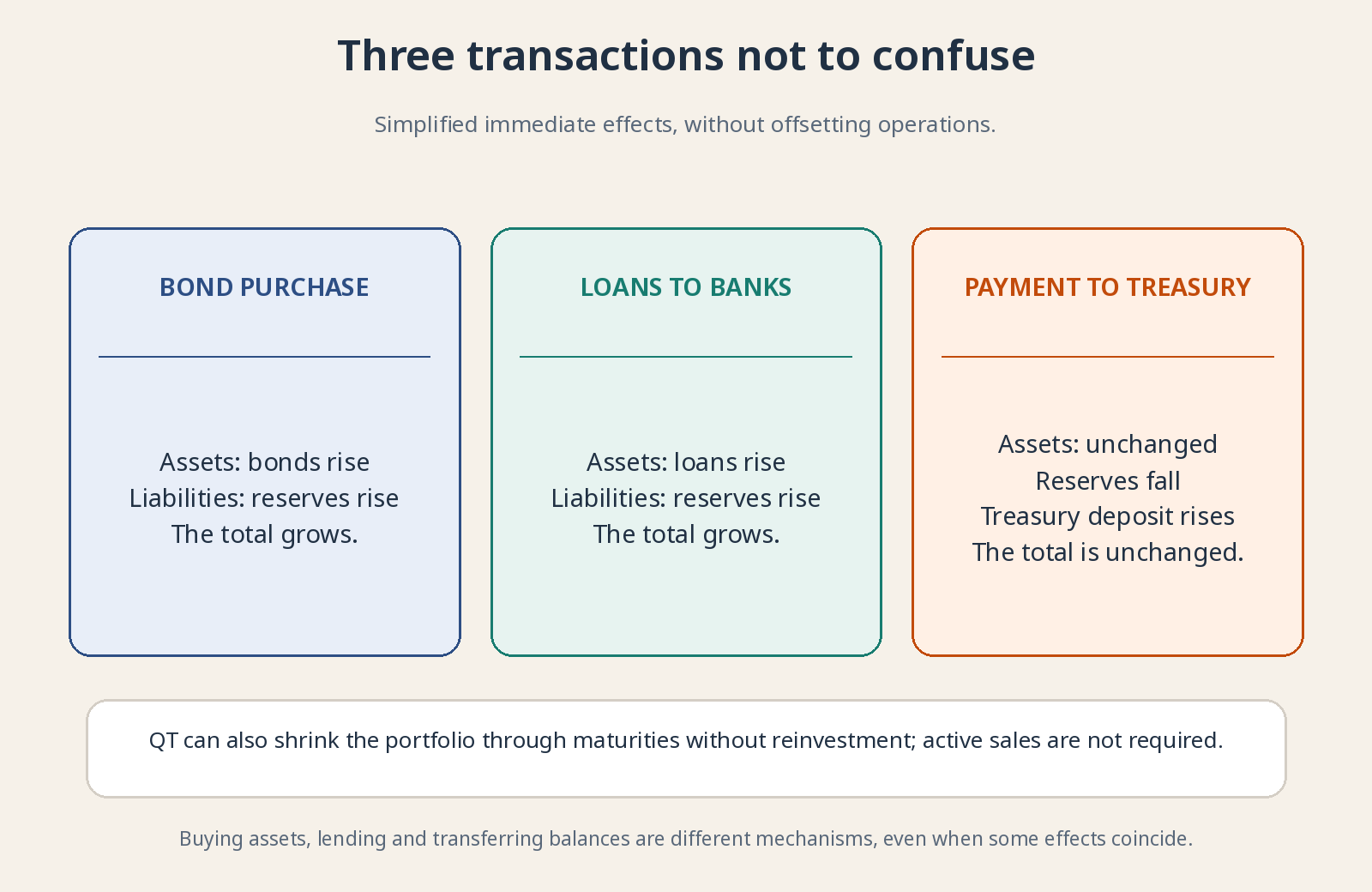
Simplified entries; secondary items omitted. A reserve decline does not by itself prove QT.
What to check in a real report, in order 🔍
First confirm the institution, reporting perimeter and units. For the euro, use the consolidated Eurosystem; for the Fed, the consolidated statement of its Reserve Banks. Check millions versus billions. Distinguish balances on a particular date from weekly averages: comparing them directly can invent a change. The table title and notes are part of the data, not decoration.
Next, separate the weekly move from the change over several months. Identify the drivers: securities, lending, foreign assets or valuation adjustments. On the other side, examine reserves, banknotes and relevant deposits. An announced purchase awaiting settlement—the exchange of cash and the security—may not yet appear in holdings. A timing difference doesn’t necessarily mean a program has failed to deliver.
For a dated exercise, consider the H.4.1 release of November 5, 2026, with balances for November 4. It separates Treasuries from MBS and weekly averages from Wednesday balances. In its year-on-year comparison, Treasury holdings rose while MBS holdings fell. The lesson doesn’t require copying the figures: a total can hide components moving in opposite directions. This is a dated snapshot, not a permanent description of policy.
What markets might do—and what isn’t guaranteed 🧭
Purchases can reduce the term risk held by private investors and put downward pressure on some yields. Term risk means exposure to changes in the price of waiting years for payment. Portfolio reduction may require private investors to absorb more of it. But inflation, Treasury issuance, foreign demand and rate expectations can offset that effect. QT doesn’t raise every yield by an identical amount.
If reserves become uncomfortable for some banks, short-term funding can become more expensive and market functioning can deteriorate. The point of discomfort depends on distribution, regulation and preferences. No universal threshold can be copied from a chart. Funding rates, volumes and facilities help identify stress—not calculate the exact day of a market fall.
Valuation changes also affect balance sheets, and accounting rules differ across institutions and assets. Losses at a central bank issuing its own currency aren’t interpreted exactly like those of an ordinary company. Operational capacity, the legal framework, fiscal consequences and credibility matter. Losses are not irrelevant—but a negative accounting row does not automatically justify declaring bankruptcy.
Why does this matter to you as an investor? 📈
Because it stops you confusing size with stimulus, and stimulus with guaranteed returns. A useful reading ends with “these entries changed for these reasons, corroborated by these signals,” not “stocks must rise.” Compare the mechanism with financing costs, profits and valuations. You can read the balance sheet correctly and still get a market bet completely wrong.
Try the closing exercise. If total assets stay unchanged while banknotes rise and reserves fall, must that be QT? No: it may be a shift between liabilities. If emergency loans grow, must that be QE? No again. You are already reading more carefully than many headlines. Use that advantage to understand risks—not justify personal leverage or predict every week.
For further reading: Federal Reserve: H.4.1 of November 5, 2026, balance sheet and methodological notes · ECB: Eurosystem financial statements and publication agreements.