
7.1 How stocks, bonds, gold and crypto react to macro data
The data was “good.” So why did your portfolio fall?
Markets don’t hand out prizes for headlines. They reassess expectations, profits and prices...
Let’s be honest: few things are more confusing than seeing a growth headline beside a falling stock market. It looks as though somebody wired the traffic lights backward. But markets aren’t voting on whether the number seems nice. They are adjusting prices against expectations, what investors had already paid and what may happen next. The temperature matters—but so does the difference from the forecast.
Today we’ll connect macroeconomic data with stocks, bonds, gold and cryptoassets. Not through a table saying “if A happens, buy B,” but through mechanisms. The same surprise can raise expected profits and also raise the rate used to discount them. Two forces pulling on one rope. Assuming the same one always wins is an expensive way to simplify.
Data vs. expectations: Surprises matter, but they aren’t everything 🎁
Consensus is a summary—often a mean or median—of analysts’ forecasts. It is not a promise or a complete map of every scenario investors hold. A macro surprise is the difference between the release and the expected figure. Its size matters, but so do the context and the competing effects on growth, rates and risk. Inflation falling less than forecast can still be an upside inflation surprise, despite the headline saying inflation fell.
Pricing in news means reflecting it in prices before the event is confirmed. If a rate cut was widely expected, the announcement itself may add little. Guidance about subsequent decisions, details of implementation or investor positioning can matter more. Markets react to changing beliefs, not to a rule that every favorable headline must produce another gain.
Revisions update initial estimates as information improves. Strong employment this month can arrive alongside downward revisions to previous months. Composition matters too: GDP growth driven by unwanted inventory accumulation sends a different signal from strong final demand. Read the details together rather than treating the first large number as the entire report.
Real interest rates: The cost of money after inflation 🧭
A nominal interest rate is quoted in money terms. A real rate adjusts for inflation’s effect on purchasing power. For decisions today, expected real rates matter particularly: roughly, the nominal rate minus expected inflation over a comparable period. Expected and subsequently realized inflation can differ, so the outcome is not guaranteed by the initial calculation.
In an invented example, a 4% nominal yield with 2% expected inflation is roughly 2% real. If the nominal yield rises to 5% while expected inflation stays unchanged, the expected real compensation for waiting increases. Lower-risk interest-bearing alternatives can become more attractive, changing the return investors demand from riskier assets.
Inflation-linked bonds help reveal market real yields, but their prices also reflect liquidity and risk premiums. Inflation compensation inferred from nominal versus indexed bonds is not a pure survey of expected inflation either. Use comparable maturities and understand the embedded premiums. A market-derived measure is informative without being a flawless reading of everyone’s beliefs.
Bonds: Pricing a promise that’s already written down 📜
A bond is a tradable debt claim with contractual payments. Its coupon is the contractual interest; its yield reflects the price paid and the assumed payments. If comparable new bonds offer higher yields, an existing fixed-payment bond generally needs a lower price to compete. The promise has not improved simply because market alternatives have changed.
Duration summarizes approximate price sensitivity to yield changes and reflects the timing of payments; it is not just maturity. As a teaching example, modified duration of seven suggests a roughly 7% price fall for a parallel one-percentage-point upward shift in yields, using a linear approximation. Actual results also depend on convexity and other effects, and sensitivity can vary across the yield curve.
Credit risk is the possibility that the issuer fails to pay as promised. A credit spread is the additional yield above a comparable lower-risk reference. During a slowdown, government yields may decline while corporate spreads widen. A risky corporate bond can therefore fall even when high-quality government bonds rise. “Rates fell” does not explain every bond’s return.
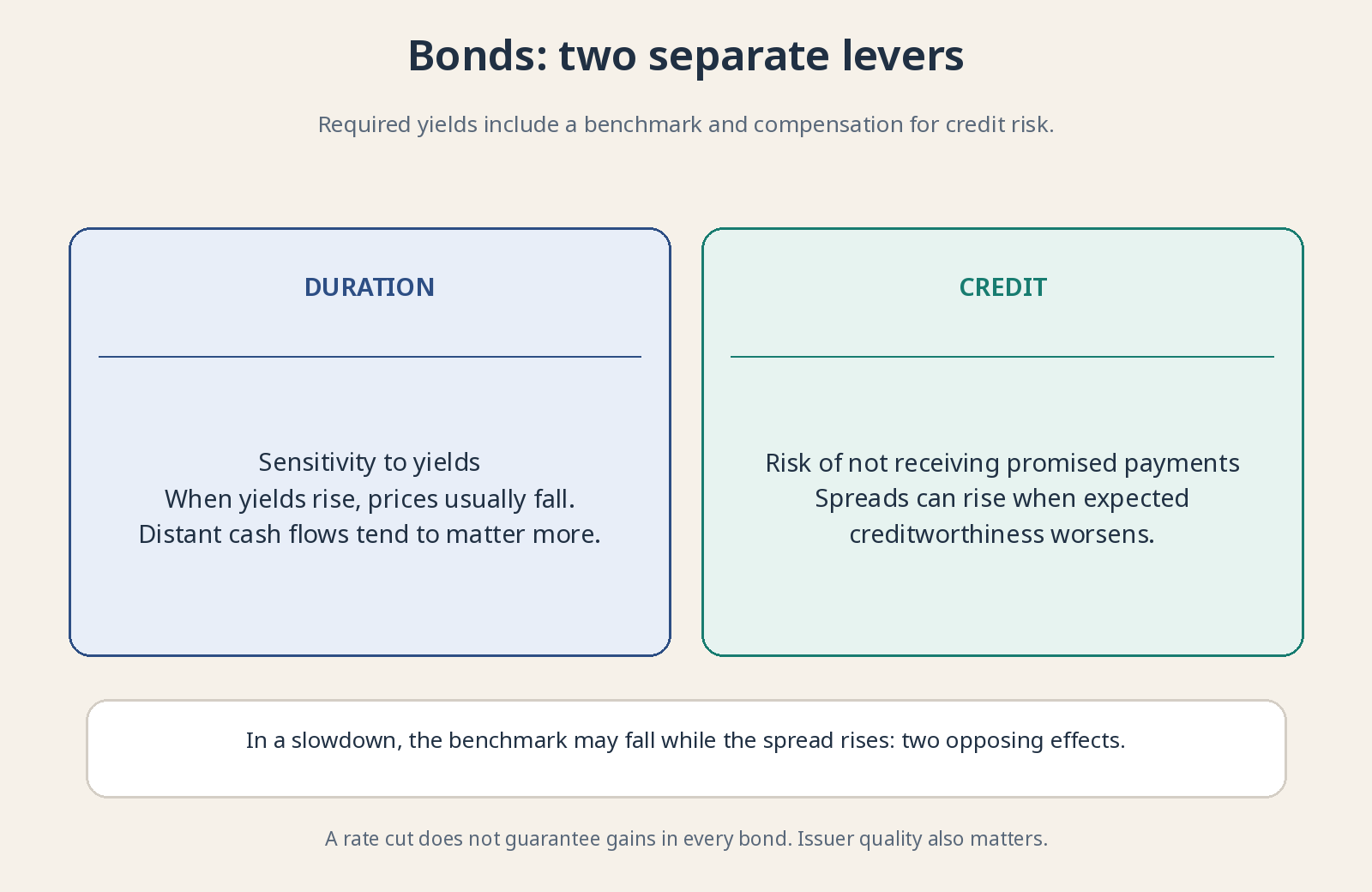
Bond prices also depend on duration, cash flows and embedded features. “Rates fell” is not the whole analysis.
Stocks: Future cash flows, valued in today’s money 🏭
Higher low-risk yields or greater company risk can raise that discount rate, reducing the present value of unchanged future cash flows. Businesses valued heavily on distant earnings may be particularly sensitive. But their earnings expectations also move. A rate change affects valuation through one channel, not a complete equation dictating every share-price move.
Growth changes sales, costs and expected defaults. Cyclical businesses, whose revenue and profits are especially activity-sensitive, may feel recession more strongly than businesses with stable demand. Stable demand does not guarantee a safe investment at any price. Compare the operating exposure, balance sheet and starting valuation together.
An inflation surprise: Where the fire starts changes the damage 🔥
Unexpected inflation driven by strong demand may support sales and price increases, while also prompting higher rates that raise financing costs and required returns. An energy-supply shock can instead squeeze margins and household budgets. The origin changes the balance between revenue, costs and discounting. The same inflation number can carry different business news.
Bond responses depend on nominal yields, expected inflation, real yields and credit risk. Equity responses balance cash-flow expectations against discount rates. Inflation-linked bonds still have real-yield sensitivity and can lose market value. Protection of specified inflation-linked payments is not a promise that your holding’s price stays unchanged.
Nor is lower inflation automatically a celebration. Improving supply can ease costs; collapsing consumer demand can damage earnings. The same thermometer reading can accompany a recovering patient or a weakening one. Ask why inflation fell before deciding whether the release is broadly helpful for the companies you own.
Jobs and growth: Why good news can get a bad reception 👷
Stronger employment can support consumption and sales while encouraging expectations of higher rates for longer. Rising unemployment can bring expected cuts alongside weaker earnings and more defaults. This is why good news can sometimes unsettle shares, or bad news lift them temporarily. The dominant channel changes with inflation, policy expectations and the economic outlook.
If the slowdown threatens companies’ ability to repay, rate relief may not offset credit damage. Markets also price future conditions rather than waiting for current activity to recover. GDP does not have to look healthy before shares can turn, nor must a policy cut immediately rescue earnings. Expectations and outcomes move on different schedules.
Gold: No coupon doesn’t mean no risk 🟡
Gold pays no coupon and generates no business earnings by itself. Its price reflects investment demand, official reserves, physical uses and perceived safety, among other forces. Higher real yields increase the opportunity cost of holding a non-interest-paying asset. That is an influence to monitor, not an inverse relationship guaranteed every day.
Geopolitical stress, official purchases, dollar movements or distrust can dominate at other times. Investors urgently seeking cash may sell gold alongside other assets. Safe haven describes a role some investors seek, not immunity to volatility or loss. An asset can provide diversification in some conditions without protecting you in every episode.
Cryptoassets: Liquidity-sensitive, without a guaranteed script ⚡
Cryptoassets use distributed-ledger technologies and have very different designs and risks. Many depend heavily on expected adoption and future demand rather than contractual cash flows. That can make valuation especially sensitive to confidence and financing conditions. A common label should not conceal differences in structure, custody and economic claims. Technology, regulation and concentration add risks too; digital ownership does not make those disappear.
Calling some cryptoassets high-beta liquidity trades is shorthand for potentially amplified sensitivity to risk appetite and financing conditions. Statistical beta measures sensitivity relative to a chosen benchmark; it is not a permanent physical property. Without a defined series, period and estimation method, the phrase is a description, not a reliable numerical rule.
Easier financial conditions may encourage risk-taking; tightening can unwind positions quickly, especially with leverage. Crypto-specific news can dominate either way. A larger central-bank balance sheet does not logically guarantee a crypto rally. Use the macro context to understand exposure, not to turn a volatile asset into an allegedly automatic policy trade. Calling something digital gold does not automatically give it the behavior or protections associated with physical gold.
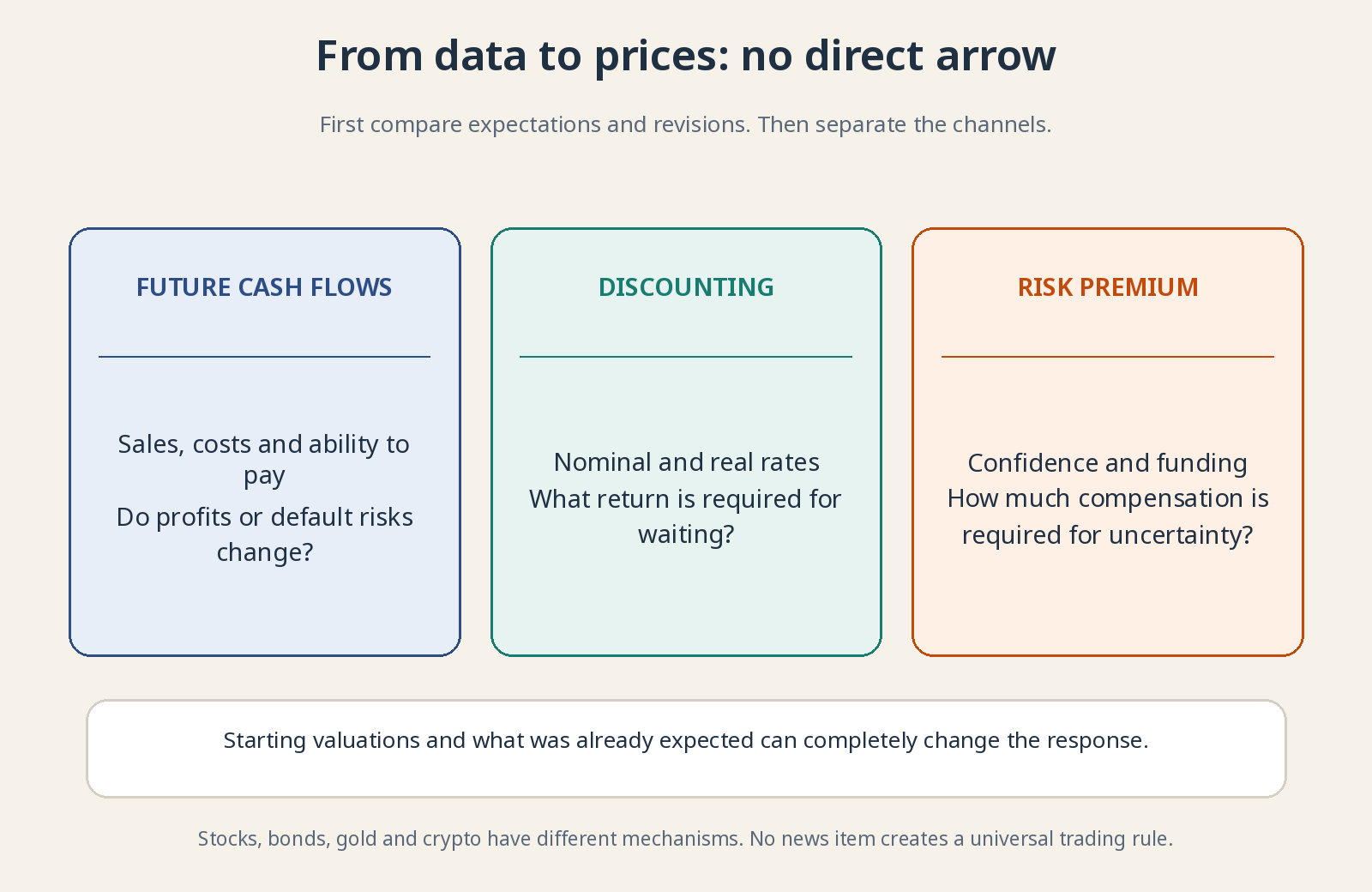
Channels, not trading orders. A good data release can coincide with a falling market.
Why does this matter to you as an investor? 📈
Because understanding the channels prevents you blaming every decline on mysterious manipulation or selling a good business after confusing noise with deterioration. Separate what changed: future cash flows, their risk or the rate used to discount them? Then ask whether it affects your horizon, liquidity needs or existing concentration. Not every headline deserves a trade.
Market timing means trying to get entries and exits right ahead of price movements. Recognizing a mechanism doesn’t grant that ability: expectations, valuation and everyone else’s reaction still matter. Regular contributions and diversification don’t eliminate losses, but keep the entire plan from depending on the next release. Macro helps you understand the road. It doesn’t make every bend an obligatory overtaking opportunity.