
5.1 The economic cycle and sector rotation: Four phases and company behavior
Does the economy have seasons—or do we keep imposing a calendar?
Economic cycles and sectors: Understand the weather without predicting the next lightning strike.
Let’s be honest: when everything is going well, sales seem capable only of rising. When everything goes badly, it feels as though nobody will ever buy another car. Both feelings tend to exaggerate. Economies don’t grow in straight lines: they accelerate, slow down, sometimes reverse and then get moving again. Think of Madrid’s M-30 ring road, except with millions of drivers making decisions simultaneously.
Today I want to discuss the economic cycle: fluctuations in activity that affect jobs, credit and profits. We’ll also cover sector rotation—changes in which groups of listed companies lead the market. This is not a cheat sheet saying “banks in March, pharmaceuticals in September.” It is about understanding why a construction company and a supermarket don’t experience a spending slowdown in the same way.
What exactly is going around? 🔄
An economic cycle does not mean returning to exactly the same starting point. Better tools, skills and ideas can raise long-term productive capacity: the underlying trend. Around that trend come accelerations and setbacks. Think of progress along a road with hills, not a car circling a roundabout forever without getting anywhere.
GDP, gross domestic product, measures production within an economy over a period. Real GDP adjusts for price changes: more sales revenue caused only by inflation is not necessarily more output. Employment, sales and industrial production add perspectives. The household–business circuit in lesson 1.2 can speed up or become blocked in several places.
We’ll use four teaching phases: recovery, expansion, slowdown and recession. Official classifications may include recovery and slowdown within a broader expansion. This is a useful way to organize conditions, not a claim that every economy runs through four equally long compartments or follows a timetable you can trade from your phone. A slowdown can also give way to renewed growth without a recession in between.
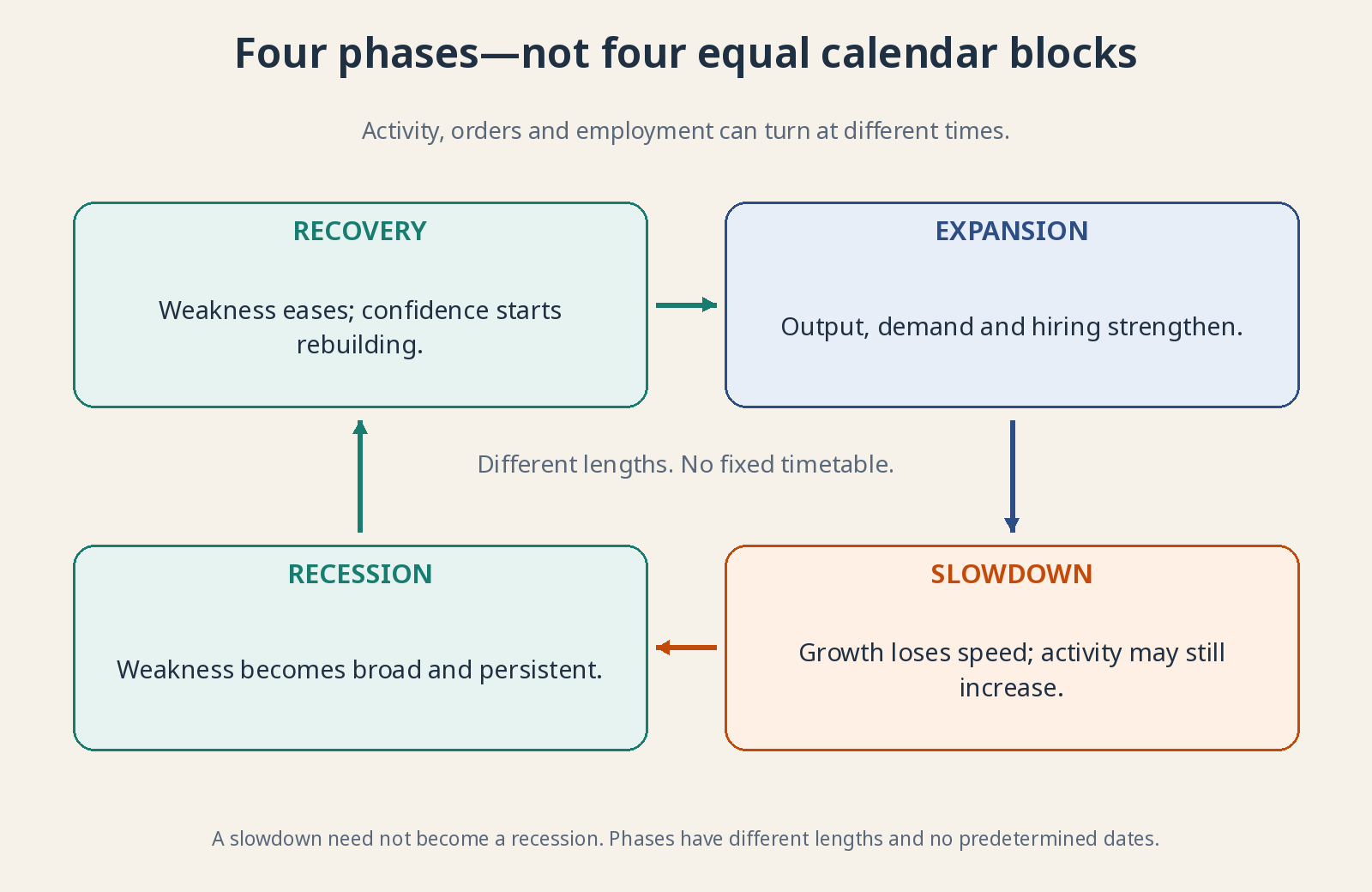
A slowdown need not become a recession. Phases have different lengths and no predetermined dates.
Recovery: Things stop getting worse before they start looking good 🌱
Recovery begins when activity turns upward from the bottom. Unemployment can remain high and the news awful. A factory may receive more orders, increase shifts and only later recruit. Waiting until every headline looks cheerful can mean waiting well beyond the initial improvement. The economic turning point and the public mood need not arrive together.
Inventory rebuilding can help. Inventories are stocks of inputs or finished goods, from screws to refrigerators. Businesses that ran them down may resume orders when conditions stabilize. That supports suppliers even before final demand looks spectacular. But rebuilding stocks is not an inexhaustible engine; eventually orders must be supported by actual sales.
Cyclical businesses have revenue or profits particularly sensitive to activity. Industrials sell equipment, components and related services; recovering orders can make better use of existing capacity. Consumer discretionary businesses sell purchases households can postpone, such as furniture. They may benefit as confidence returns, but cyclical is a description of exposure, not a guaranteed return label.
Banks may face fewer expected defaults and stronger loan demand, but “recovery means buy banks” skips inherited losses, deposit costs and capital strength. Housing can respond to improving financing too, depending on affordability and supply. A phase helps frame the questions; it does not answer the company analysis for you.
Expansion: Confidence builds around the circuit 🏭
During expansion, improvement broadens: employment, income and business investment strengthen. Business investment here means equipment, facilities or development to serve customers—not purchasing existing shares in an app. It can create capacity for future growth. Whether that capacity earns an adequate return remains a separate question.
Industrials, transport operators and technology suppliers can benefit from that investment. Technology is not one uniform business model. Equipment replacement can follow the industrial cycle, while recurring-service revenue may behave differently. Look at customers, contracts and costs rather than assuming that every company sharing a sector label has the same sensitivity.
The trap is confusing growth with safety. A retailer opens more shops because the previous ones did well, and competitors do the same. Soon there are too many locations, expensive leases and discounts. Yesterday’s expansion plants tomorrow’s excess capacity. A growing economy does not prevent management from overpaying or building too much.
Slowdown: Still moving forward isn’t the same as speeding up 🍂
A slowdown means slower growth, not necessarily shrinking output. Sales rising from 100 to 110 and then 113 are still increasing, but the growth rate has weakened. The distinction matters when interpreting data. A declining growth rate can signal lost momentum before the level of activity actually falls.
Higher rates, larger debt payments, overinvestment or expensive energy can cause the slowdown. Disappointing sales leave unwanted inventories and prompt fewer orders. Margins—the share of revenue left after specified costs—can narrow. Conditions weaken through orders and profits before every official aggregate gives an unambiguous recession signal.
Defensive sectors attract attention because demand is relatively stable. Consumer staples include food, cleaning and hygiene products: you may change brands, but you still eat. Healthcare includes medicines and care services. Utilities supply essentials such as electricity and water. Stable demand is useful, but it is only one part of the investment case. Utilities are often regulated, so public rules partly determine what they can charge or earn.
Defensive does not mean immune. A heavily indebted utility suffers when refinancing gets expensive; a supermarket can maintain volume while costs squeeze profit. A small biotechnology firm without revenue does not become a safe haven merely because it sits under healthcare. Balance sheets and business models matter more than comforting category names.
Recession: Weakness spreads ❄️
A recession is a significant, broad decline in activity lasting a period—not simply a bad day for shares. Two consecutive quarters of falling real GDP are often called a technical recession, but this is not the universal definition. Some authorities assess a wider set of indicators and judge depth, duration and breadth.
Households postpone spending, firms reduce investment and lenders become more cautious. Defaults rise when borrowers cannot meet agreed payments. A well-run business can still suffer because its customers have less money. Management quality helps navigate the storm; it does not grant control over every customer’s budget. A recession is not automatically a healthy cleansing process: employment and even viable businesses can be lost through financing stress.
Staples and healthcare may hold up better relatively: they can fall less rather than rise outright. High-quality government bonds may benefit if inflation expectations and yields decline. But an inflationary recession can look different. Relative resilience is not a promise of positive returns, and credit quality is not the only bond risk.
Energy and materials need similar care. Oil and metals producers may gain from scarcity and lose from collapsing demand. An oil company does not automatically prosper because somebody declares “late cycle.” Global supply, inventories, costs and policy can outweigh a neat domestic phase label.
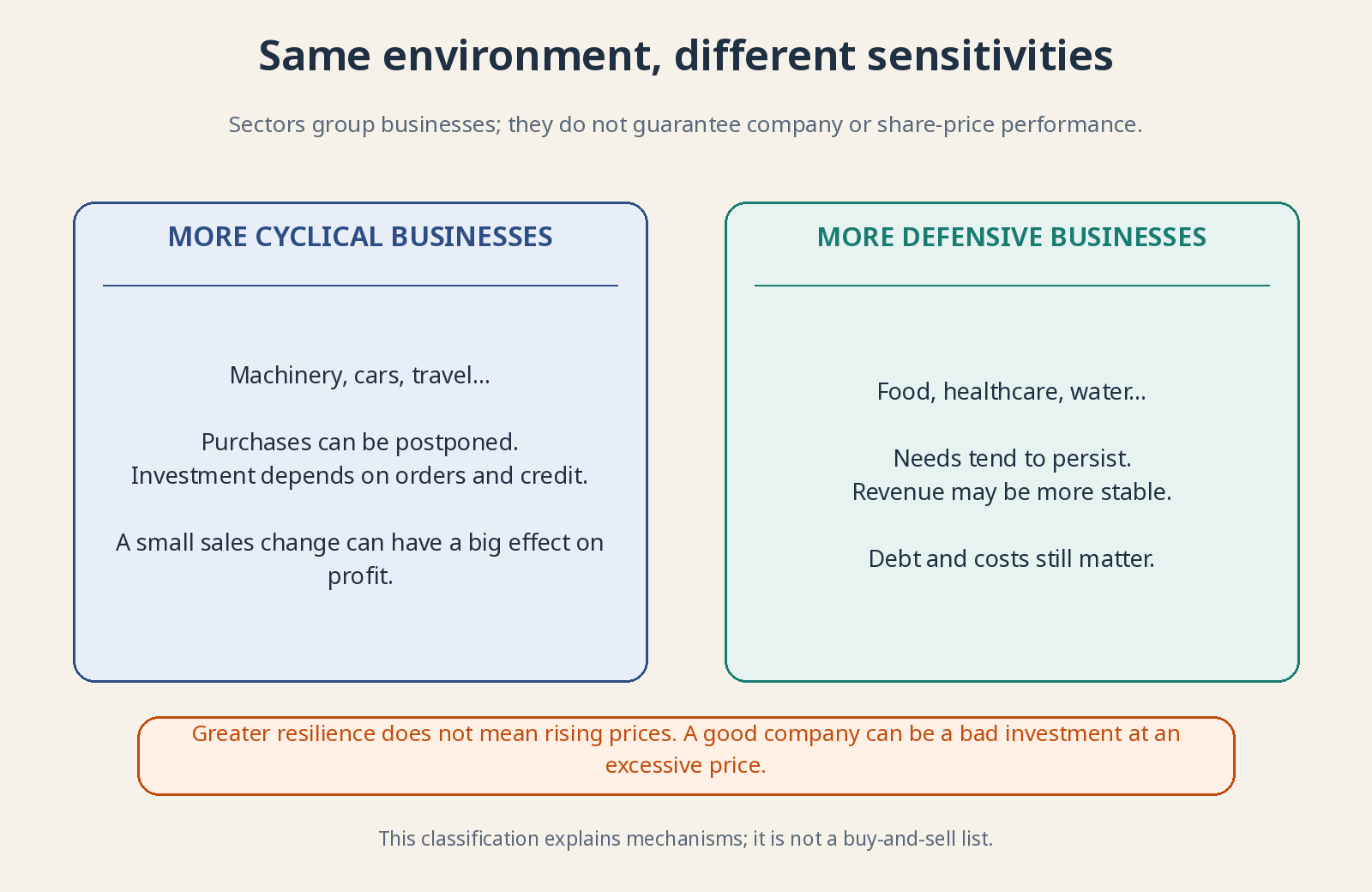
A good business can be a poor investment at the wrong price. Sector labels do not replace company analysis.
Sector rotation: Money doesn’t ask the calendar for permission 🔀
Sector rotation describes some sectors outperforming others over a period as expectations and positioning change. It does not require one mysterious pot of money to leave an entire sector and enter another intact. Every secondary-market trade has a buyer and a seller. Prices change as the terms investors are willing to accept change.
Markets price expectations: today’s price incorporates beliefs about tomorrow. Shares can recover while current economic data worsen if the future looks less bad than previously feared. They can also fall alongside record profits if those profits were expected to be even higher. The economic present and the market’s changing forecast are not the same thing.
Imagine a furniture maker with a factory and costs that cannot quickly shrink. A modest sales recovery spreads those costs across more units and can sharply improve profit. A supermarket with steadier demand may have less profit sensitivity. This operating leverage helps explain cyclical behavior, but also makes a downturn more painful. Greater profit sensitivity does not establish that the furniture maker is cheap or the supermarket expensive.
The capital cycle—and each country’s own cycle 🧩
The capital cycle is another mechanism: high profits attract investment, new capacity arrives and excessive supply can eventually depress prices and returns. After years of underinvestment, the reverse may occur. Watch how much capacity is being built relative to demand, not merely how attractive the most recent profit margin looks.
The capital cycle is not identical to the economy-wide cycle. One industry can have too many factories while the country grows. Countries also move at different speeds. A Spanish company selling mainly abroad may depend more on foreign customers than Spain’s GDP. Map the actual business exposure before assigning it to a national economic phase.
Why does this matter to you as an investor? 📈
Because it helps you ask where profits come from and how much they might change. Does the company sell necessities or postponable purchases? Carry high fixed costs? Depend on credit? Was its great year driven by a lasting advantage or unusually favorable prices? Understanding the cycle stops you projecting the best year into eternity.
It doesn’t justify rotating the whole portfolio whenever somebody announces a new phase. Real-time identification is hard; by publication, markets may already have moved. Long-term investing, diversification and sustainable regular contributions don’t require guessing the month of the next trough. They require being able to withstand it without selling investments to replace the refrigerator.
Keep the logic, not a winners list: different businesses respond differently to the same environment. The map reveals vulnerabilities. It doesn’t give you control of the traffic lights.