
5.5 Short- and long-term debt cycles: Dalio’s framework
Does debt make us richer—or just bring payday forward?
Ray Dalio’s debt cycles: A useful lens on credit, not a universal law with a countdown.
Buy a washing machine on installments today and you can use it without first saving the whole price. Wonderful. But the installments aren’t paid by a parallel-universe version of you. They come out of your future income. Credit brings decisions forward while committing some of tomorrow’s earnings. When millions of households, businesses and governments do this together, the effect on the economic circuit is enormous.
Today I want to discuss the framework popularized by Ray Dalio, investor and founder of investment manager Bridgewater Associates. It explains economic behavior through productivity and short- and long-term debt cycles. It is a way of organizing real mechanisms. You don’t have to turn its author into a prophet, or believe every crisis is another episode of one universal script.
The starting point: Producing more isn’t the same as owing more 🛠️
Productivity is output obtained from a given set of resources. A bakery producing more loaves with the same working hours after improving ovens and organization has become more productive. Over time, knowledge, tools and institutions expand what an economy can produce. That is a real improvement in capacity, not merely a larger borrowing limit.
Credit is different: purchasing power today in exchange for future repayment obligations. It can fund a productive oven or simply a higher price for an existing asset. Both involve financing, but only the useful investment necessarily aims to expand future output. Ask what the borrowing supports rather than assuming all credit creates equivalent growth.
As lesson 2.2 explains, a bank loan can create a deposit and a debt simultaneously. There need not be a pre-existing pile of banknotes waiting to be allocated. But creating a financial claim does not manufacture unlimited workers, materials or viable projects. Accounting entries and real resources are connected without being the same thing.
Calling borrowing spending brought forward is a useful simplification, not a rule that each borrowed euro must subtract one euro of consumption on a fixed future date. A productive loan can raise future income and be refinanced sustainably. The central question is whether cash generation can support the obligations without depending on permanently favorable conditions.
The short cycle: Accelerate, tighten and ease again 🎢
In Dalio’s framework, the short-term debt cycle resembles the familiar activity-and-credit cycle. Easier financing encourages borrowing and spending. One person’s expenditure becomes another’s income, speeding the circular flow from lesson 1.2. Confidence can reinforce that expansion as stronger income makes further borrowing appear more manageable.
If spending strains productive capacity and inflation rises, the central bank may increase rates. Financing becomes more expensive, some purchases are delayed and some projects stop looking profitable. Banks may tighten lending standards too. Credit conditions and spending can then reinforce one another in the opposite direction.
As spending cools, households and firms become cautious. If price pressures allow, the central bank can ease conditions and help support recovery. This is a stylized mechanism: a simplified outline with many complications removed so you can see the main connections. Stylized does not mean guaranteed or universally sufficient.
The cycle has no fixed duration, and not every recession begins with rate rises. Pandemics, energy disruptions and political decisions can change the sequence. Dalio emphasizes credit’s role; the real economy has not signed a contract promising to follow his timetable. Use the framework to identify vulnerabilities, not forecast turning points by calendar arithmetic.
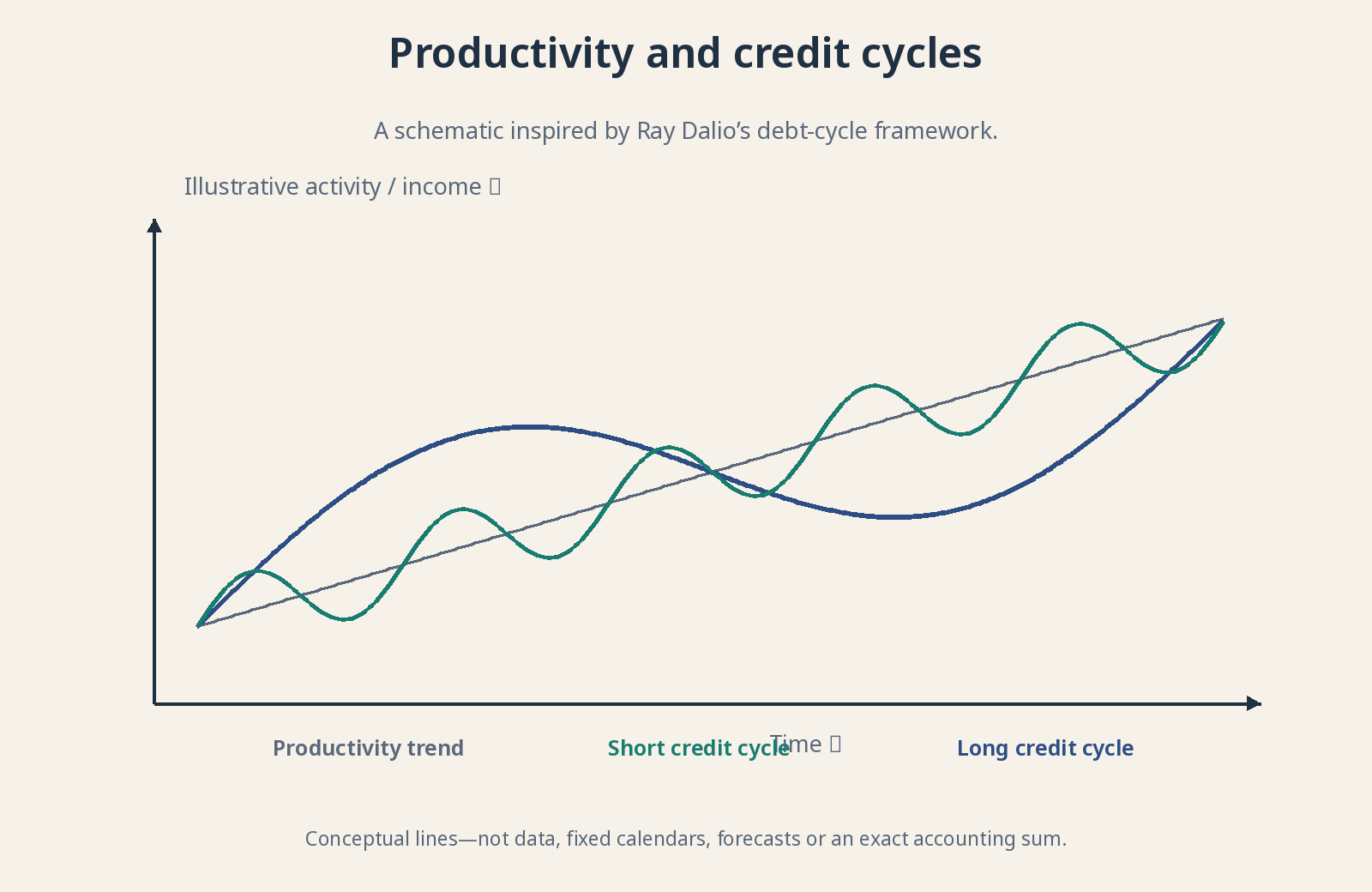
Conceptual lines—not data, fixed calendars, forecasts or an exact accounting sum.
The long cycle: When cutting rates no longer does enough 🧱
The long-term debt-cycle thesis proposes that obligations can accumulate faster than the income supporting them across successive shorter cycles. Good years encourage confidence and borrowing; crisis responses relieve immediate stress without necessarily eliminating every vulnerability. A renewed expansion can therefore coexist with a heavier underlying debt burden. The result can be greater dependence on refinancing and low rates.
That does not mean all sectors and countries endlessly increase debt together. Some repair balance sheets while others borrow. The framework’s useful warning is that a cyclical rebound and accumulated fragility can coexist. A stronger quarter is encouraging, but cannot by itself tell you whether years of financial commitments have become sustainable.
Debt service is the interest and principal due according to the payment schedule. It can become difficult even when asset values look impressive. If obligations fall due now and income arrives later, timing matters. A large property valuation does not pay this Friday’s installment unless you can generate or obtain the necessary cash.
When borrowers prioritize reducing debt, lower rates may not induce much new spending. A balance-sheet recession describes this emphasis on repairing net worth and obligations rather than expanding activity. If policy rates are already near their effective lower bound, further conventional easing also has less room. Cheap financing is not the same as a willingness to borrow. Other tools remain possible; what narrows is the scope for solving the problem with conventional rate cuts alone.
Deleveraging: Reducing the burden, not just the nominal amount 🎒
Leverage uses debt to support assets or activity; deleveraging reduces that dependence or its weight relative to income and equity. A debt-to-income ratio compares outstanding obligations with income over a stated period. Both numerator and denominator matter. A smaller nominal balance is not the only route to a lighter burden.
Suppose a business owes 100 and earns annual revenue of 100: the ratio is one. With debt unchanged and revenue rising to 125, it falls to 0.8. Conversely, debt declining to 90 while revenue falls to 70 worsens the ratio. These are invented numbers illustrating relative burden, not a complete measure of repayment capacity or profit.
A collective problem follows. One household can spend less to repay debt, but if many do so simultaneously, businesses sell less and may cut jobs. The resulting income decline makes repayment harder elsewhere. Sensible individual action can worsen aggregate conditions. The circular flow does not stop operating just because everyone decides to tighten their belt.
Four routes, each with somebody on the other side ⚖️
Dalio groups responses into combinations of expenditure adjustment, debt restructuring, redistribution and monetary support. None is costless. Your liability is someone else’s asset, potentially connected to a pension, a bank balance sheet or an investment portfolio. Changing the promise reallocates losses and risks; it does not simply make them disappear.
-
Spending cuts seek to free income for repayment. They can improve an individual account, while abrupt simultaneous cuts may weaken activity and tax revenue. Design matters: not all cuts have the same effects, and not every existing expense deserves preservation. “Spend less” states a direction, not a complete adjustment strategy.
-
Debt restructuring changes maturities, interest or amounts owed. A haircut reduces the creditor’s recovery; extending maturity spreads payments over time but does not automatically remove the economic loss. An orderly process can prevent chaotic liquidation. Someone must still recognize the difference between the old claim and what can realistically be paid.
-
Redistribution shifts resources between groups through taxes, transfers or other measures. It changes who bears adjustment and who can keep spending. Political limits and incentive effects remain. Moving numbers between accounts can change demand and hardship, but it does not itself create the goods and services needed to meet every claim.
-
Monetary and fiscal support can ease financing, sustain demand or recapitalize viable institutions. Central-bank bond purchases financed with reserves are not identical to handing cash to every household, and they do not automatically cancel public debt. The specific operation, counterparties and constraints determine its effects. A large policy label is not a substitute for the balance-sheet mechanics.
Beautiful, ugly and inflationary: Simple names for difficult balances 🎭
A beautiful deleveraging, in Dalio’s terminology, combines loss recognition with enough support to reduce debt burdens without collapsing income or losing price stability. Beautiful does not mean painless or equally favorable to everyone. It describes a difficult balance among competing objectives, not a button policymakers can press once they agree on the adjective.
An ugly or deflationary adjustment involves falling spending, prices and income increasing the burden of nominal debt. Lower earnings with unchanged payments make repayment harder. Forced sales and failures can reinforce the decline. Deflationary refers to the price-and-income mechanism; the damage is not simply a few cheaper items on a shopping list.
An inflationary path erodes some debts’ real value in the currency losing purchasing power. It is not a universal pardon. Savers and incomes that adjust slowly can suffer, new borrowing may become more expensive and confidence can deteriorate. Foreign-currency obligations can become harder to service rather than conveniently shrinking with domestic inflation. Floating-rate or inflation-linked debt may offer less of that apparent inflation relief.
These are explanatory scenarios, not three sealed compartments. A prolonged adjustment can combine inflation in one phase, contraction in another and very unequal losses across households, businesses and creditors. The label should help you follow the mechanisms, not persuade you that a messy process must fit one tidy box.
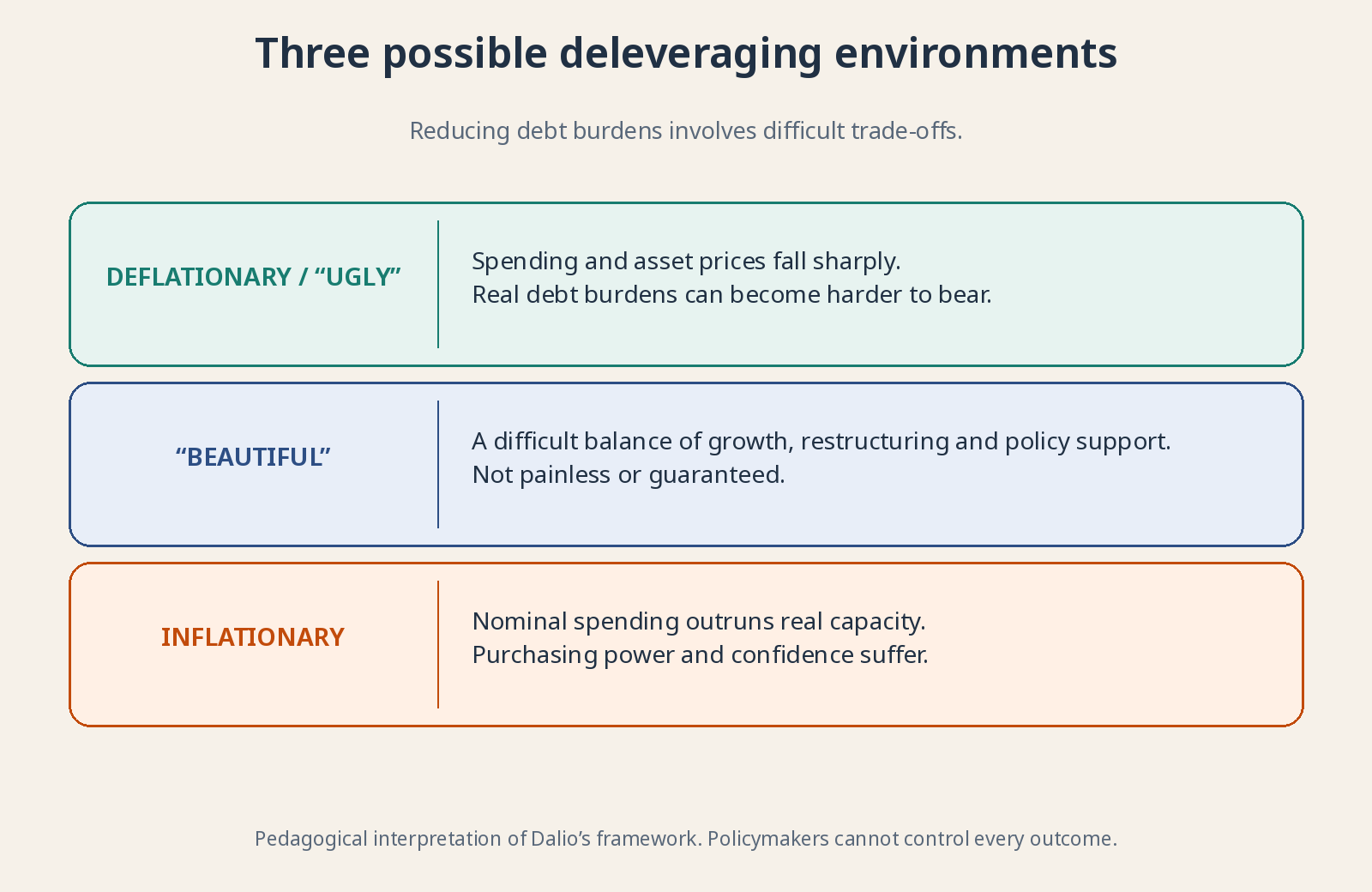
A teaching interpretation of Ray Dalio’s framework. Pedagogical interpretation of Dalio’s framework. Policymakers cannot control every outcome.
The criticisms worth keeping on the table 🔍
The first limitation is apparent regularity. Long cycles are easier to identify afterward than to date in advance. Truly comparable episodes are few and institutions change. You cannot rerun the same country under identical conditions with a different policy. A memorable historical pattern is not automatically a reliable forecasting clock.
The second is aggregation. Public and private debt differ, as do domestic- and foreign-currency obligations and thirty-year versus overnight funding. A country can hold foreign assets while particular domestic borrowers face immediate stress. Totals can hide who owes, to whom, in what currency and when. Those details often determine where a crisis starts.
The third is giving credit too much explanatory weight relative to productivity, demographics, energy, inequality, technology and institutions. These forces can transform repayment capacity and growth; they are not merely noise around a debt clock. Keep the framework as one lens among several, not the only explanation you allow yourself to see. Policy room also differs between a state issuing its own currency and a member of a shared currency area.
Why does this matter to you as an investor? 📈
Because good income and easy credit aren’t permanent guarantees. Can a company fund itself through operations? When do its obligations mature? What happens if sales fall while interest costs rise? A brilliant story doesn’t replace the cash needed to pay bills.
You don’t need to forecast the end of the great debt cycle to invest prudently. You need a sustainable horizon and no dependence on selling assets in a crisis to repay borrowed money. The framework reveals promises that may prove hard to keep. It doesn’t justify personal leverage because “we know which phase we’re in.”
For further reading: Ray Dalio: How the Economic Machine Works. This lesson explains the framework and its limitations. It does not treat suggested cycle lengths as fixed laws or diagnose the current cycle.