𝟱.𝟲 📈𝗟𝗲𝘃𝗲𝗿𝗮𝗴𝗲 𝗮𝗻𝗱 𝗟𝗶𝗾𝘂𝗶𝗱𝗶𝘁𝘆 💸
How They Really Pull the Strings of the Stock Market 🧠📈
1. Leverage: The Power (and Risk) of Borrowed Money ⚖️
What exactly is leverage?
Leverage is basically investing or trading with money that isn't yours. It measures the balance between what you owe (mortgages, car loans, credit cards, margin debt) and what you own (your house, stocks, funds, and savings) 🏠📈.
The Myth of the U.S. Debt Collapse
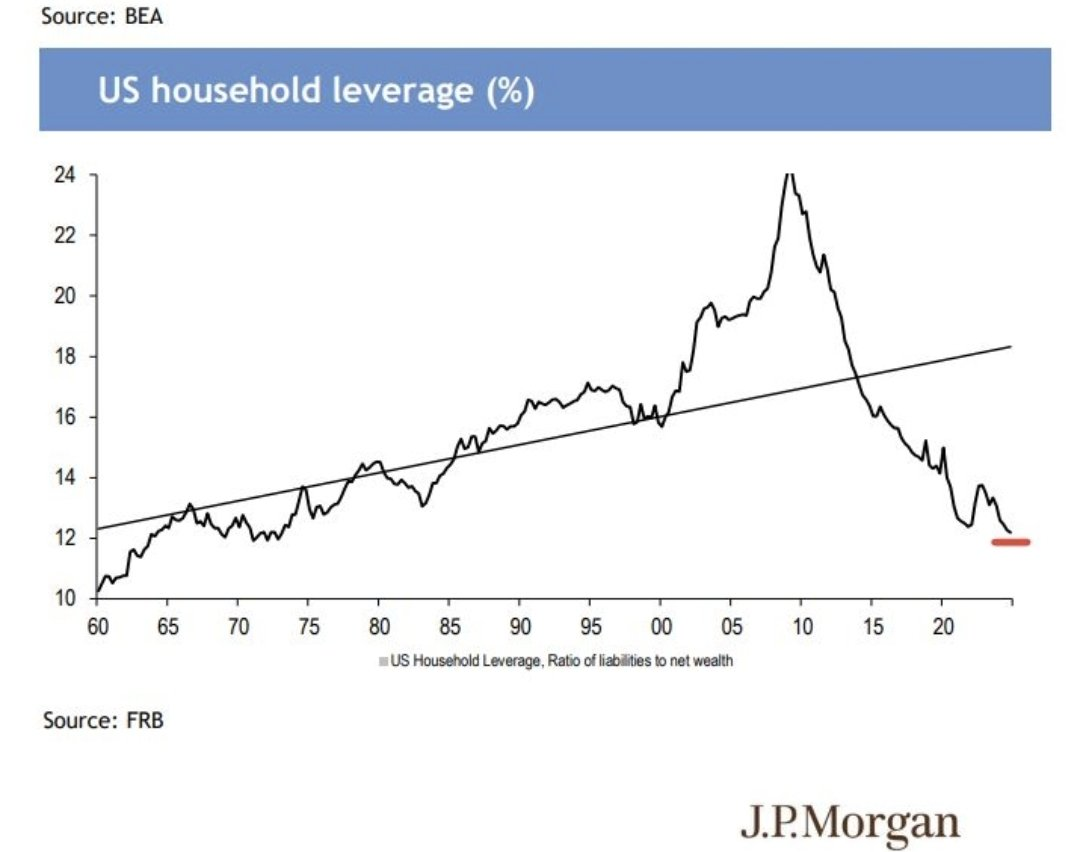
We love to think the average American lives drowning in debt, just one step away from financial ruin 💳💥. However, Federal Reserve and J.P. Morgan data hit us with a reality check:
-
60-year low: Household leverage in the US (total debt vs. net worth) is at its lowest level in 60 years, sitting around 12% 📉.
-
Comparing to 2008: Far from the chaos of the subprime crisis, when this ratio skyrocketed to 24%.
What makes this number go up or down?
-
Asset values: When housing prices and the stock market surge, net worth goes up. Even if debt in dollar terms stays high, it drops as a percentage of total wealth. That's exactly what happened after 2008 🚀.
-
Access to credit and interest rates: When money is free, everyone borrows like crazy 🏦. When rates rise or banks tighten rules, borrowing slows down.
-
Post-crisis trauma: After getting wrecked in 2008, both families and banks got much smarter about handing out mortgages to anyone with a pulse.
How does this impact the stock market?
-
Higher recession resilience: With deleveraged household balance sheets, families handle rate hikes or inflation spikes much better without defaulting en masse 🛡️.
-
Solid consumer spending: Consumer spending (70% of US GDP) isn't hanging by a thread of easy credit like in 2007—it's backed by real, expanded wealth.
-
Less systemic risk for banks: A borrower with debt but assets worth far more than what they owe is a controlled risk for lenders 🏛️.
Bottom line: Asset owners have seen their wealth grow much faster than their debts. For the stock market, the nightmare of massive debt defaults is much further away than social media gloom-doomers claim 😅.
2. Liquidity: The Oxygen the Market Breathes 💧💸
What is market liquidity?
If leverage is the engine, liquidity is the fuel. Liquidity measures how easily and quickly money can move into assets without breaking their prices.
It has two main angles:
-
Systemic Liquidity (Money Supply): The total cash available in the global economy (driven by central banks and bank lending) 🖨️.
-
Asset Liquidity (Trading Volume): How easily you can buy or sell a stock without moving its price. You can trade millions in Apple in seconds without blinking; in a low-volume micro-cap, a medium order sends the chart wild.
Where does global liquidity come from?
-
Central Banks (Fed, ECB): They pump money in by buying bonds or lowering rates (Quantitative Easing), or drain it by raising rates and shrinking balance sheets (Quantitative Tightening) 🏦.
-
Savings & Institutional Investors: Big pension funds and sovereign wealth funds deciding whether to hoard cash/T-bills or push money into stocks.
How liquidity impacts stock prices
-
High liquidity (Abundant cash): Cash earns nothing. Money "burns" in pockets and chases yields, flowing straight into equities. This drives up valuation multiples (P/E ratios) and fuels bull runs 🚀.
-
Low liquidity (Taps turned off): When central banks drain liquidity, money gets scarce and expensive. Investors demand higher margins of safety, leading to valuation compression 📉.
3. The Explosive Mix: How Do They Interact? 🍸
Combining leverage and liquidity helps identify where we sit in the market cycle:
| Scenario | Global Liquidity | Leverage | Market Behavior |
| Stock Market Bubble | High 🌊 | Very High 🚀 | Cheap money + heavy borrowing to buy stocks = parabolic rallies and hyper-valuations. |
| Orderly Adjustment (Current) | Moderate / Tight 🛑 | Low / Healthy 🛡️ | Liquidity withdrawal cools valuations, but strong balance sheets prevent default crashes. |
| Margin Call Crash | Vanishes 🏜️ | Very High 💥 | Prices drop, collateral requirements trigger, and everyone sells at once with no buyers around. |
📌 3 Essential Takeaways for Students
-
Leverage amplifies results: It multiplies gains in bull markets, but wipes out accounts during sharp corrections.
-
Liquidity drives the tide: "Don't fight the Fed". If central banks pump liquidity, markets usually go up even if economic headlines look bleak.
-
Current Outlook: The market is trading under tighter liquidity due to interest rates, but it rests on a solid safety net: households and corporations are far less leveraged than during major historical crises.