
𝟱.𝟲 📈𝗟𝗲𝘃𝗲𝗿𝗮𝗴𝗲 𝗮𝗻𝗱 𝗟𝗶𝗾𝘂𝗶𝗱𝗶𝘁𝘆 💸
What good is wealth if you can’t pay tomorrow’s bills?
Liquidity and leverage: Markets can give you time—or take it away when you need it most.
Imagine owning a mortgage-free apartment with just twenty euros in your account. Your wealth on paper might look excellent. Unfortunately, dentists rarely accept “I’ll sell you half a square meter of my living room” as payment. Now imagine owning shares that were easy to sell yesterday, while today everyone needs cash at once. You still own assets. You may no longer be able to turn them into money at the price you expected.
Today I want to discuss liquidity and leverage: two ideas that explain why a manageable decline for one person can become a catastrophe for another. One concerns available money and the ability to exchange assets; the other concerns obligations taken on to finance positions. Together they can form a deeply unpleasant loop. You don’t need fifteen trading charts on your screen to get caught in it.
Liquidity: Selling without smashing the price 💧
Market liquidity is the ability to buy or sell a quantity of an asset quickly, at reasonable cost and without moving its price too far. Almost anything can be sold if you give it away. The useful question is whether you can trade the amount you need without accepting a painful discount.
Cash is an immediate means of payment. An accessible bank deposit can support transfers, subject to the bank’s terms and risks. A house usually needs more time and transaction costs to sell; a unique painting may need a very particular buyer. Valuable and liquid are different descriptions. You cannot pay the electricity bill with a corner of the living room.
The bid–ask spread is the gap between the best buying offer, the bid, and the best selling offer, the ask. Market depth is the quantity available near those prices. Volume records what has already traded, not a promise about the next order. A narrow spread for a tiny trade does not guarantee easy execution of a large one.
Having cash and being able to borrow are different things 🚰
Funding liquidity means obtaining cash to meet payments and maintain positions: renewing borrowing, drawing a credit line or supplying collateral. You can own tradable assets and still face a deadline before sale proceeds settle. Market liquidity concerns trading the asset; funding liquidity concerns financing your commitments. They interact, but are not interchangeable.
System liquidity is a broader and often frustratingly vague phrase. It might mean bank reserves, access to funding, credit availability or investor demand. M1, M2 and M3 measure defined forms of money, not the number of buyers ready to defend a particular share price. Always ask what the speaker is measuring.
“There’s plenty of liquidity, so stocks must rise” is convenient rather than rigorous. Deposits can stay put, credit can fail to reach borrowers and investors can demand lower prices. When you buy an existing share, the seller receives the payment. Ownership and prices change; the stock market is not a drain swallowing the money out of existence.
A rate cut is not the same as QE: central-bank asset purchases financed by creating reserves. A rate rise is not automatically QT: a reduction in the central bank’s securities portfolio. These tools can influence related conditions through different mechanisms. Don’t collapse them into a single on/off switch labeled liquidity.
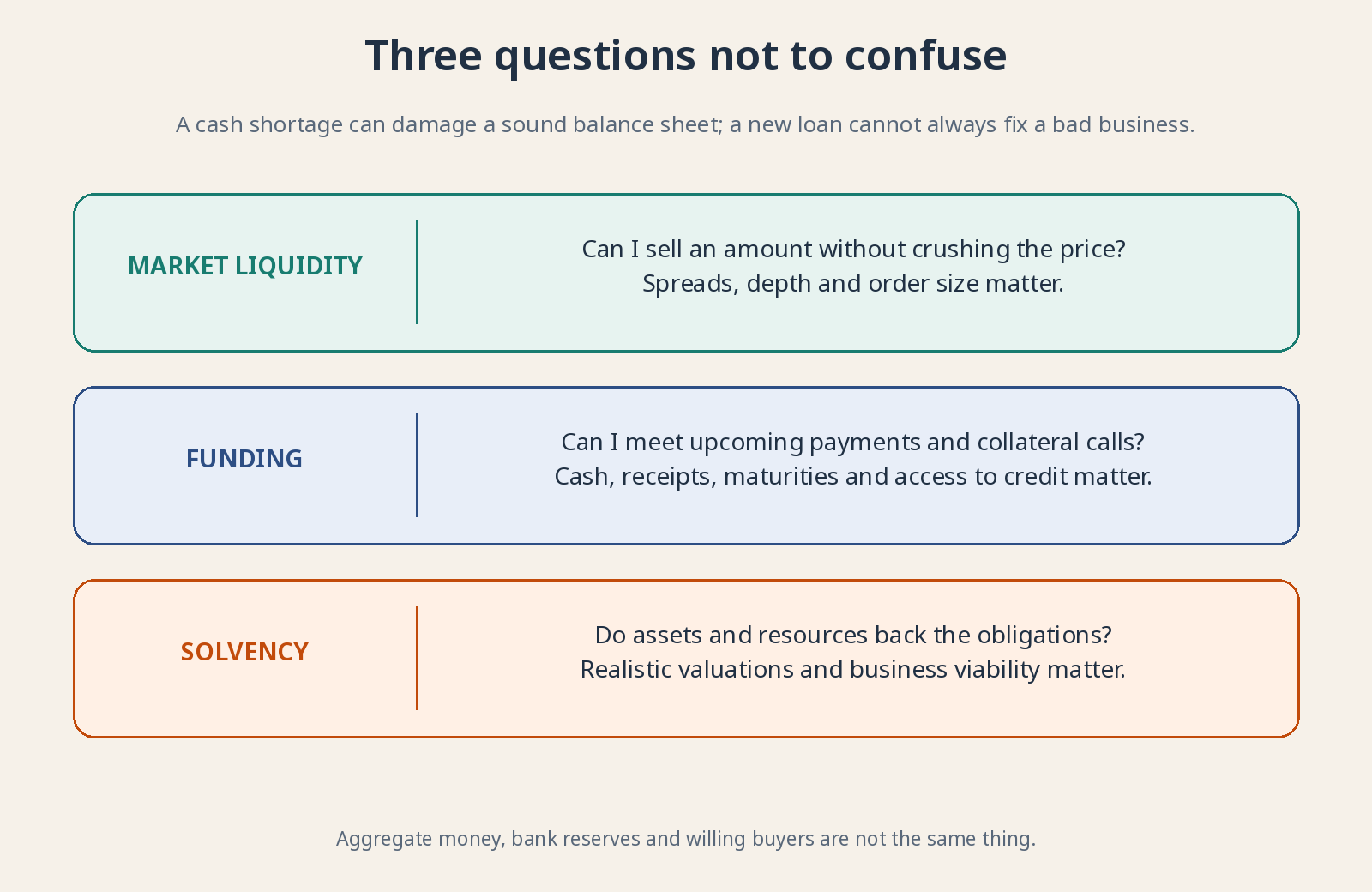
A problem in one can spread to the others. Valuable assets do not automatically pay tomorrow’s bills.
Solvency: Do your assets cover what you owe? 🧱
Solvency concerns meeting obligations through asset values and the business’s ability to generate resources, as lesson 2.5 explains. It is not identical to having cash available today. Nor does positive reported equity guarantee safety if valuations are unrealistic. Check what assets can genuinely earn or realize, not just the reassuring total on the balance sheet.
A viable business can have a temporary cash gap: reliable customers pay in two months, but wages are due this week. Selling assets at deep discounts to bridge that gap can turn a liquidity problem into losses and impaired solvency. Distinguishing the initial problem matters because emergency cash and a repair of the underlying balance sheet are different remedies.
Think of available cash as money in your current account and solvency as the broader ability to meet your obligations. A good overall position does not eliminate a payment deadline; a new short-term loan does not create profit. Both questions matter: can you pay now, and can your finances support what you owe over time?
Leverage: A lever that works both ways ⚖️
Financial leverage uses borrowing or other obligations to increase exposure relative to equity—the owners’ resources rather than lenders’ claims. Like a lever, it magnifies movement in both directions. Gains and losses fall on a smaller equity base while the financing claim remains. The apparently clever shortcut works against you just as efficiently.
Buy an asset for €100 entirely with your own money. A rise to €110 gains 10%; a fall to €90 loses 10%. Now use €50 of your own and €50 borrowed. At €110, repaying €50 leaves €60: a 20% gain on your €50. At €90, it leaves €40: a 20% loss, before interest, fees and taxes.
If the asset falls to €50, the €50 debt consumes its entire value and your equity is wiped out. A further fall may create additional obligations, depending on the instrument, contract and applicable protections. Loss limits on a particular product do not make its leverage harmless. Losing all the money committed is already a serious outcome.
Derivatives—contracts linked to an underlying asset—can create leveraged exposure without a conventional loan funding the whole purchase. Compare the economic exposure with your resources and required collateral. The absence of a line labeled bank loan does not mean the absence of leverage. What matters is how losses and payment obligations respond.
Households: Debt divided by wealth won’t tell you everything 🏠
A household may have a mortgage, car loan and credit-card balance. Assess income, installments, maturities and job stability alongside debt. Debt-to-equity compares obligations with net wealth; debt-service burden compares required payments with disposable income. They answer different questions. A family can look wealthy on paper and still struggle with its monthly cash commitments.
A higher house valuation can improve some leverage ratios without reducing debt or a single installment. National averages can also combine asset-rich households with others carrying most of the borrowing. Look at distribution and payment capacity. The average household is a statistical construction, not a neighbor who can lend everyone else the missing cash.
Valuable collateral does not automatically make a bank loan safe. The lender must consider realizable sale value, costs and timing as well as the borrower’s repayment capacity. In a crisis, job losses and falling collateral values can occur together. The security is weakest precisely when the borrower most needs a fallback.
Companies: Check debt, cash and the repayment calendar 🏭
A company can sensibly borrow for a machine generating income over many years. Study whether future cash receipts can service the financing rather than treating all corporate debt as a sin. But a long-lived asset funded with debt due very soon creates refinancing risk: the firm may need renewed credit before the investment has paid for itself.
Net debt commonly subtracts cash and cash equivalents from financial debt. Cash equivalents are short-term, highly liquid investments convertible to known cash amounts with insignificant value-change risk. Check definitions and how much cash is actually accessible rather than restricted or needed for operations. Maturities and fixed-versus-floating rates complete the picture. A large cash headline alone is not enough. Cash greater than debt can be a useful resilience clue, not an automatic valuation rule.
Debt-to-EBITDA is another common measure. EBITDA means earnings before interest, taxes, depreciation and amortization. The ratio compares a debt stock with an earnings measure over a period, often a year. It is a rough financing indicator whose definitions may vary, not a substitute for examining actual cash generation and obligations.
It is not literally the number of years needed to repay every debt. EBITDA is not free cash flow: capital expenditure, taxes, interest and working-capital needs still matter. Falling earnings can worsen the ratio sharply without new borrowing. Check its components and the resilience of earnings rather than trusting a single apparently precise multiple. A manageable multiple for stable earnings may be excessive for a highly cyclical business. There is no universal cutoff that excuses you from understanding the company.
Margin and collateral: When you’re forced to act 📞
Margin trading maintains exposure while posting only part of its value as collateral, through borrowing or a leveraged contract. Initial margin is required to open the position; maintenance margin sets ongoing minimum requirements. Collateral supports the obligation. It is not the full amount you are economically exposed to, nor a guarantee against loss.
If losses erode the required cushion, a margin call may demand more funds or reduced exposure. It is not a courtesy call asking whether you still believe in the investment. Under the contract, the broker may close positions without waiting for your permission or the time you expected. Requirements can also tighten when markets become nervous.
That breaks the dangerous claim, “I invest for the long term, so I can wait.” You can wait only if nobody can demand money before your thesis works out. Being right in five years does not prevent forced liquidation this afternoon. A long horizon and borrowed exposure are not automatically compatible.
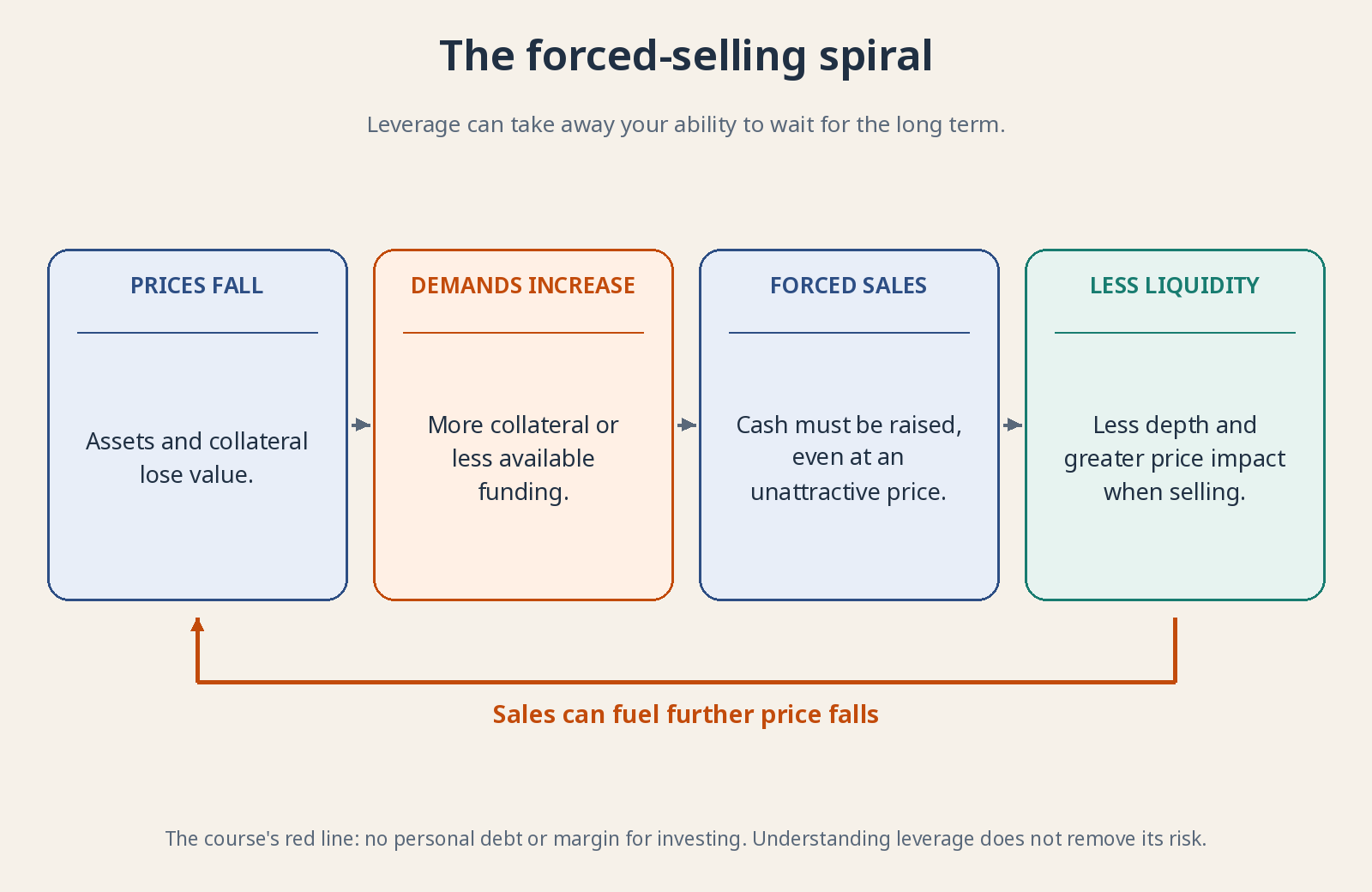
Not every fall produces this spiral. Fragility exists before the spiral starts. Avoid personal leverage.
Why liquidity disappears just when you go looking for it 🌪️
In calm markets, buyers participate, lenders extend funding and collateral valuations inspire confidence. During stress, market makers may reduce risk, lenders request more protection and buyers lower bids. Liquidity can deteriorate across several channels at once. Yesterday’s easy trade tells you little about the terms available when everyone wants the exit. Bid–ask spreads can widen and depth can shrink. Yesterday’s price is not a standing obligation for someone to buy today.
A collateral haircut is the share of an asset’s value a lender will not accept as loan backing. In a hypothetical example, if collateral worth €100 previously supported €90 of borrowing but now supports only €70, the borrower must supply more acceptable collateral or repay €20, all else equal. A bigger haircut means less funding against the same asset—not a fall in the debt automatically owed.
Borrowers without spare cash may have to sell. Sales push prices down, weaken other collateral and trigger further sales. Different assets can fall together because investors sell what they can, not just what they dislike. A good company’s shares can suffer without an equivalent deterioration in its business. That neither makes every fall a bargain nor guarantees a central-bank rescue.
Why does this matter to you as an investor? 📈
Because avoiding personal leverage for investing is a red line in this course. No loans, margin borrowing or money you need for essential expenses to chase returns. Understanding a company’s debt doesn’t authorize another layer of debt in your own account. Compound interest needs time; forced liquidation can take that time away.
Separate emergency and near-term spending money from capital you can leave invested. Check whether regular contributions remain affordable under stress. A resilient portfolio isn’t one that never falls. It is one whose risks fit your obligations and don’t force you to sell at the worst moment.
When studying a business, ask not only how much it earns but when it collects, when it pays and whose cooperation keeps it open. Wealth matters. Making it to Monday matters too.
For further reading: FINRA: margin-account risk disclosure. This reference concerns FINRA’s US jurisdiction; terms and protections differ by jurisdiction and instrument. The numerical examples explain the mechanism, not current market conditions.