
𝗜𝗻𝘃𝗲𝘀𝘁𝗺𝗲𝗻𝘁 𝗙𝘂𝗻𝗱𝘀 𝗮𝗻𝗱 𝗘𝗧𝗙𝘀
1. Traditional Mutual Funds 🏦
An investment fund is like a common basket where many investors pool their money. A team of professionals is in charge of moving that capital to buy assets (stocks, bonds, etc.) following the fund's specific strategy.
Depending on what they invest in and how they are managed, we find these types:
📈 Equity Funds (Active Management): They invest mainly in company stocks. Here, managers try to "beat the market" by hand-picking what they think will rise. The perfect historical example is Peter Lynch, who, at the helm of the Magellan fund, achieved a spectacular 29% average annual return between 1977 and 1990.
📉 Fixed Income Funds (Active Management): They buy debt (government or corporate bonds). Managers look to scrape together the maximum return by closely monitoring interest rates and the risk of default.
⚖️ Mixed/Balanced Funds (Active Management): A blend of the two previous ones to balance risk. The classic example is the 60/40 portfolio (60% stocks, 40% bonds), which shifts according to the manager's decisions.
1.1 🔄 What happens with the profits? Accumulation vs. Distribution
-
Accumulation Funds: If the companies in the basket pay dividends, the fund automatically reinvests them to buy more shares. This makes your money grow faster thanks to compound interest. It is the ideal option to grow your net worth.
-
Distribution Funds: Dividends or interest are deposited directly into your checking account periodically. Useful if you are already living off your investments and need cash month by month.
1.2 Alpha: The Ego Metric in Active Management
Alpha is the Holy Grail for active managers. It’s the figure that proves whether a manager is a genius who brings real value or just someone who got lucky. 🍀
What is it? It is the excess return a fund achieves compared to its expected performance, accounting for the risk taken.
The breakdown:
-
Alpha = 0: The manager brings nothing to the table. They have achieved exactly the same as the risk-adjusted market. You might as well just buy a low-cost index fund for that.
-
Negative Alpha (< 0): The manager is destroying value. They have earned less than they should have for the risk assumed. Spoiler alert: most active funds end up here in the long run.
-
Positive Alpha (> 0): The manager is profitable. They have beaten the market through their own merit (stock picking, market timing, etc.).
If you're paying high fees for active management, always demand consistent, positive Alpha. Otherwise, you're being played. 💸
1.3 🏄♂️ Beta: The Sensitivity Thermometer
Beta measures how much a fund moves when the market moves. It is pure market risk.
-
Beta = 1: The fund moves in lockstep with the market. If the market goes up 1%, the fund goes up 1%. (This is what indexed ETFs aim for).
-
Beta > 1: The fund is more "nervous." If the market rises 10%, a fund with a 1.5 Beta will jump 15%. But if the market drops 10%, the fund will nosedive 15%.
The active trap: Many managers pretend to have great Alpha simply by buying highly volatile stocks (high Beta) during a bull market. When the market turns, the fund crashes. 📉
2. Types of "ETFs" by Structure 🏗️
Before throwing a single euro into these products, we need to clear one thing up: calling everything that trades on the stock exchange an "ETF" is a massive mistake. It’s like calling every tissue a "Kleenex" or every yogurt a "Danone." In the financial world, the real deal is called an ETP.
The ETP (Exchange Traded Product) family tree 📦
ETP (Exchange Traded Product): This is the umbrella term. It simply means "a product traded on an exchange." If an asset isn't a stock in a regular company (like Apple or Inditex), but is bought and sold in real-time on the market, it’s an ETP. This group includes the following three types:
-
ETF (Exchange Traded Fund): The classic exchange-traded fund. Here, there’s an actual fund manager buying the physical shares of companies and putting them in a basket. You buy a stake in that basket and you are a proportional owner of its assets.
-
-
Real-world example: The iShares Core S&P 500 UCITS ETF. If you buy it, you have the physical backing of the 500 largest U.S. companies in your portfolio.
-
-
-
ETC (Exchange Traded Commodity): Designed exclusively to get your hands on commodities (gold, silver, oil, wheat...) without having to store bars of gold in your storage room.
-
-
Real-world example: WisdomTree Physical Gold. It tracks the price of gold to the millimeter because the manager keeps the physical gold safe in a bank vault.
-
-
-
ETN (Exchange Traded Note): Be very careful here. This is not a fund; it’s a debt security issued by a bank. If the issuing bank goes bust, you're left empty-handed because there are no physical shares backing your money—just a promise to pay.
-
-
Real-world example: Leverage Shares 3x Tesla ETN. They’re used for short-term speculation, but they carry that hidden counterparty risk. ⚠️
-
-
3. Types of ETFs by Content 📦
Once we focus solely on ETFs (the real-deal funds), the game changes depending on the strategy the manager uses to fill the basket:
-
Index ETFs (Pure Replication): These are the most boring, and that’s precisely why they tend to be the most profitable in the long run. They simply copy major global markets.
-
Real-world example: The Vanguard S&P 500 ETF. If the U.S. economy goes up, you win; if it crashes, you take the hit. No "creative" middlemen involved.
-
-
Sector ETFs: They take it a step further. They're useful when you're sure which industry is going to take off, but you're terrified of betting on just one company in that sector.
-
Real-world example: The VanEck Semiconductor ETF. Instead of guessing whether Nvidia, AMD, or Intel will win, you buy the ETF and take the entire chip sector home with you.
-
-
Thematic ETFs: The apple of financial marketing's eye. They don't follow a classic sector, but rather "future ideas" or highly attractive mega-trends.
-
Real-world example: The Global X Robotics & Artificial Intelligence ETF. It sounds sexy to invest in robots and AI, but watch out: they often charge bloated fees and suffer from volatility that isn't for the faint of heart. Most of the time, you end up buying the trend just when it's already expensive. 💸
-
4. How ETFs Work and Where to Find Them 🛒
Unlike traditional funds, which only calculate their price once a day at market close, ETFs are bought and sold in real-time during market hours—exactly like a share of Apple or Telefónica.
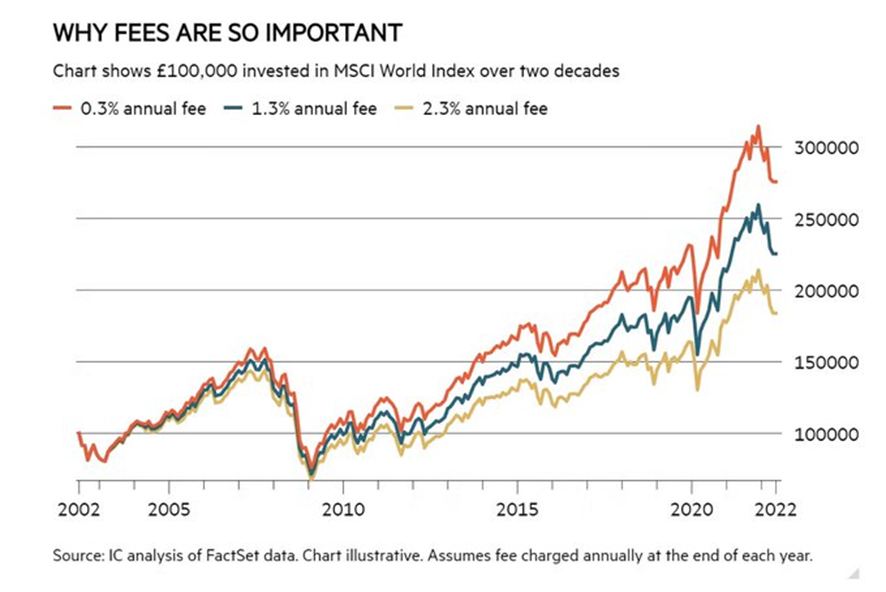
They have two massive advantages: they are extremely transparent, and their fees are ridiculously low (typically between 0.1% and 0.9%, capping out at 1.5% at most). In contrast, traditional active management can bleed you dry with accumulated fees ranging from 3% to 15% if you add up maintenance, subscription, redemption, or performance fees.
To build your portfolio with these assets, you have two paths:
-
Manual Option: You open a broker account, look for the ETFs that interest you, and buy them based on your own strategy.
-
Automated Option (Robo-Advisor): An automated manager gives you a risk-profile test and designs an ETF portfolio for you, rebalancing your money automatically without you having to lift a finger.
4.1 The UCITS Seal: Your European "Safety Net"
If you invest from Spain or another EU country, you’ll notice that most ETFs available on your broker carry the "UCITS" tag at the end of their name. This isn't just for show. It’s the European regulation (Undertakings for Collective Investment in Transferable Securities) that sets the ground rules to protect your money from financial shysters.
To earn the UCITS seal, an ETF must abide by three sacred commandments:
-
Strict Diversification: They are forbidden from betting the whole fund on one horse. There is a 5/10/40 rule (no single company can exceed 10% of the fund, and the sum of companies weighing more than 5% cannot exceed 40% of the total). If one company goes under, you aren't dragged down with it.
-
Total Asset Segregation: If the ETF manager (like Amundi or BlackRock) goes bankrupt, your shares are safe. The money isn't theirs; it’s held by an independent custodian bank.
-
Daily Liquidity: By law, they are required to let you sell your shares on any market day. They cannot freeze your assets.
A word to the wise: Due to this regulation, European residents cannot directly buy U.S.-issued ETFs (like the famous SPY or QQQ) because they don't issue a mandatory document called a KID. If you want to replicate those markets, you must look for their "cloned" UCITS-compliant version.
4.2 Pro Tip: Creating Synthetic Positions by Selling PUT Options 🎯
What if I told you that you could buy these ETFs at a discount or collect income while waiting for them to drop? This is where financial options come in—a brutal strategy for squeezing the most out of ETFs without buying them at market price right out of the gate.
Instead of placing a standard buy order for the ETF you like, you can sell a PUT option (Cash-Secured Put), setting a lower buy price (the strike) that you find attractive. When you do this, the following happens:
-
You get paid an instant premium: Just for committing to buy the ETF if it drops to that price, the market deposits cash into your account. That money is yours, no matter what happens.
-
Scenario A (The ETF doesn't drop): If the ETF price stays flat or rises, the option expires worthless. You don't buy the shares, but you keep the premium as net profit. You've created yield out of thin air.
-
Scenario B (The ETF falls to your price): If the market tanks and hits your set price, your purchase obligation is triggered. You end up with the ETF shares, but you've bought them at the discount you chose. Plus, your actual cost basis is even lower because you already pocketed that initial premium.
It’s an intelligent way to "synthetically" enter your favorite ETFs, forcing the market to pay you to wait for your ideal buying moment.
Note: Through this operation, you can technically trade non-UCITS ETFs as a European resident. This is because you are buying/selling options, not the underlying asset itself. Since the counterparty to a PUT sale is a forced buy, even if the law says "no," it effectively ends up saying "yes"... the wonders of bureaucracy. 🙄
5. Tracking Error 🎯
In the world of ETFs, "Tracking Error" is a bit more complex than in traditional index funds. Since they trade on the stock exchange like a stock, technical factors come into play that can distort how well they replicate the index:
-
Physical vs. Synthetic Replication: A physical ETF buys the actual shares of the index. If the index changes, the ETF has to buy and sell, which creates transaction costs and increases the Tracking Error. A synthetic ETF uses derivatives (swaps) with a bank. It’s essentially a "digital contract": the bank guarantees you the exact return of the index. Interestingly, synthetic ETFs often have a Tracking Error close to zero, but the trade-off is that you take on the risk that the bank goes bust.
-
Market Price vs. Net Asset Value (NAV): The ETF trades in the market, and its price is driven by supply and demand. Sometimes, the ETF price deviates slightly from the actual value of the shares it holds (creating premiums or discounts). If you buy at a premium, you’re overpaying, which ruins your index fidelity.
⚠️ The common mistake: Confusing "Error" with "Difference"
People often lump Tracking Difference and Tracking Error into the same bucket. They’re cousins, but definitely not the same thing:
-
Tracking Difference: This is the net gap in profitability. If the S&P 500 goes up 10% for the year and your ETF goes up 9.8%, the difference is -0.2%. It’s what you lost along the way (usually due to fees).
-
Tracking Error: This is the volatility of that daily difference. It measures consistency. You could end up with a very small final difference at the end of the year, but if the ETF has been swinging wildly above and below the index every single day, the Tracking Error will be high. 🎢
6. Advanced Trading and Hidden Dangers: Leverage, CFDs, and Contango ⚠️
So far, everything sounds great: low costs, diversification, and long-term growth. But the financial market is always designing dangerous toys for those looking for a thrill or a quick buck. This is where complex products come into play.
6.1 Leveraged ETFs 💥
Multiply your gains... and your losses. Leverage is, basically, trading with borrowed money. Leveraged ETFs (2x or 3x) promise to multiply an index's performance. If the Nasdaq goes up 1%, a 3x leveraged ETF will go up 3%. It sounds fantastic, but it hides a lethal mathematical trap: daily rebalancing. These funds calculate leverage for a single trading day only. Due to the effect of inverse compound interest (or volatility decay), if the market moves sideways for several days with high volatility, the leveraged ETF will consistently lose money, even if the original index ends up being worth exactly the same. These are trading tools to be used for a few hours, never to be held in a long-term portfolio.
6.2 CFDs 💥
CFDs (Contracts for Difference) have a worse reputation than a politician in the middle of a campaign. If you log into any broker, you’ll see the mandatory warning: "75-80% of retail investors lose money trading this product."
With that opening, it’s normal to think of them as weapons of financial mass destruction. But the reality is more nuanced. A CFD is neither good nor bad: it’s just a tool. A CFD is a derivative product. This means that when you buy a CFD on Apple or Bitcoin, you don't actually own anything. You have no Apple shares or Bitcoin tokens in your wallet.
You are simply signing a digital contract with your broker agreeing that when you close the position, you will settle the price difference the asset has undergone between the time you "bought" and "sold."
-
If the price rises and you go "long" (buying), the broker pays you the difference. 💰
-
If the price falls, you pay the broker the difference. 💸
🛑 When are CFDs BAD?
CFDs become a death trap mainly due to three factors that lure in the most inexperienced investors:
-
Uncontrolled Leverage: The ability to trade with more money than you actually have. If you use 10x leverage, you put €100 on the table but trade as if you had €1,000. If the asset goes up 1%, you gain 10%. Wonderful, right? The problem is that if the asset drops 1%, you lose 10%. If it drops 10%, your account hits zero and the broker forcibly closes your position (margin call). You’re playing with fire. 🔥
-
Holding them long-term (The "Swap" curse): Trading a leveraged CFD means the broker is lending you the money to cover the rest of the position. And loans aren't free. Every night you leave the trade open, you'll be charged an interest commission called an "overnight fee" or swap. If you hold a CFD for months, these fees will eat your potential profits alive. 💸
🟢 When are they NOT bad?
An experienced investor knows that CFDs offer tactical advantages impossible to achieve with standard spot stocks:
-
Profit when the market falls (Going Short): If you think a company is overvalued or the market is about to correct, with normal stocks you can only sit and watch. With a CFD, you can "sell" something you don't have first, and "buy" it back cheaper later, making money on the way down. 📉
-
Hedging: Imagine you have a long-term stock portfolio you don't want to sell for tax reasons, but a crisis is coming and you know the market is going to bleed for a month. You can open a short CFD on an index (like the S&P 500). Whatever your real stocks lose due to the drop, you'll offset with the gains from your short CFD. You've temporarily protected your wealth. 🛡️
-
Flexibility with complex assets: They allow you to trade commodities (gold, oil, wheat) or entire indices with small amounts, something that would otherwise require very expensive and complex financial futures contracts.
6.3 Contango 🔄
If you decide to invest in commodities (like oil, natural gas, or gold) through ETCs or ETFs, you’re going to run into the Contango effect. These products don't buy physical barrels of oil (they have nowhere to store them), but rather futures contracts that expire every month. When the current contract expires, the fund manager is forced to sell it and buy the next month's contract. If the market is in "Contango," it means the future contracts are more expensive than the current ones. By doing this mandatory "rollover," the manager systematically loses money because they are selling cheap and buying expensive. You might find yourself in the paradox where the price of oil rises 15% in a year, but your commodity ETF is in the red due to this constant drip of money lost on every renewal. A real bloodletting for the investor who doesn't read the fine print.
7. Great Debate: Active vs. Passive Management 🥊
To decide where to put your savings, you have to understand the ground rules for each side:
🧠 Active Management (Traditional Funds)
-
The promise: A star manager will study the market to dodge the hits and find the best opportunities to beat the benchmark index.
-
The harsh reality: Very few manage to do it in the long run. Plus, the burden of high fees makes it very difficult to come out ahead. Their big advantage is the flexibility to shift to liquidity (cash) if they see a market catastrophe coming.
🤖 Passive Management (ETFs and Index Funds)
-
The promise: We aren't trying to be smarter than anyone else. If the S&P 500 goes up, your portfolio goes up; if the S&P 500 goes down, your portfolio goes down. You replicate the market exactly.
-
The big advantage: Since they don’t need an army of analysts collecting million-dollar bonuses, costs are minimal. That savings in fees stays in your pocket, and in the long run, it makes a massive difference in the final profitability of your portfolio.
-
The downside: If the market takes a hard hit, you take the full fall without any anesthesia.
At the end of the day, the key for any retail investor boils down to diversifying, keeping costs as low as possible, and letting time work its magic. ⏳
🔍 Below are the links to search, analyze, and compare ETFs, so you know where to find all the information on these financial products.